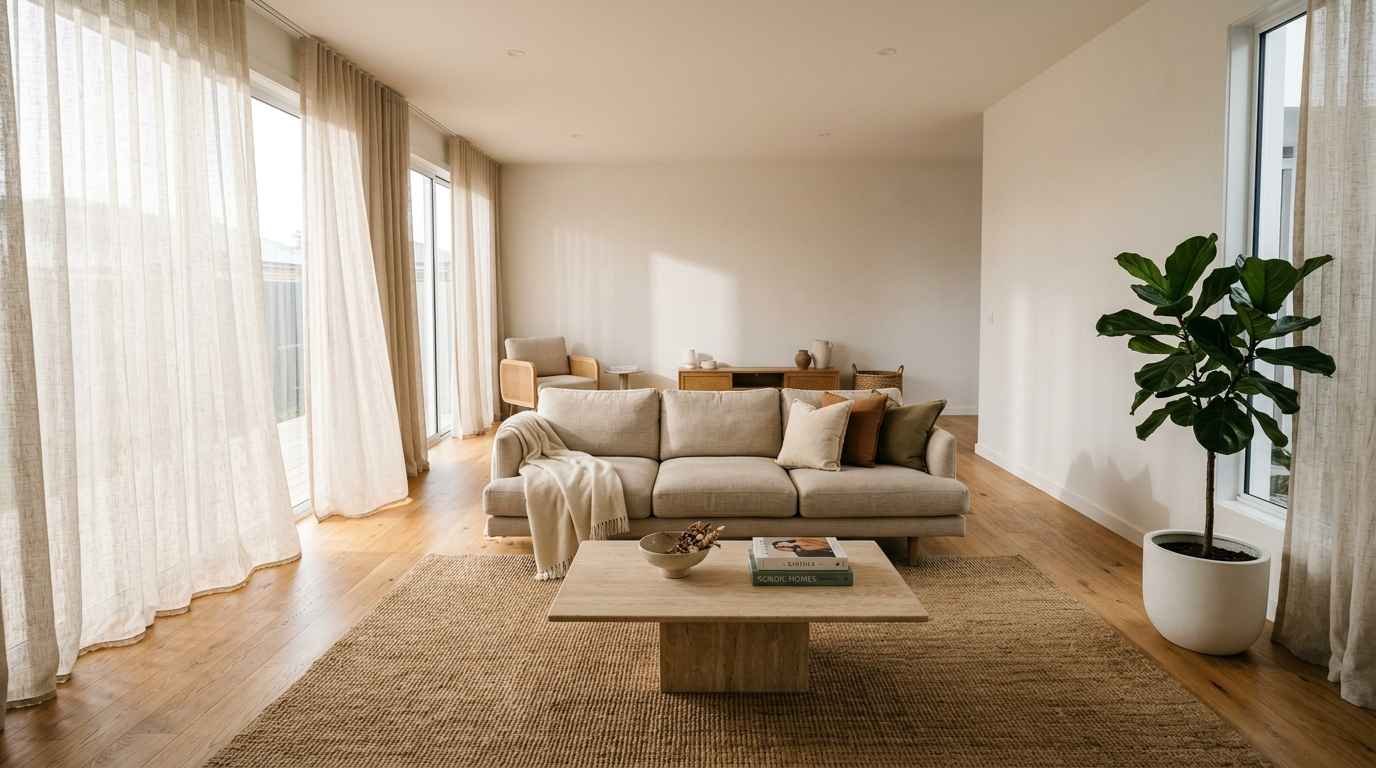
You know that feeling when you walk into a living room and your whole body just… relaxes?
No visual clutter, no pile of throw pillows you couldn’t name the purpose of, no random knick-knacks collecting dust on every shelf.
Just calm. That’s the cozy minimalist sweet spot, and I’ve been borderline obsessed with getting there for the past 3 years.
The thing about cozy minimalism is that it sounds like a contradiction until you actually try it.
Bare walls don’t automatically feel cold. A single sofa doesn’t automatically feel lonely. The warmth comes from texture, light, and materials that actually earn their spot in the room.
So here are 32 ideas I’d genuinely use (and have used, some of them) to get that look in your own space.
Start with a neutral base that breathes
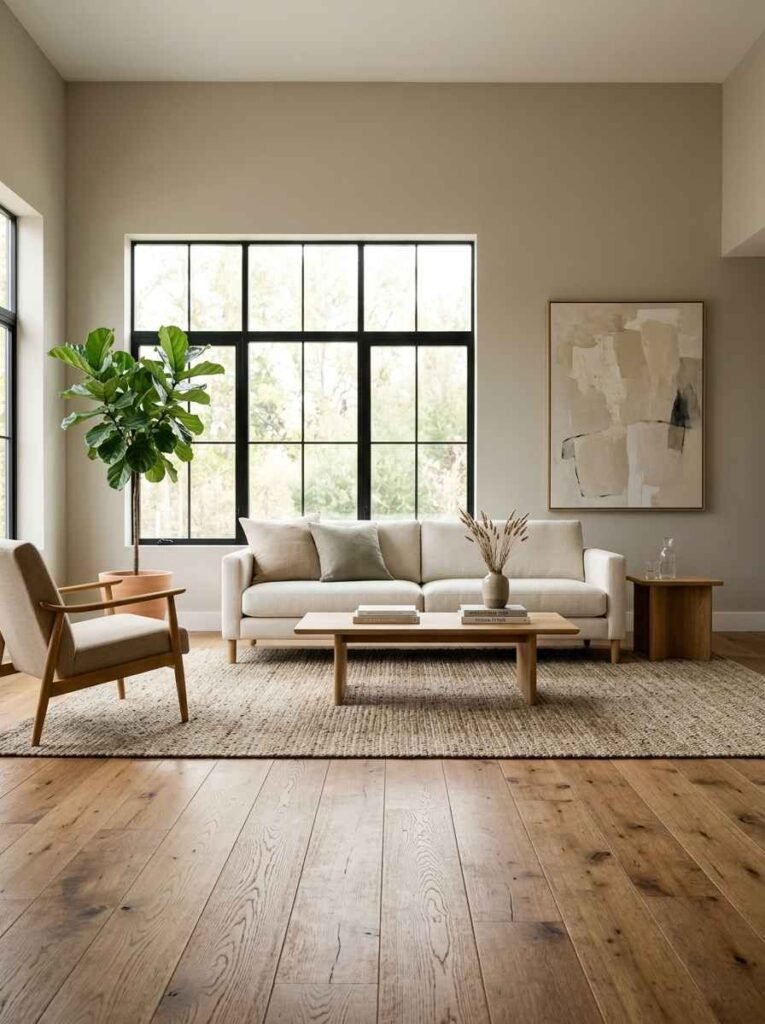
The foundation of any cozy minimalist room is the wall color. I’d go warm white, soft linen, or a muted greige every single time.
These aren’t boring choices; they’re the blank canvas that makes everything else pop without competing.
Farrow & Ball’s “Elephants Breath” and Benjamin Moore’s “White Dove” are genuinely good picks for this, especially in rooms with limited natural light.
They hold warmth without going too yellow.
Pick one wall color and commit to it throughout the main living area. Switching tones between rooms breaks the visual rest you’re building.
Invest in 1 statement sofa, not 4 okay ones
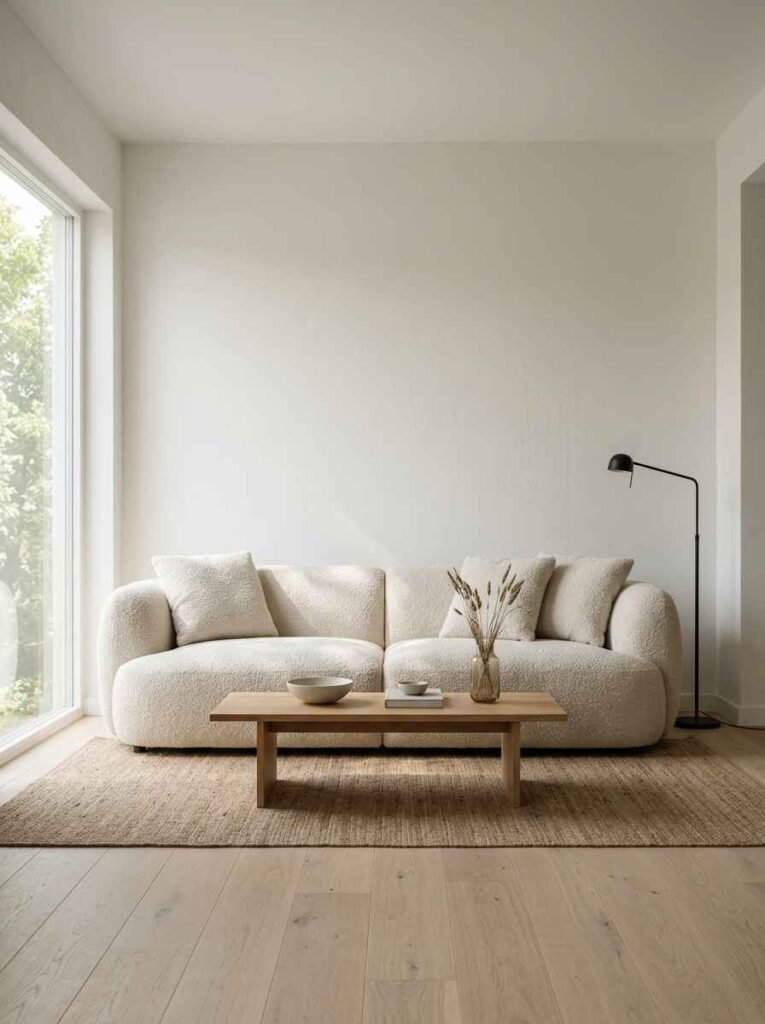
Most living rooms fail because someone bought a matched set and called it done.
A cozy minimalist room usually has 1 really good sofa in a natural material like linen, cotton, or bouclé, and nothing else competing with it.
I personally love a low-profile sofa in oatmeal or warm cream. The lower the profile, the more spacious the room reads, even if the square footage is the same.
Bouclé has had its moment (and hasn’t quite left), but for longevity, linen in a warm neutral is probably the better investment.
It ages well and photographs beautifully for Pinterest, which I know is why half of us are here. FYI, a slipcover sofa is also a clever budget move since you can swap the cover seasonally.
Use wood tones, not wood species
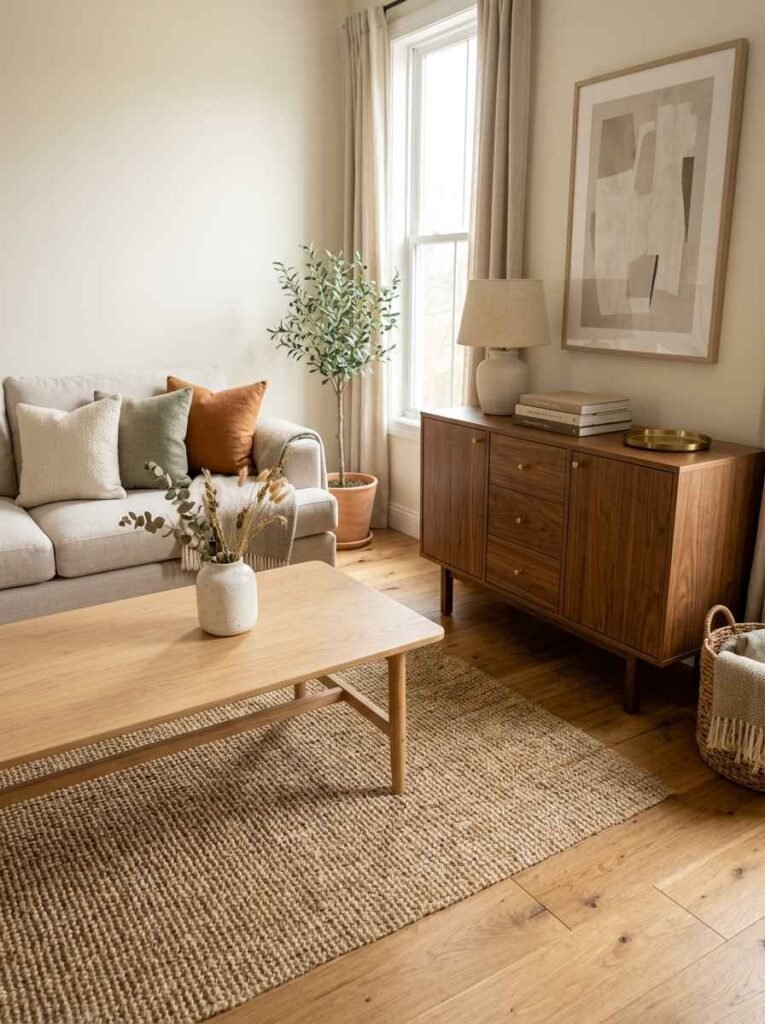
Here’s something that took me a while to figure out: you don’t need to match wood species across your furniture, you just need to match the tone.
A light ash coffee table next to a medium oak console works if both lean warm. It’s the temperature that reads as cohesive.
Go for warm honey, blonde, or medium walnut as your main wood tone. Avoid mixing a very light Scandi wood with a very dark espresso stain; that combination tends to chop the room visually.
Layer textures instead of colors
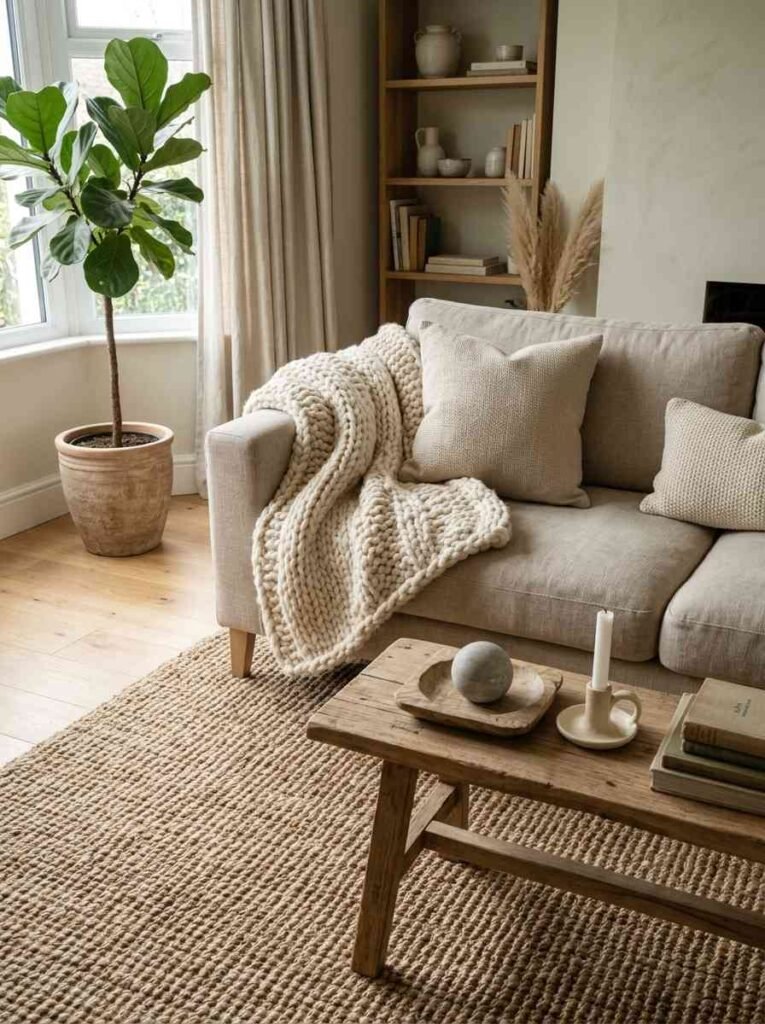
Cozy minimalism gets its warmth almost entirely from texture.
A chunky knit throw on a linen sofa, a jute rug under a glass coffee table, a smooth ceramic vase next to a raw wooden tray. You’re stacking tactile interest without adding color noise.
Specific textures I’d layer in order:
- Linen or cotton for the main upholstery
- A wool or jute rug as the room anchor
- A waffle-weave or chunky knit throw on the sofa arm
- A smooth ceramic or stone object somewhere on the coffee table
4 texture families is plenty. More than that and it starts competing.
The rug rule: bigger than you think
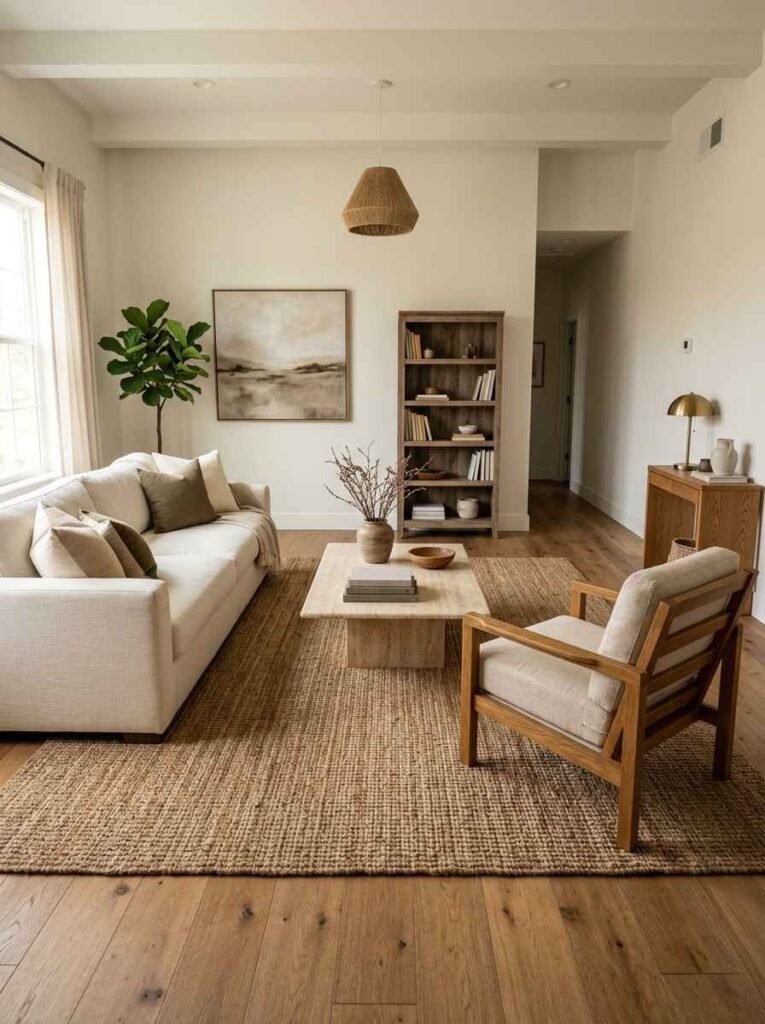
This is the mistake I see most often on Pinterest living room boards. The rug is always too small.
A rug should sit under the front legs of every piece of furniture in the seating area, minimum. Ideally, it goes under all 4 legs.
A 5×7 rug in a standard living room almost always looks like an afterthought. Go 8×10 at minimum, or 9×12 if you have the space.
Natural fiber rugs in jute, seagrass, or wool work especially well for the cozy minimalist look.
Keep the coffee table simple but specific
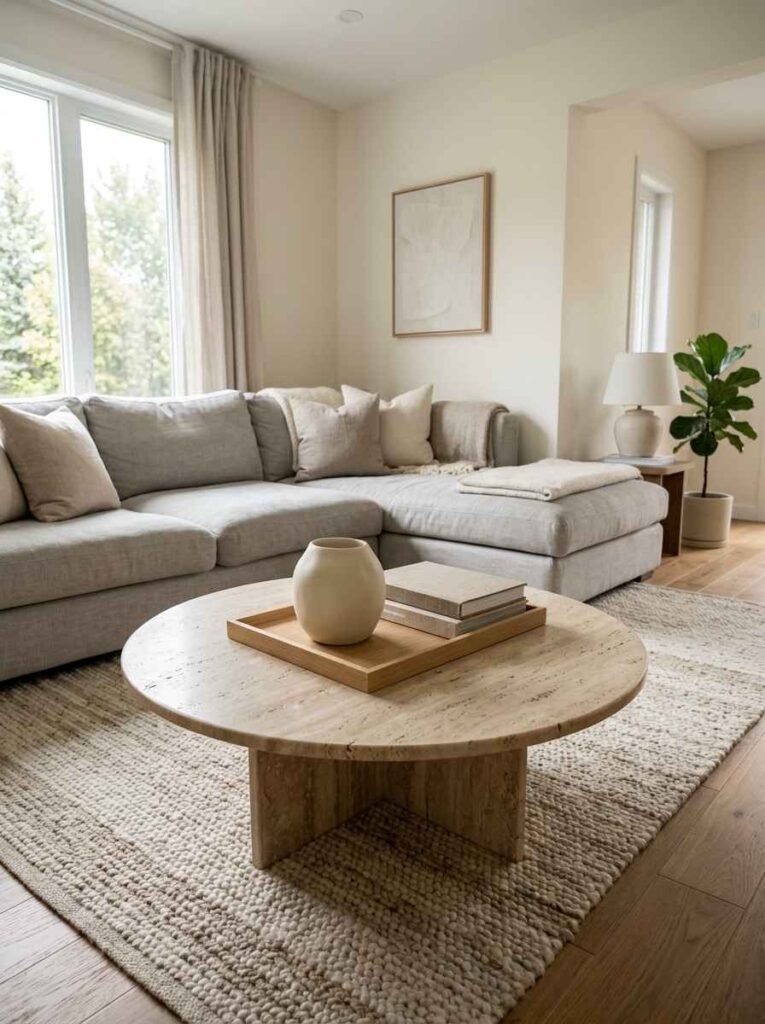
A coffee table in a minimalist room shouldn’t try to do too much. One good material, one clear shape. A round travertine table, a simple wooden slab, a low rattan piece, any of these work.
What I’d skip: glass tops (they show every fingerprint and feel sterile), overly ornate legs, and anything that needs a style explanation.
And then on top of it: 1 tray, 1 object, maybe a small stack of 2 books. That’s it. Coffee table styling gets out of hand fast.
Get serious about your lighting layers
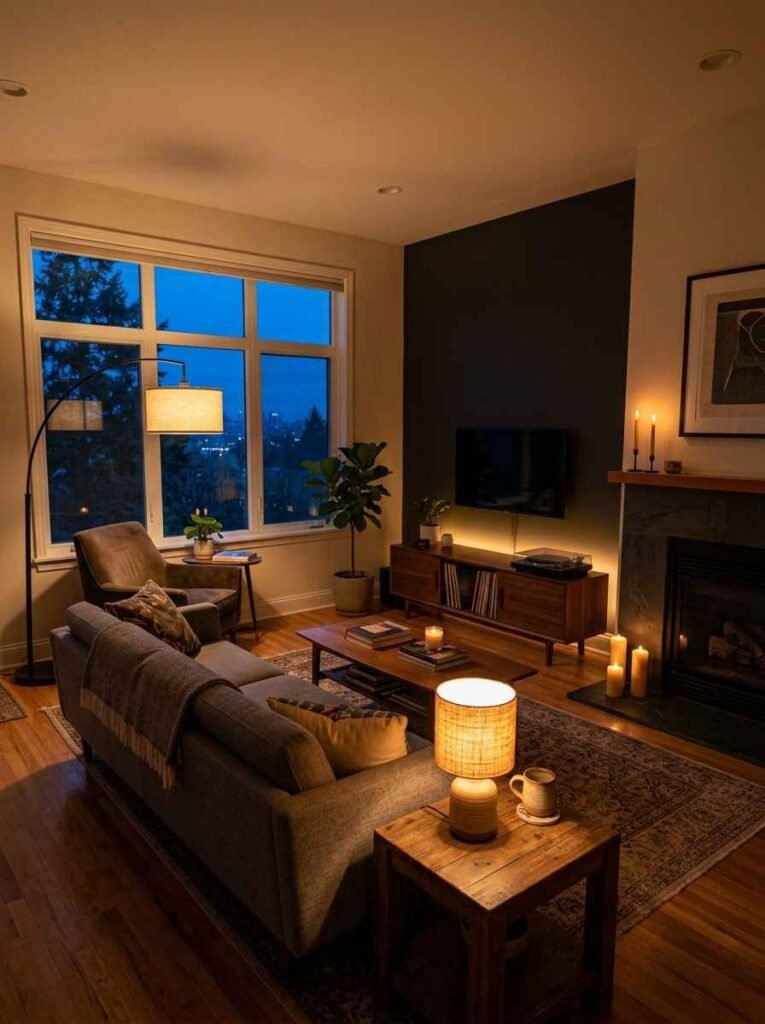
A single overhead light does the room no favors.
Cozy rooms almost always use 3 to 4 light sources at different heights: a floor lamp in a corner, a table lamp on a side table, maybe some candles or a small LED strip behind the TV unit.
Warm bulbs only. 2700K is the sweet spot for a living room. 3000K starts reading as office light and kills the atmosphere immediately.
The Nordlux and Muuto floor lamps are genuinely beautiful options if you want something that doubles as a sculptural object.
A rattan or paper pendant over a reading nook also adds tons of warmth for very little money.
One gallery wall or none
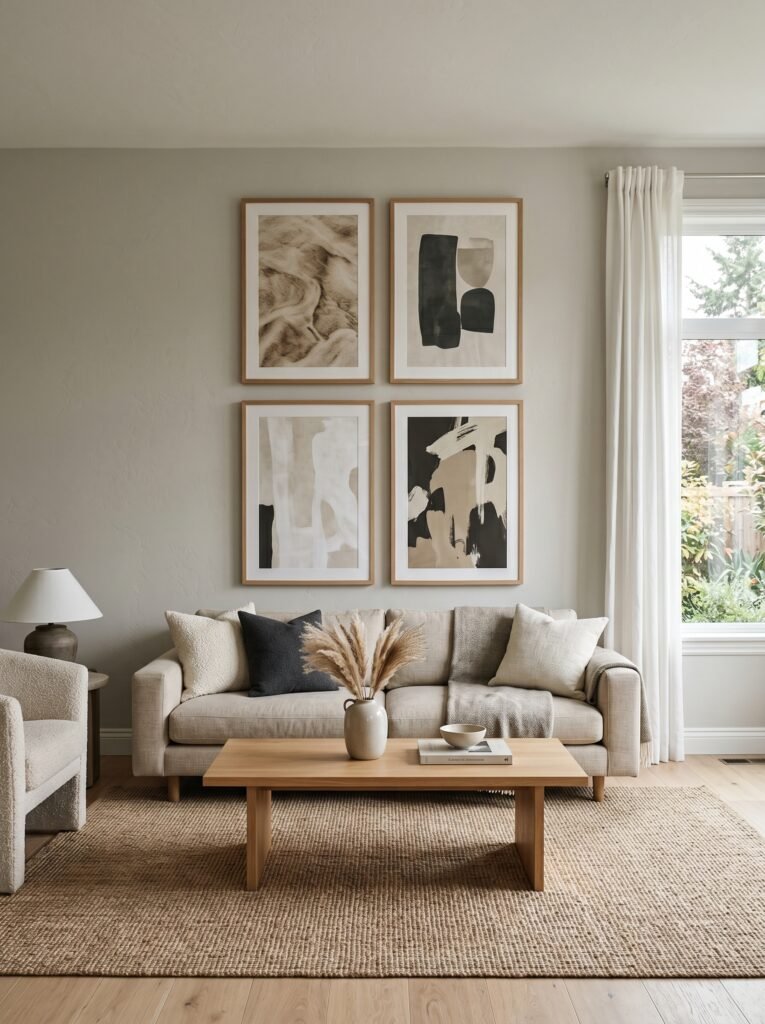
I know gallery walls get a lot of Pinterest love, but in a minimalist room, they can wreck the calm pretty fast. If you’re doing one,
keep it tightly edited: 3 to 5 frames max, consistent frame finish (all black, all natural wood, all white), and frames that are large enough to read clearly rather than a cluster of small prints.
A single oversized art piece at about 80% of the sofa’s width is my personal preference. It anchors the whole seating area and reads more considered than a scattershot collection.
Websites like Desenio and Society6 have affordable large-format prints if you don’t want to commission original art.
Plants: 1 large, 2 small
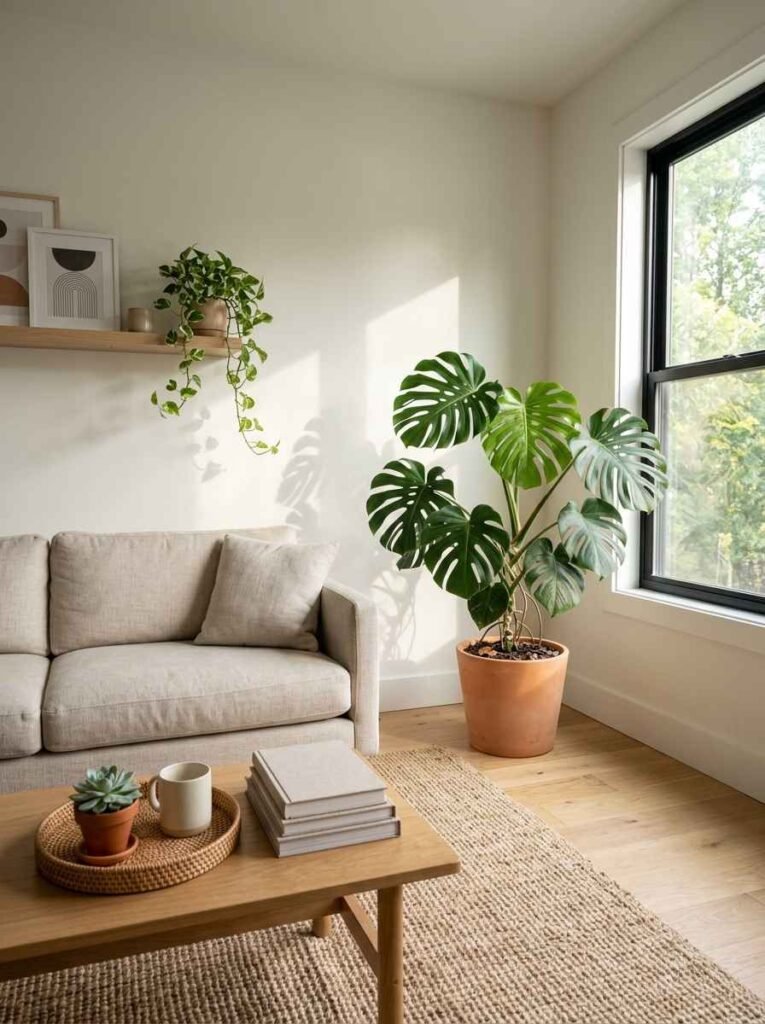
I know people go plant-parent crazy and end up with 23 pots on every surface.
For a cozy minimalist room, I’d suggest 1 large floor plant (a Fiddle Leaf Fig, Monstera, or Olive tree work well), and 2 small plants somewhere on shelving or a side table.
That’s the whole plant situation. More than that starts to feel like a greenhouse, which is a different vibe.
Window treatments that go to the ceiling
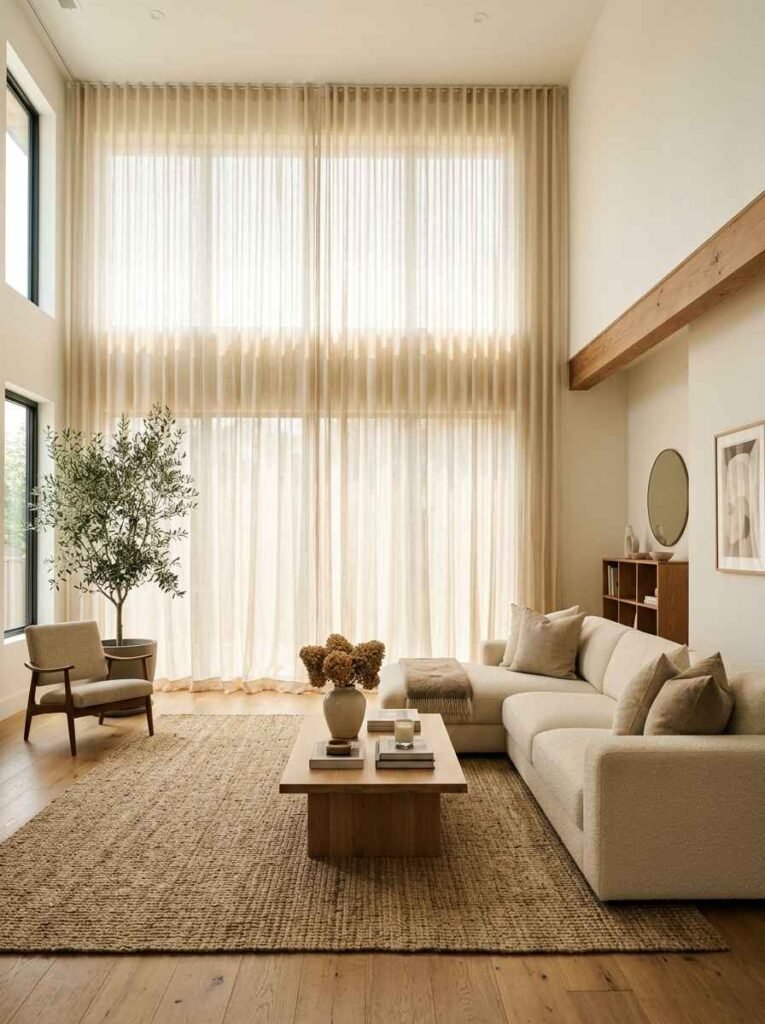
This one change makes every room look taller and more expensive. Hang your curtain rod as close to the ceiling as you can, then use curtains that pool slightly on the floor or just graze it.
Linen curtains in off-white or warm sand are the go-to for cozy minimalism. They filter light beautifully and move in a breeze in a way that feels genuinely alive.
IKEA’s LENDA curtains in white are an honest bargain, and they look much more expensive than they are once they’re hung high.
I’ve used them myself and still haven’t replaced them after 2 years, which is a decent endorsement.
Edit your bookshelf ruthlessly
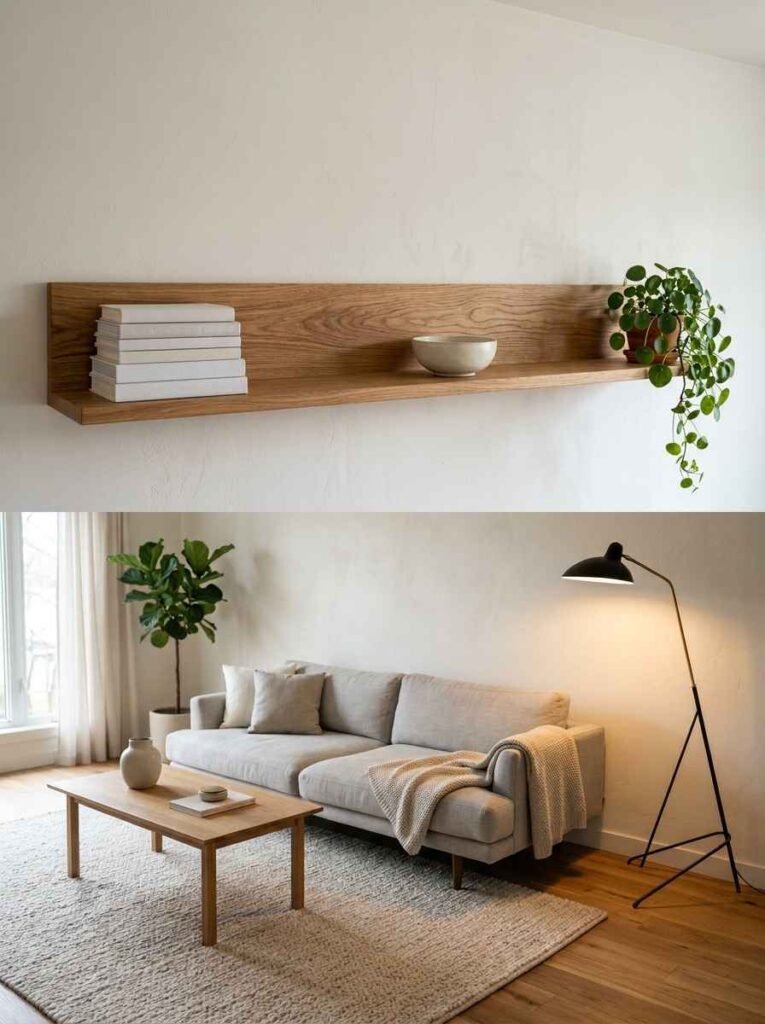
A shelf in a minimalist room shouldn’t look like a storage unit. The styling formula that works: books horizontal (a small stack, 5 to 8 at most), 1 object, some negative space, repeat.
Pull out any books with spines that visually clash, or face them backwards so you see only white pages. Yes, this is a mildly controversial move in bookish circles, but it’s effective.
Low furniture, high ceilings
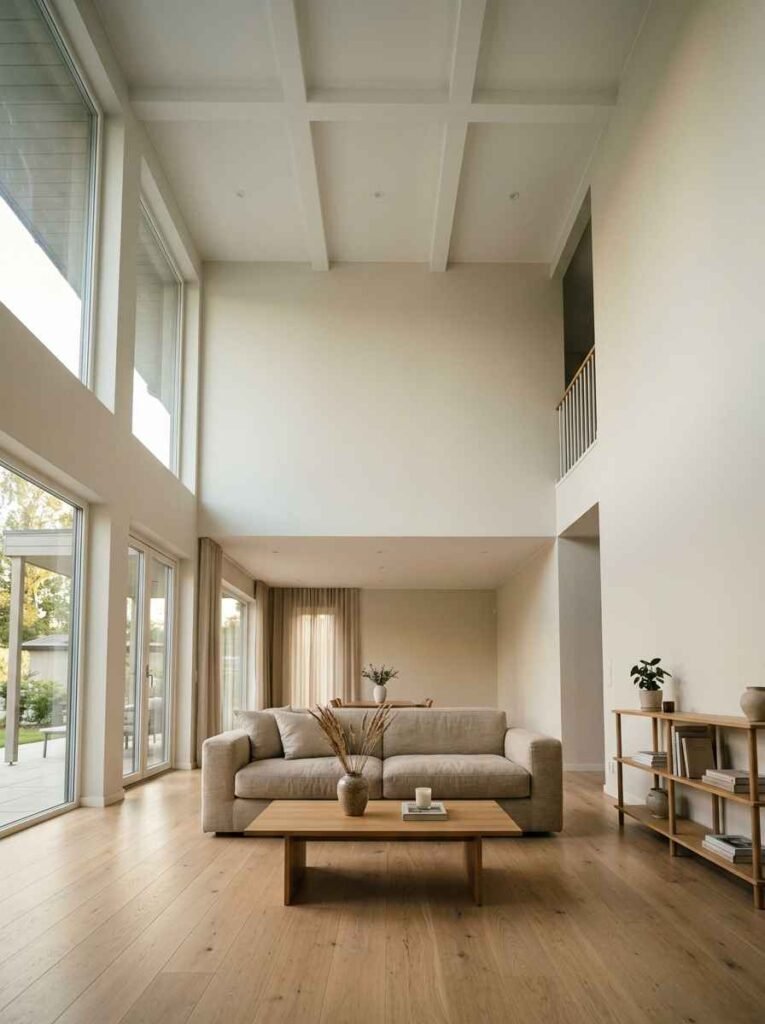
Low-profile furniture (sofas, coffee tables, shelving close to the floor) makes ceilings read higher. This is a simple optical trick that works in any room size.
Japanese and Scandinavian design traditions use this all the time. A sofa seat height of around 16 to 17 inches is on the lower end and reads as grounded rather than hulking.
Pick a single accent color and repeat it exactly 3 times
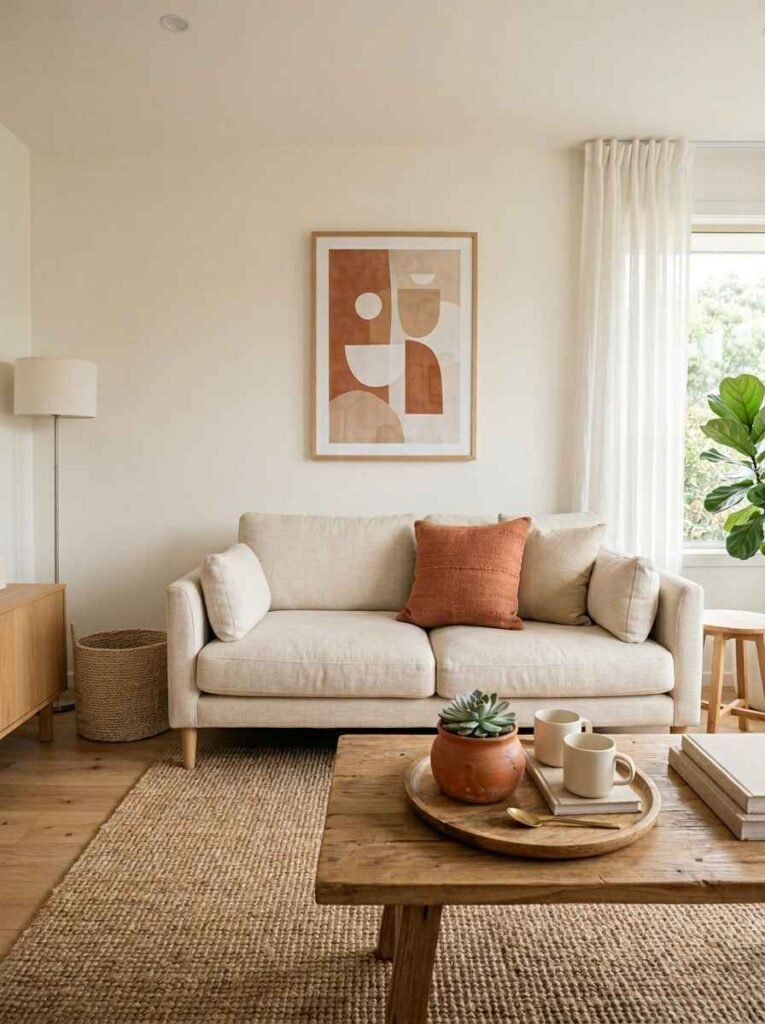
Most minimalist rooms go full neutral, which is fine. But if you want a little life, pick 1 accent color and use it in exactly 3 places. Terracotta: a throw pillow, a ceramic pot, a small art print. Sage green: a cushion, a tray, a candle holder.
The repetition is what makes it look intentional rather than accidental.
Try a stone or concrete object
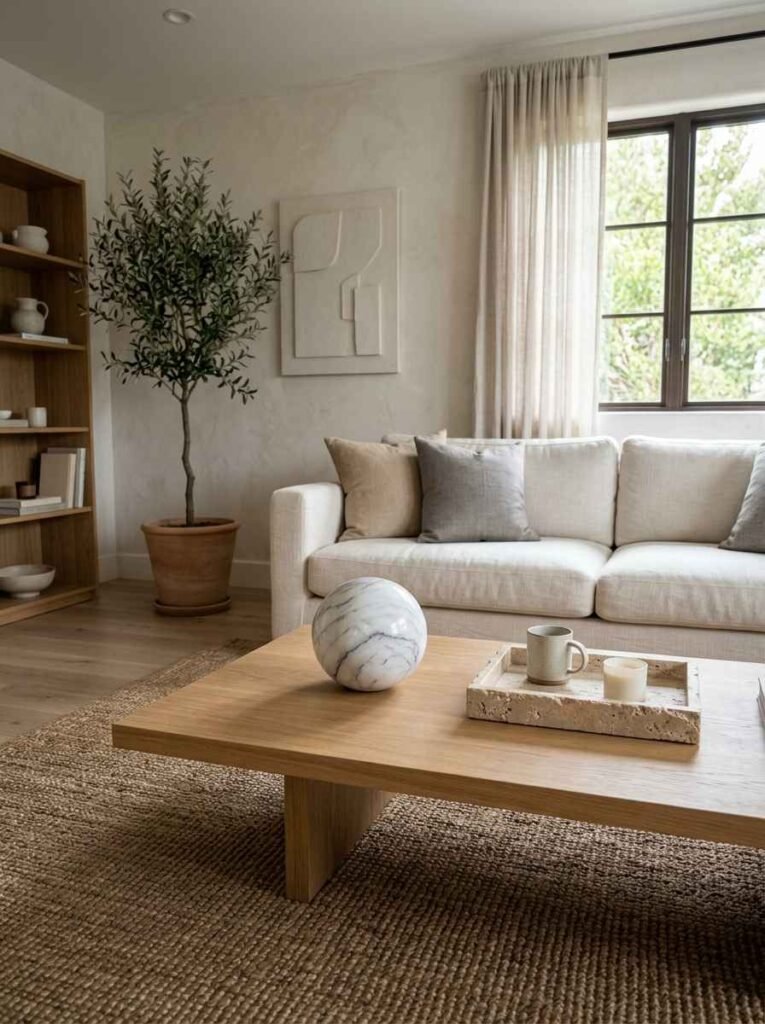
Something about a smooth stone object (a marble sphere, a concrete bookend, a travertine tray) adds an almost instant sense of calm weight to a room. I think it’s the material’s inherent quietness.
These don’t have to be expensive. Thrift stores and HomeGoods regularly have travertine-look pieces for under $20.
Fireplace or the illusion of one
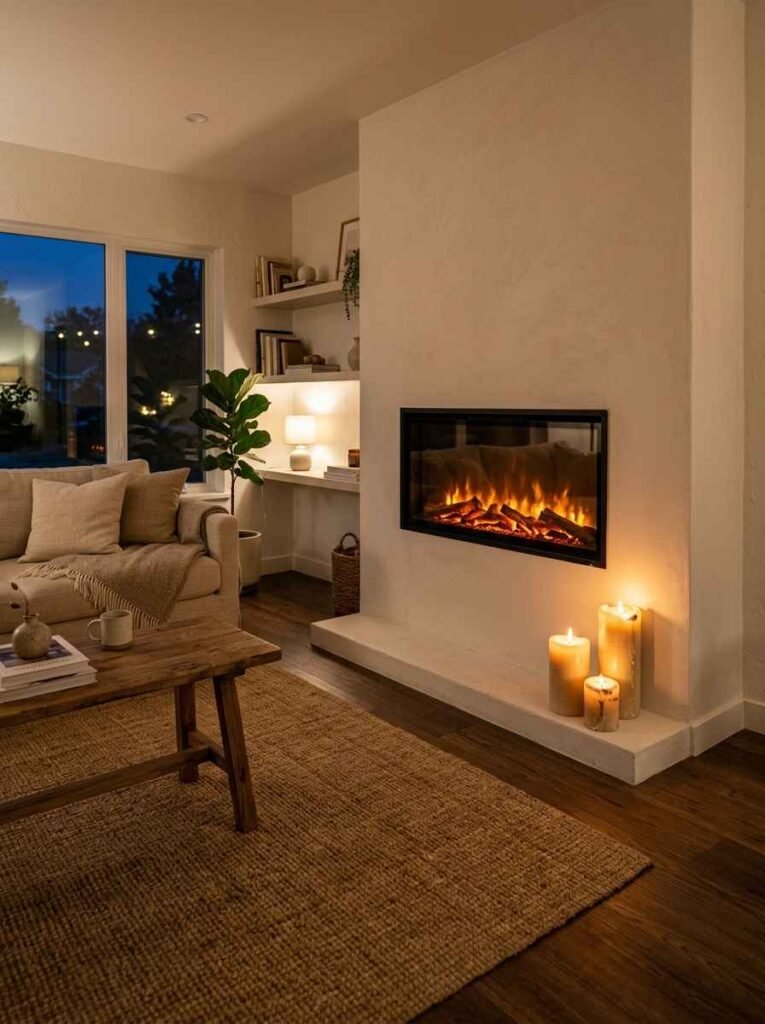
Okay, I realize this sounds wildly out of reach for anyone in a rented apartment. But hear me out.
Electric fireplaces have gotten genuinely good in the last 5 years. A recessed electric fireplace insert (Dimplex makes several), even mounted flush against a wall without a real surround, reads as warm and considered.
If you have a real fireplace and never use it, a large pillar candle arrangement inside the hearth gives the same effect.
Floating shelves: fewer, larger
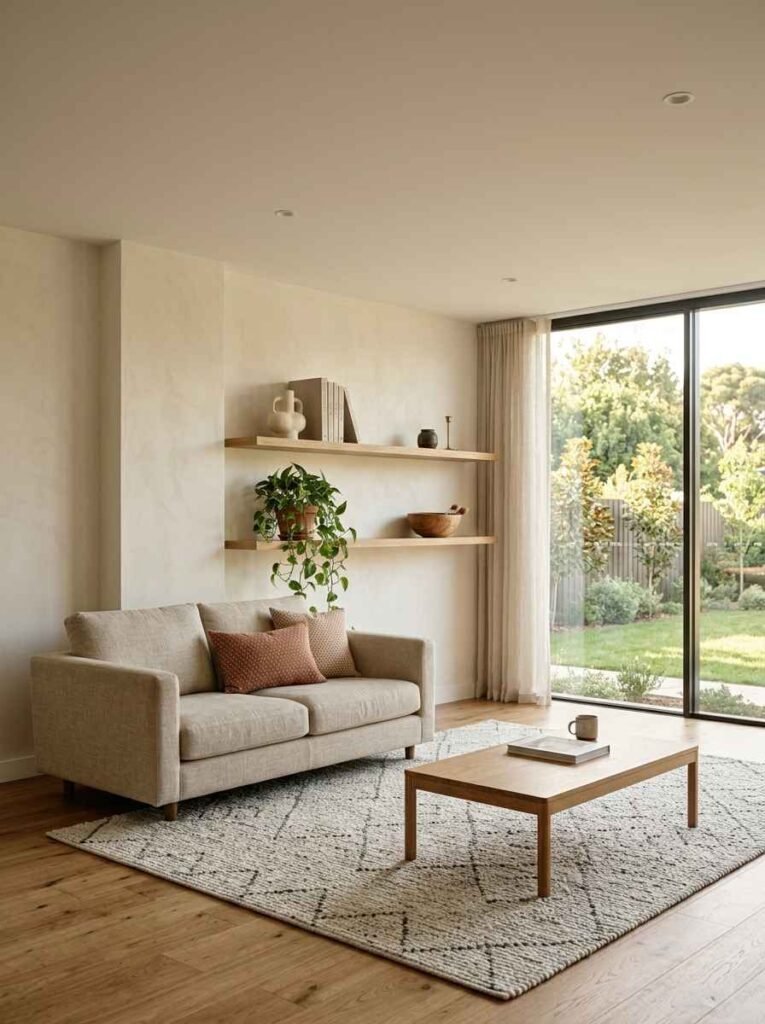
2 long floating shelves beat 5 small scattered ones every time. Longer shelves have room for negative space; small shelves always end up crammed.
Natural oak, walnut stained pine, or powder-coated steel all work. Whatever you pick, keep the bracket hidden if possible, or use a bracket that’s part of the design.
A reading corner with 1 dedicated chair
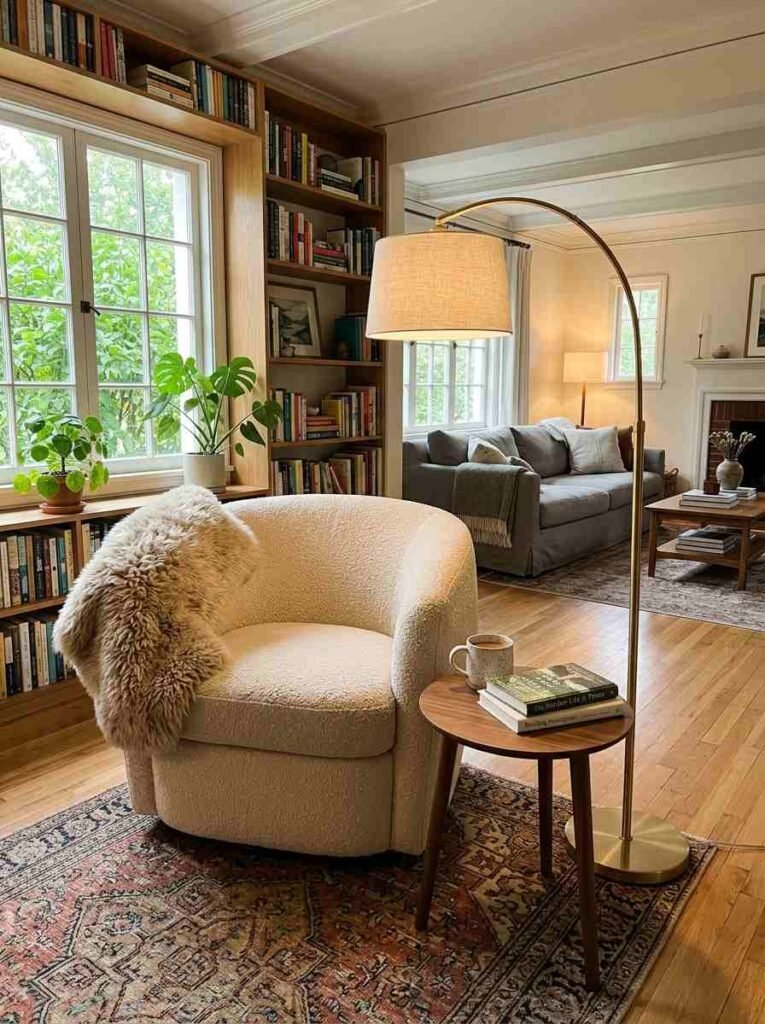
If the room allows it, carve out a reading corner: 1 armchair, 1 small side table at arm height, 1 floor lamp nearby. That’s the whole setup.
This makes a living room feel like it has more than 1 purpose, which somehow makes the whole space feel richer and less sterile, even with minimal furniture elsewhere.
A sheepskin or boucle throw draped over the chair arm does most of the work here.
Scent is part of the room
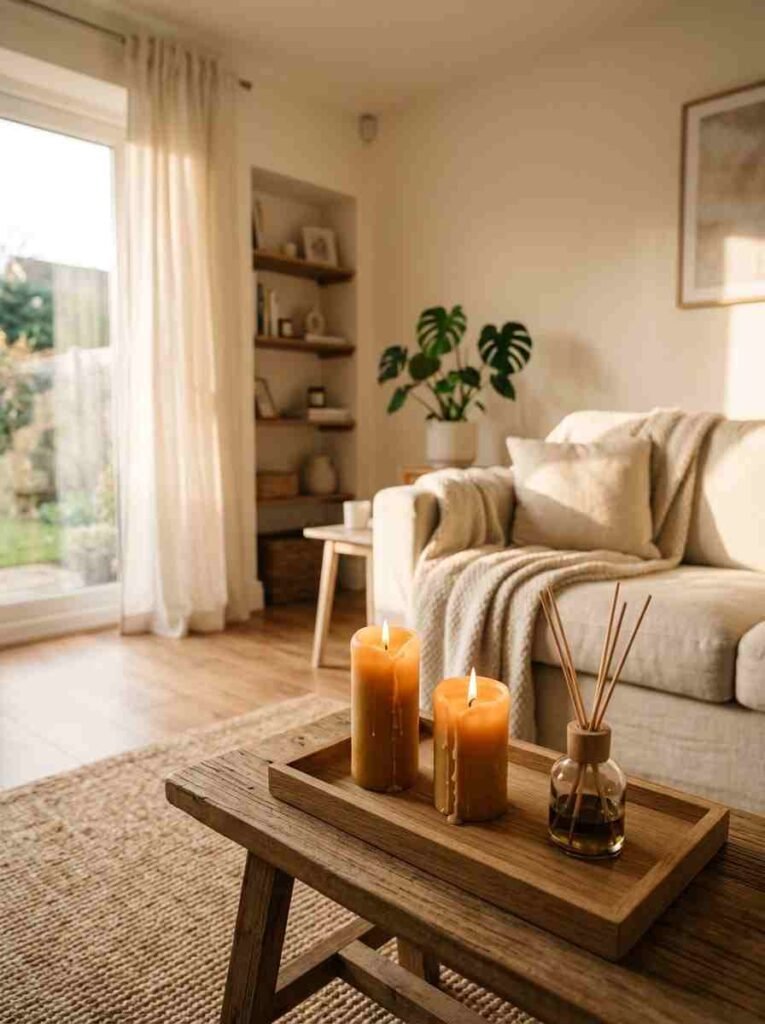
This is a genuinely underrated part of cozy minimalism, and I rarely see it mentioned.
A room that smells good (a single quality candle, a reed diffuser, the faint memory of morning coffee) reads as more considered and personal than a room that only looks good.
Aesop Ptolemy, Skandinavisk Ro, and Maison Louis Marie No. 04 are all worth trying if you want a scent that leans woody and calm rather than floral.
Remove 30% of what’s currently on display
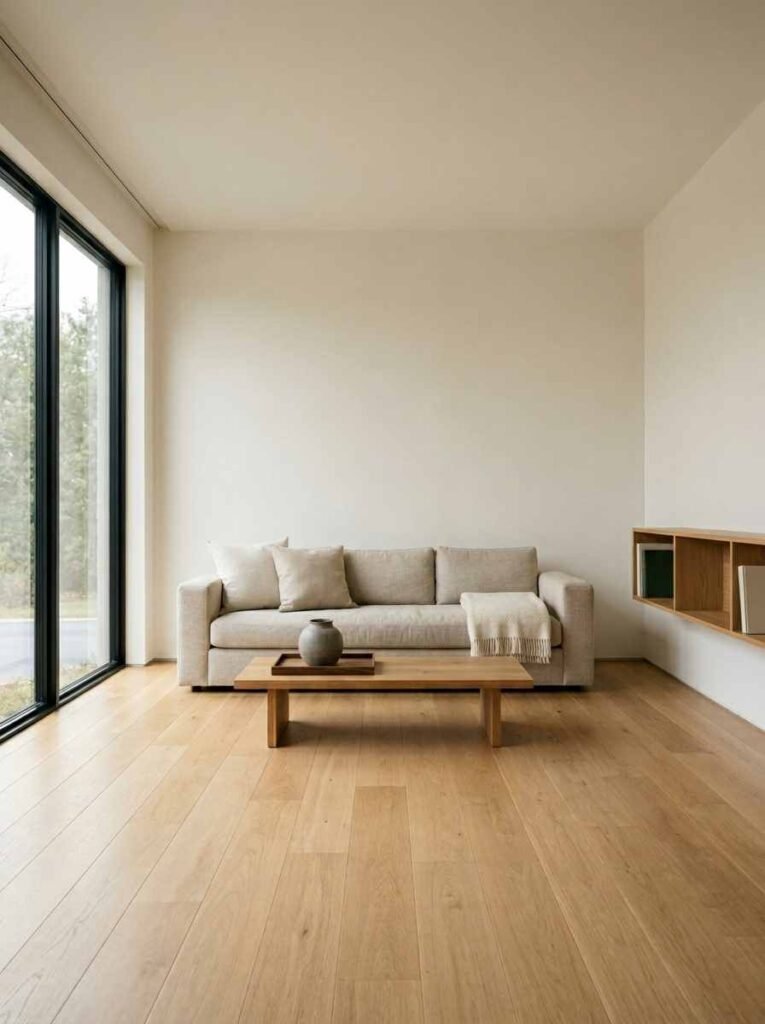
This is the most uncomfortable piece of advice and also probably the most effective one. Walk into your living room, look at every surface, and pull out roughly 1/3 of what’s sitting there.
Live with it for a week. You’ll almost certainly keep it that way.
The TV situation
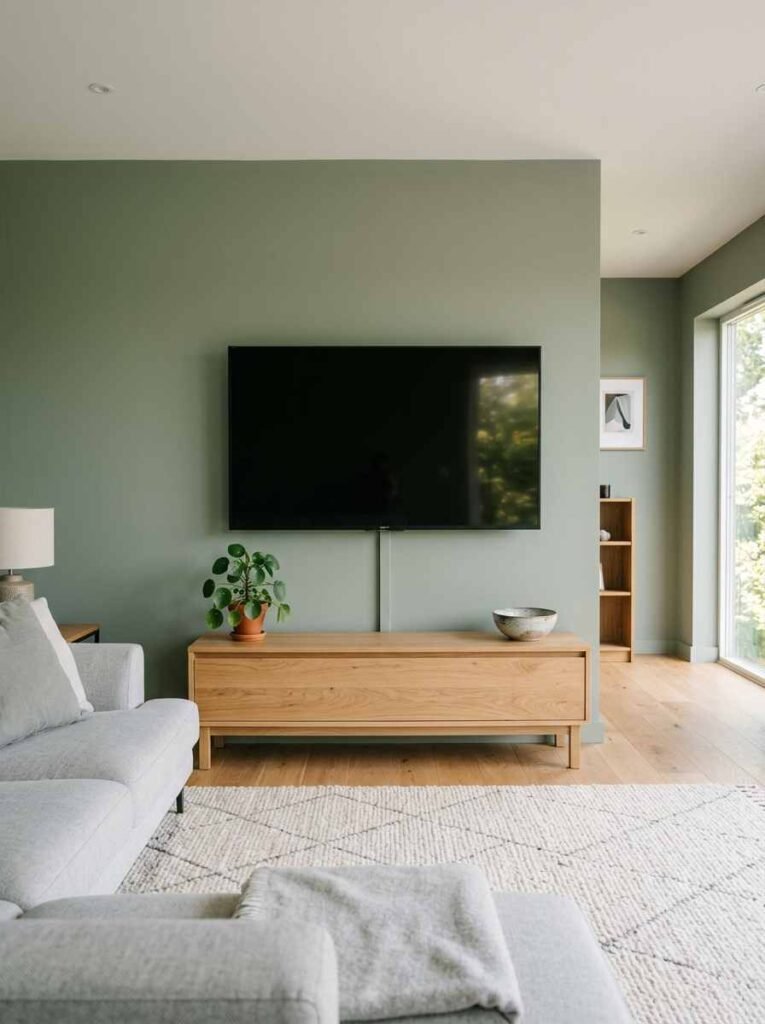
A TV mounted flush on the wall, with cables fully hidden, reads far cleaner than a TV on a stand with a cord rat’s nest behind it.
Cable management channels are about $15 at any hardware store and take 20 minutes to install.
Some people go Samsung Frame TV for the artwork-when-idle feature, which I think is actually a pretty smart move for a minimalist room.
At its price point it’s a real splurge, but it does solve the “black rectangle problem” genuinely well.
Cushion count: 2 to 4, never more
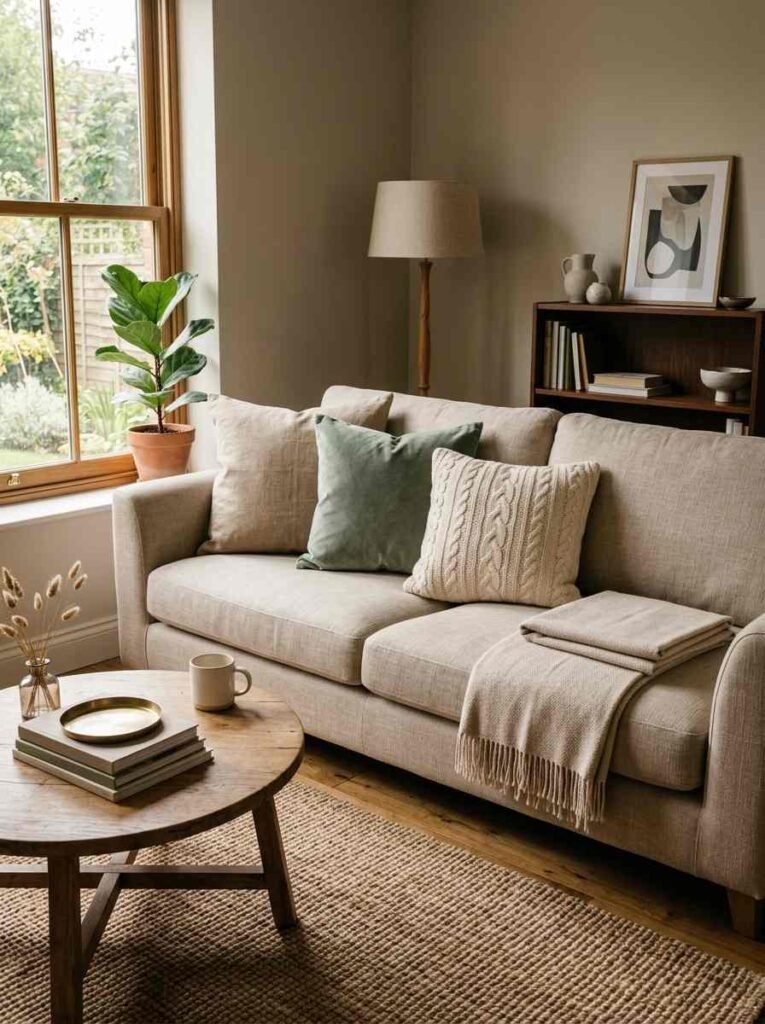
I know. Pinterest boards are full of sofas with 9 cushions artfully stacked. In a real room, 9 cushions means 9 cushions you move before you sit down.
2 to 4 cushions in complementary textures (linen, velvet, knit) is plenty. Keep them all within the same color family as the sofa or slightly warmer.
Use trays everywhere
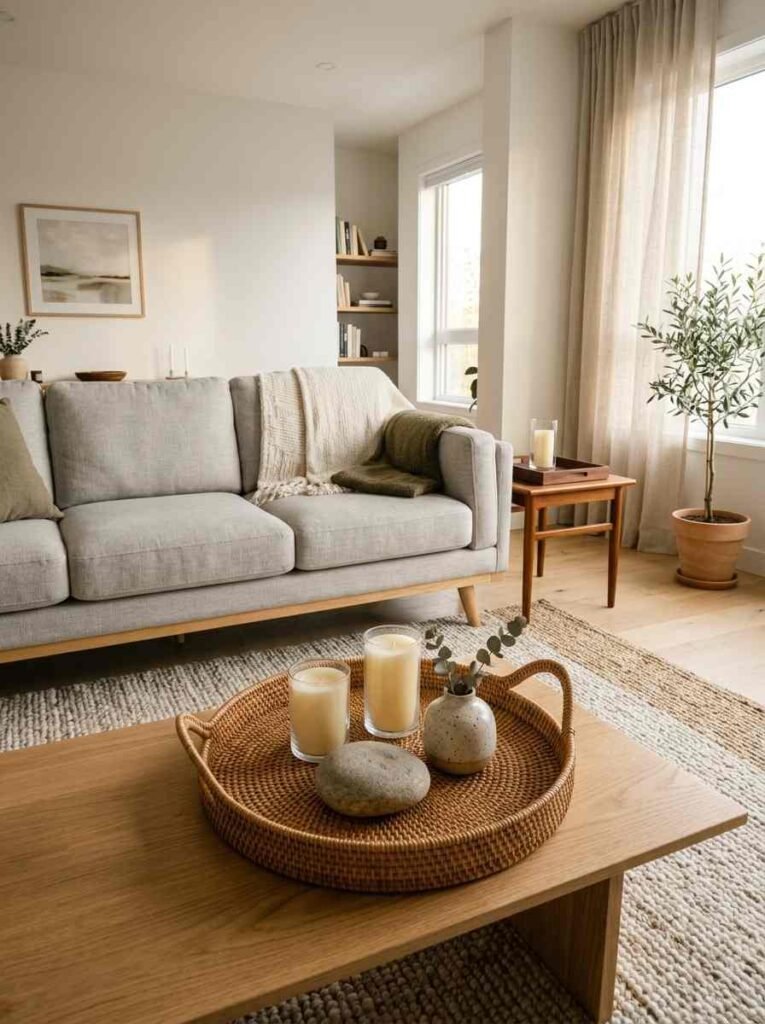
A tray is the quickest way to make a cluster of objects look like a considered display. Candles on a tray look styled. Candles scattered around look forgotten there.
Wooden trays, woven rattan trays, and marble trays all work. Pick the material that matches your room’s main tone.
A simple media console, not an entertainment center
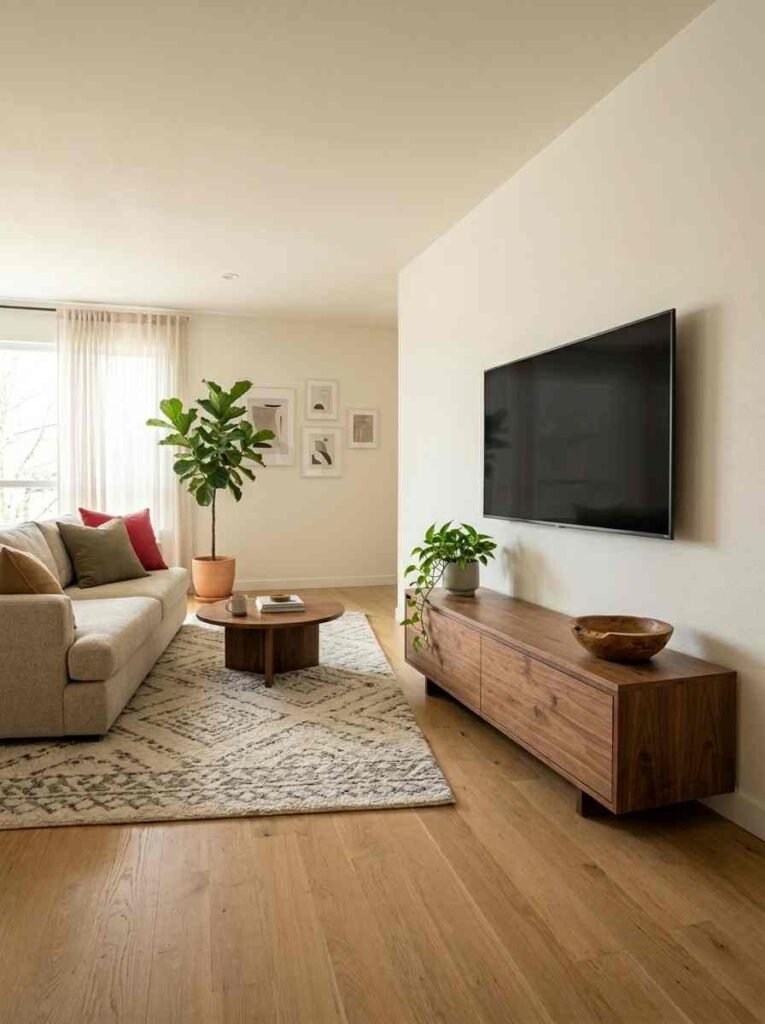
An entertainment center with built-in shelves for DVD collections and gaming equipment is the fastest way to make a living room look dated. A low, simple media console in natural wood or white lacquer keeps the TV area calm.
Something around 60 to 72 inches wide for a standard living room, with 2 drawers for the remotes and cables that inevitably accumulate.
Concrete, rattan, and linen: the holy material trinity
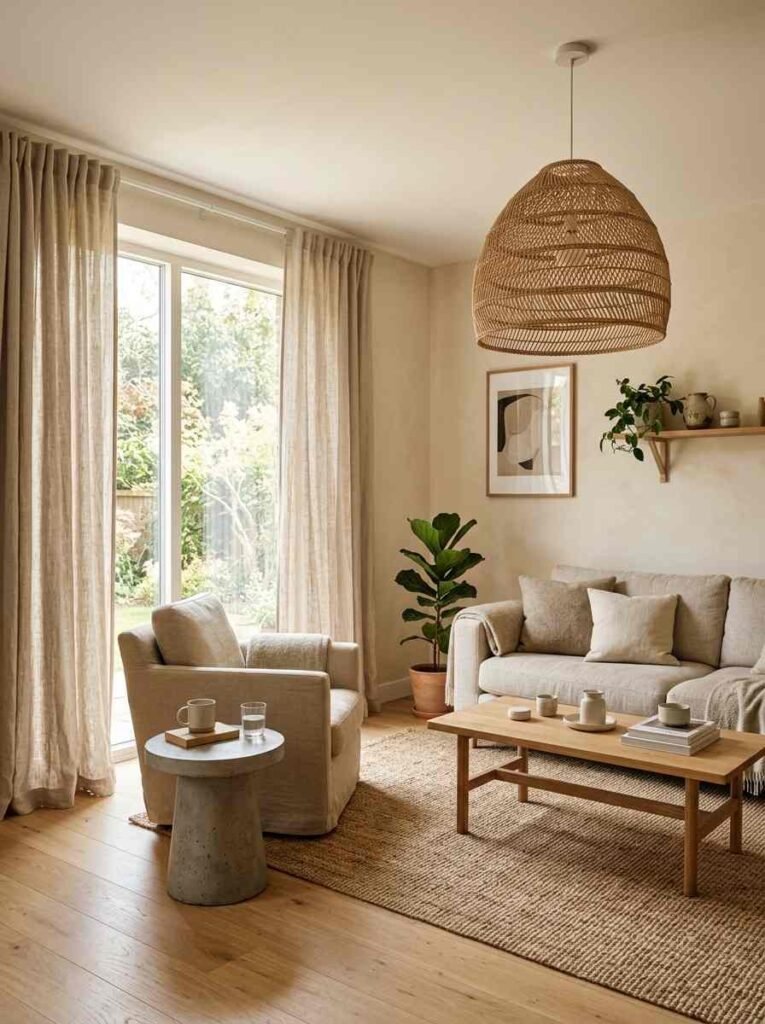
For a cozy minimalist room on a real budget, these 3 materials get you most of the way there without spending much.
Rattan for a floor lamp shade or small basket, linen for curtains or a cushion cover, concrete or cement look for a side table or planter.
These materials are everywhere right now and available at every price point, so there’s genuinely no budget excuse.
Natural light before artificial light
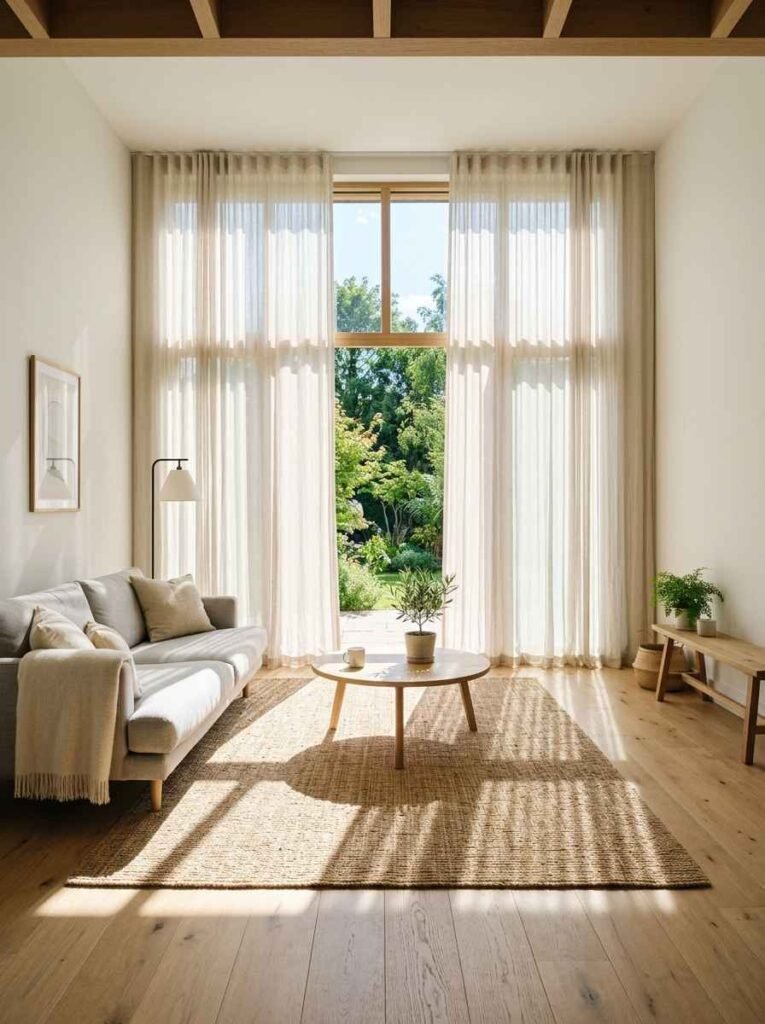
Before you buy any lamps, deal with what’s blocking your natural light. Heavy dark curtains pulled half-shut. A piece of furniture sitting right in front of the window. A frosted window film that made sense in the bathroom but not here.
Clear, open, natural light is the foundation that all the warm artificial light builds on.
A low sideboard instead of a TV unit
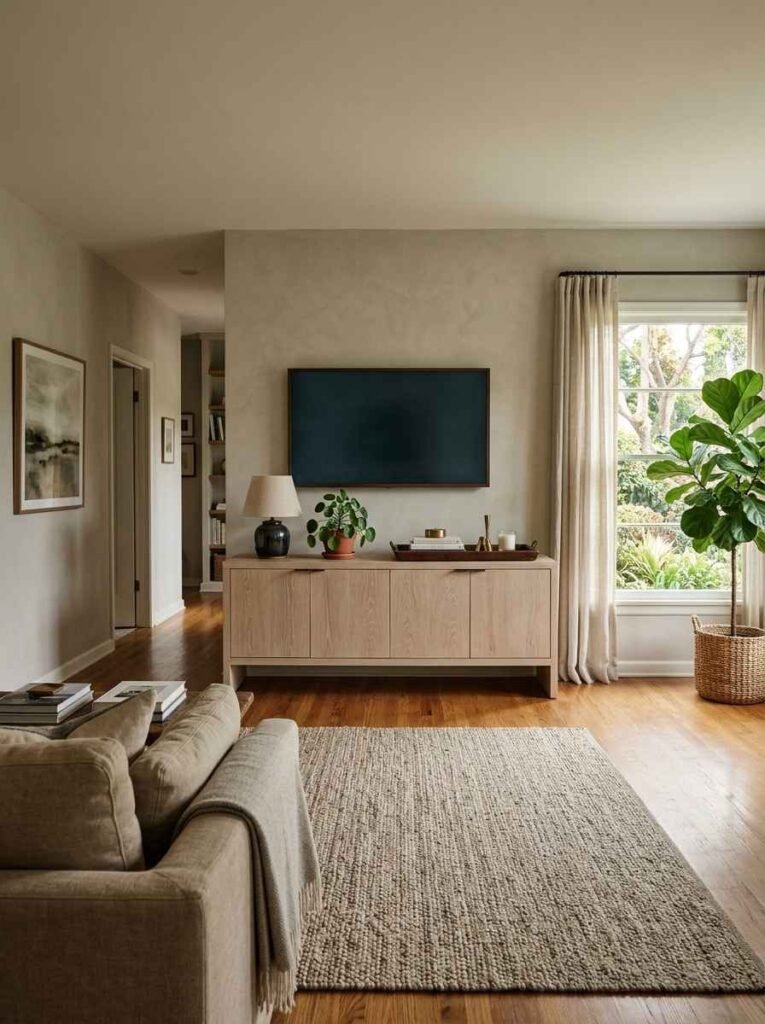
This is a space trick I love: use a low sideboard (the kind originally meant for a dining room) as the base for your TV and AV equipment.
These typically sit about 28 to 32 inches tall, lower than most TV stands, and they look far more considered.
IKEA’s BESTA system and West Elm’s Anton sideboard are both worth a look at opposite ends of the price range.
Imperfection is part of the look
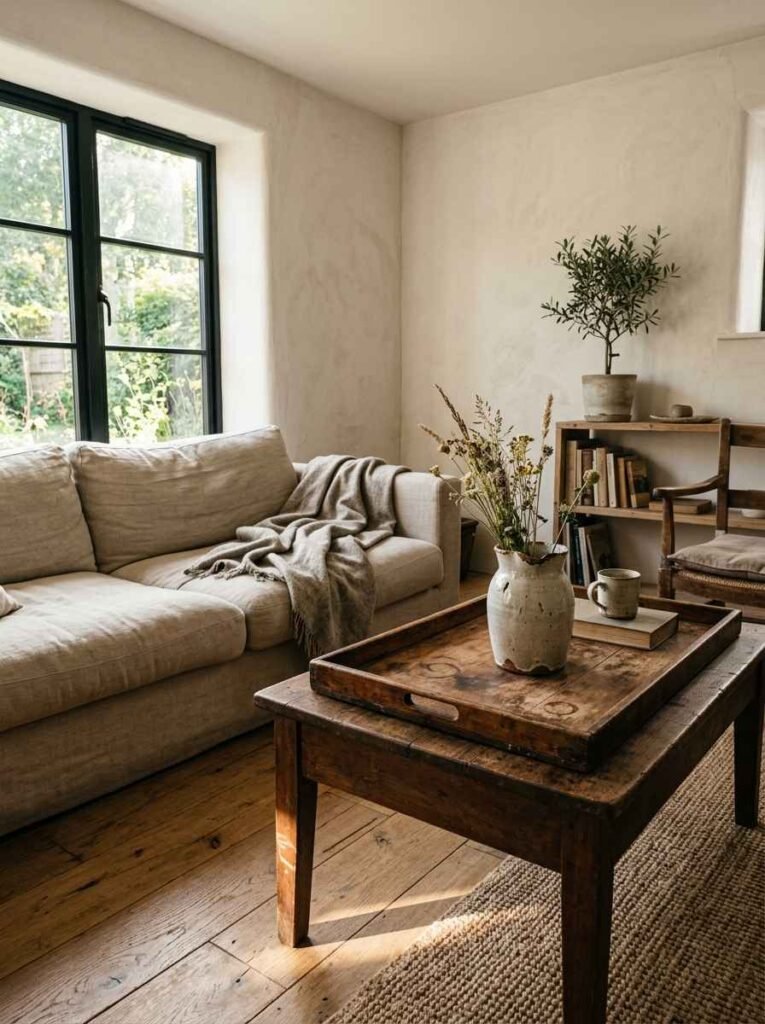
Cozy minimalism isn’t a staged hotel room. A slightly worn wooden tray, a handmade ceramic that’s not perfectly symmetrical, a throw that’s been actually used and shows it. These things are part of the warmth.
Buying everything matching and perfect usually ends up reading as cold. A little wear, a little handmade irregularity, a little “this has a story” goes a long way.
Consider the floor as a surface
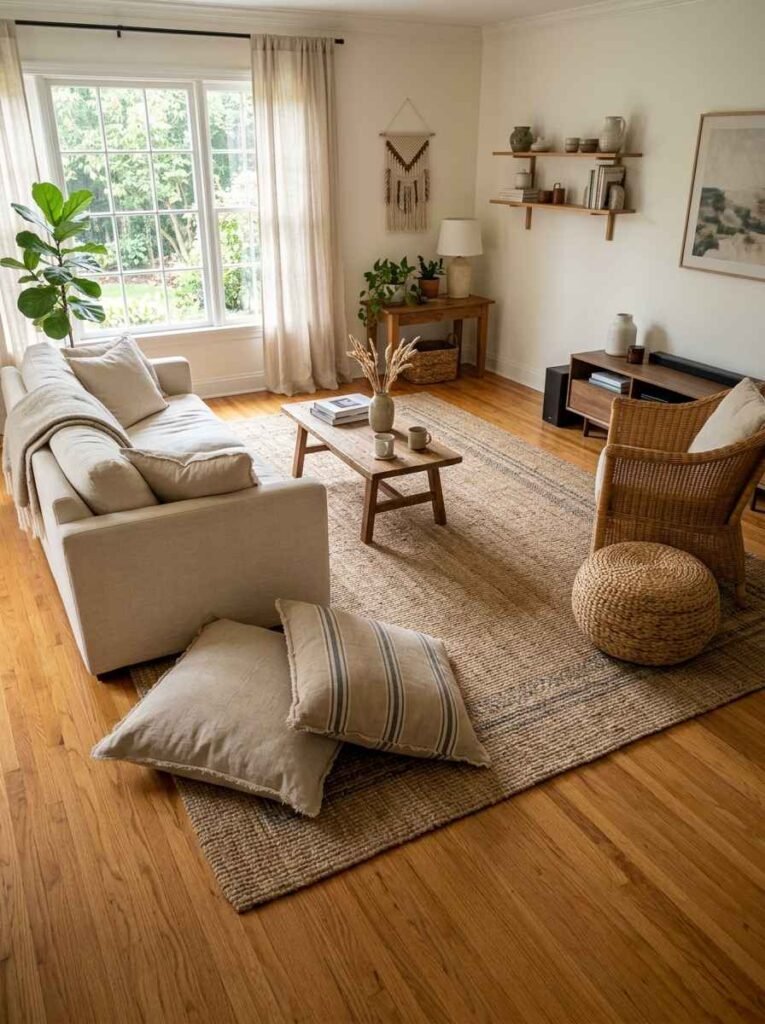
In a room with little furniture, the floor shows. A natural fiber rug is obvious, but floor cushions for a low casual seating area, a simple floor pouf, or even a large linen floor pillow can add a layer of cosiness that no amount of throw pillows on a sofa achieves.
One piece of art that’s too big
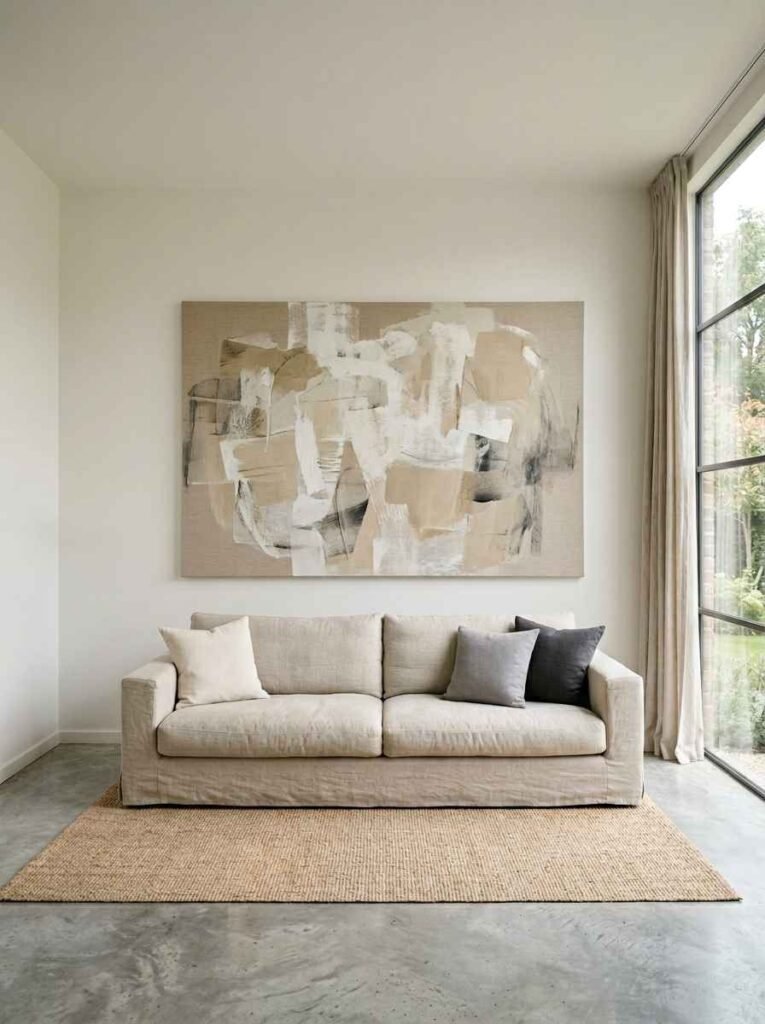
IMO, the most common mistake in living room art is going too small. A piece that’s genuinely too big for the space, that takes up real wall real estate, makes a room feel curated and intentional in a way that a row of small prints never quite manages.
60 to 80% of the width of your sofa is the target. Bigger if you’re brave.
Wabi-sabi objects, not perfect objects
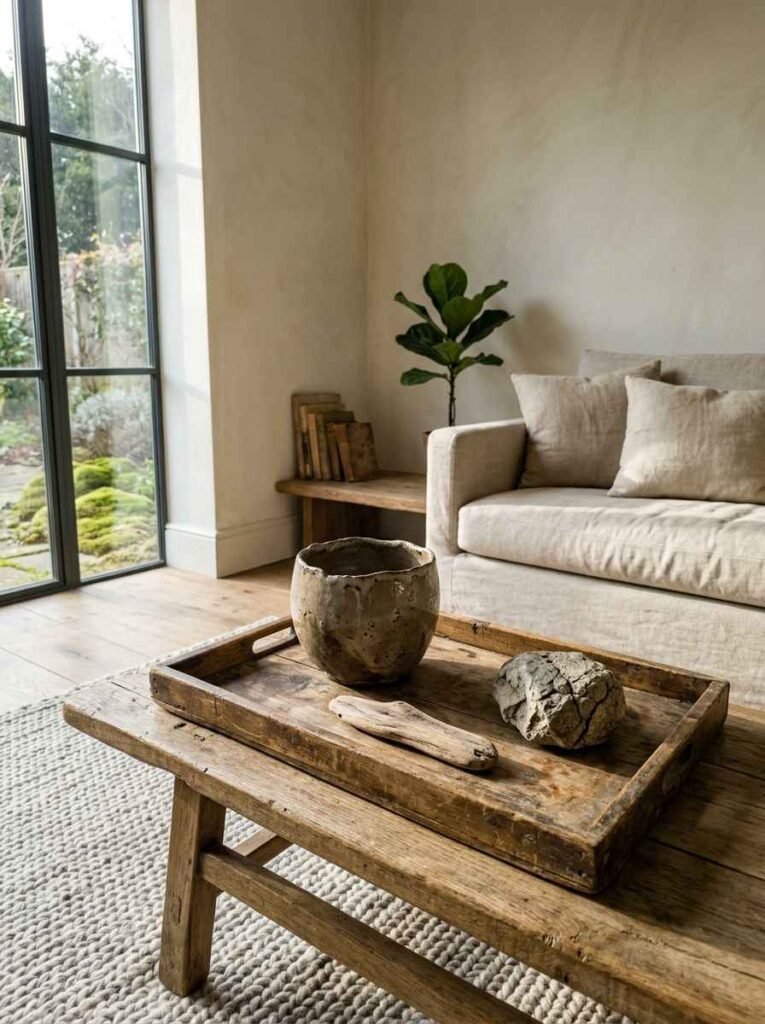
Wabi-sabi is the Japanese concept of beauty in imperfection and impermanence. For a living room, it means choosing the slightly lopsided ceramic, the driftwood piece, the stone with an interesting crack.
These objects have presence in a way that factory-perfect decor rarely does.
This is actually good news for budgets because imperfect handmade objects from local markets and thrift stores are almost always cheaper than their spotless mass-produced equivalents.
The 60-30-10 color rule (adapted for minimalism)
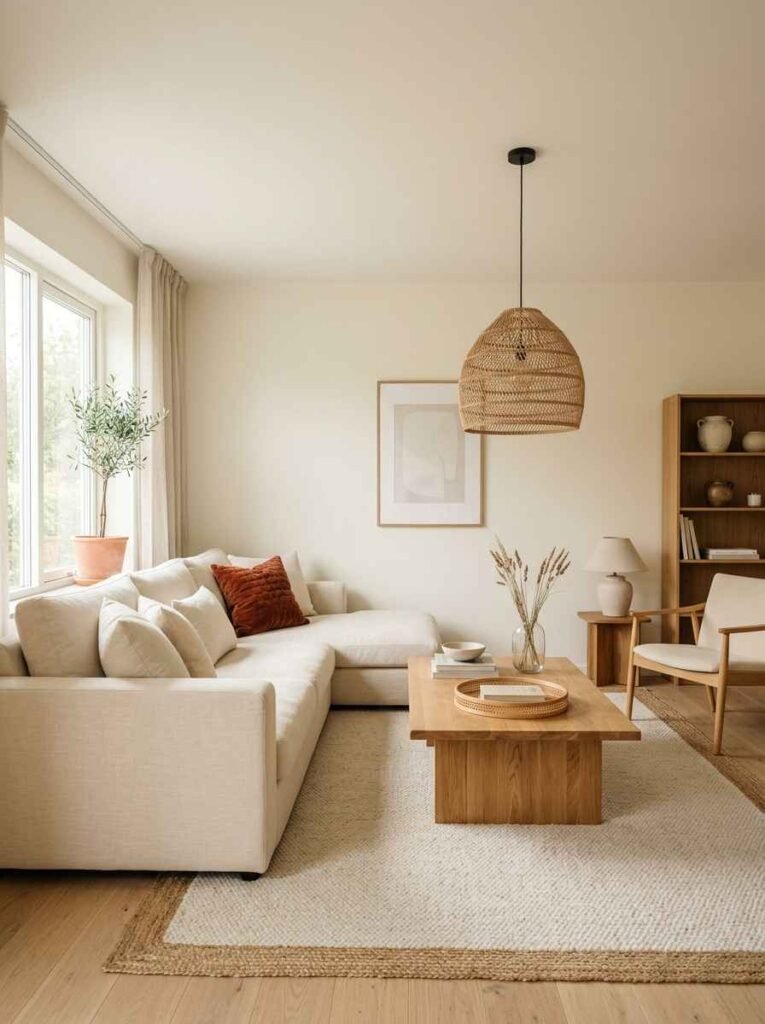
The classic interior design rule says 60% dominant color, 30% secondary color, 10% accent. For cozy minimalism, I’d adapt it: 75% neutral (walls, floor, main sofa), 20% warm wood tones and natural fiber, 5% accent color or material (maybe a deep terracotta cushion, a black iron lamp).
The heavy tilt toward neutral is what keeps the room calm. The 5% accent is what keeps it from feeling sterile.
Spend money on the sofa and rug, nowhere else
If you have a real budget to work with, put it here. A good sofa and a good rug are the 2 pieces that define how the room feels daily.
Everything else (lamps, cushions, art, plants) can be budget-friendly without the room suffering.
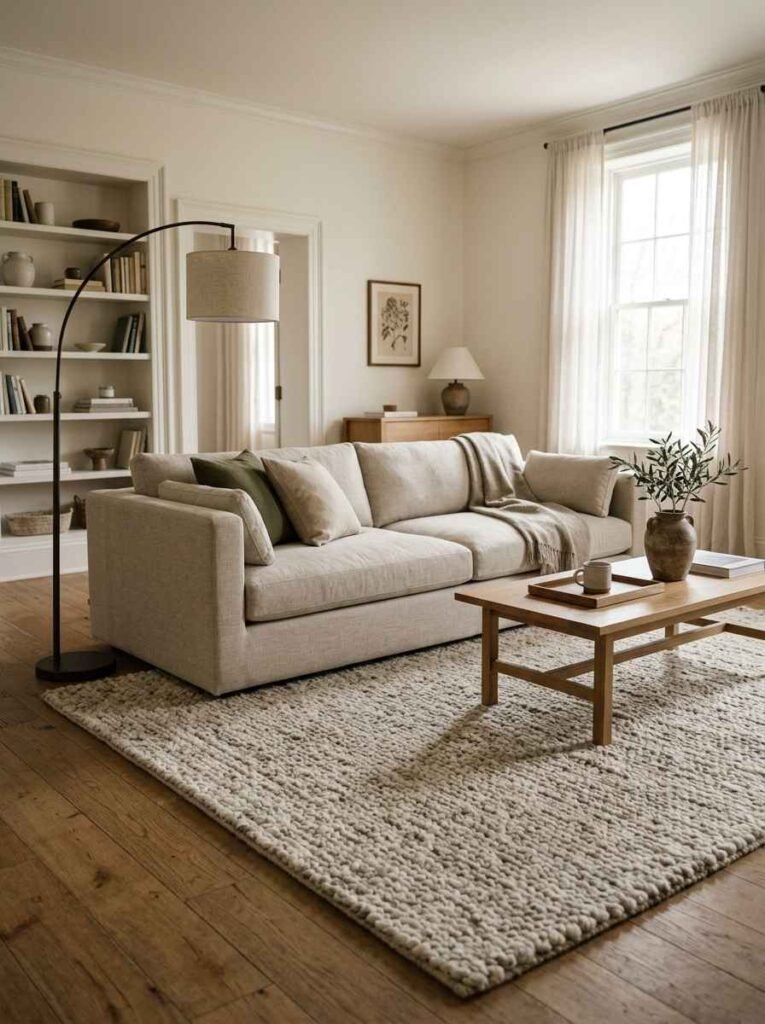
I’ve seen $3,000 rooms with $200 art and $20 plants that looked incredible because the sofa and rug were excellent. And I’ve seen the opposite fail every time.
Quick reference: cozy minimalist living room essentials
| Element | What to do | What to skip |
|---|---|---|
| Sofa | 1 linen or bouclé in warm neutral | Matched sets, dark heavy fabric |
| Rug | 8×10 min, natural fiber | 5×7 and smaller, synthetic |
| Lighting | 3-4 warm sources at varied heights | Single overhead only |
| Art | 1 large piece or tight 3-5 gallery | Scattered small prints |
FAQs
Can a minimalist room actually feel cozy, or does it always feel cold?
Yes, genuinely. The warmth in a minimalist room comes from material choices and lighting, not from volume of stuff. Linen, wool, wood, and warm-toned bulbs do most of the work.
A room with 8 pieces of furniture in natural materials reads warmer than a cluttered room with 25 pieces in synthetic ones.
What’s the biggest mistake people make when decorating a minimalist living room?
Buying a rug that’s too small. It’s almost universal, and it makes the whole seating area look unmoored. Size up, almost always.
How do I make a minimalist room feel personal without cluttering it?
Pick 3 to 5 objects that genuinely mean something to you and give them real display space. A travel souvenir with breathing room around it reads as intentional and personal. The same object buried in a shelf of 40 things disappears entirely.
You’ve got 32 ideas here, which I know is a lot to process at once. My actual suggestion: pick 3 that you could do this weekend without buying anything new. Rearrange furniture, pull 30% of objects off the shelves, hang your curtains higher. See how it feels before you spend a dollar.
And if you’ve already done any of this, or you have a specific room situation I didn’t address (awkward layout, no natural light, rented space with white walls you can’t change), drop it in the comments. I’m curious what you’re working with.
