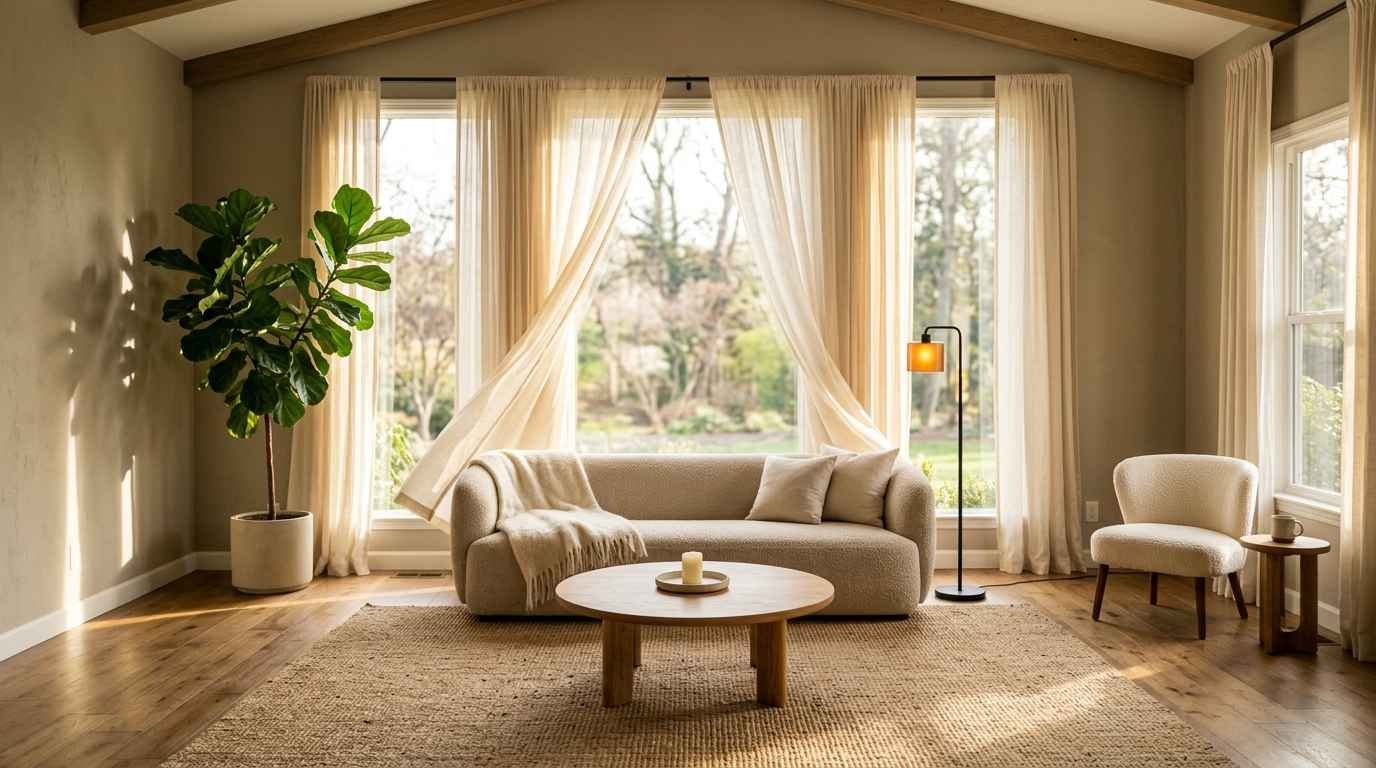
You know that feeling when you walk into a room and just… exhale?
No clutter yelling at you, no random throw pillows from three different design phases of your life, just clean lines and a space that actually feels like somewhere you’d want to sit down and stay awhile.
That’s what cozy minimalism does. And honestly? Getting there is way less complicated than most people think.
I’ve spent a ridiculous amount of time obsessing over living room setups, saving every other Pinterest board that crosses my feed, and rearranging my own furniture at 11pm on a Tuesday (we’ve all been there).
So here are 26 ideas that actually work, pulled from real inspiration and a few hard-learned lessons.
1. Start With a Neutral Base, Then Layer Intentionally
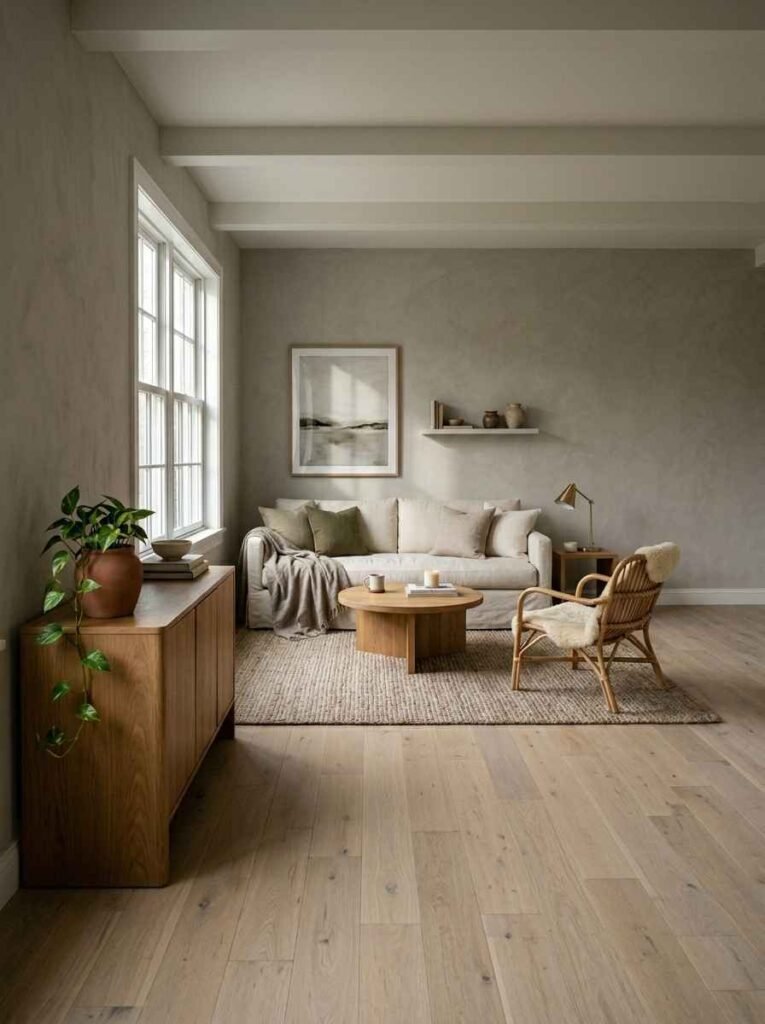
The biggest mistake people make with minimalist rooms is confusing “neutral” with “boring.”
A warm greige wall (that blend of grey and beige that somehow works with everything) gives you a canvas that lets your textures and materials do the talking. Paint something like Sherwin-Williams’
Accessible Beige or Benjamin Moore’s Pale Oak on your walls and watch the room settle.
Once you have your base, layer in one warm-toned wood piece, one plant, and one textile in a slightly darker shade. That’s your starting trio. Everything else builds from there.
2. Pick One Anchor Piece and Let It Lead
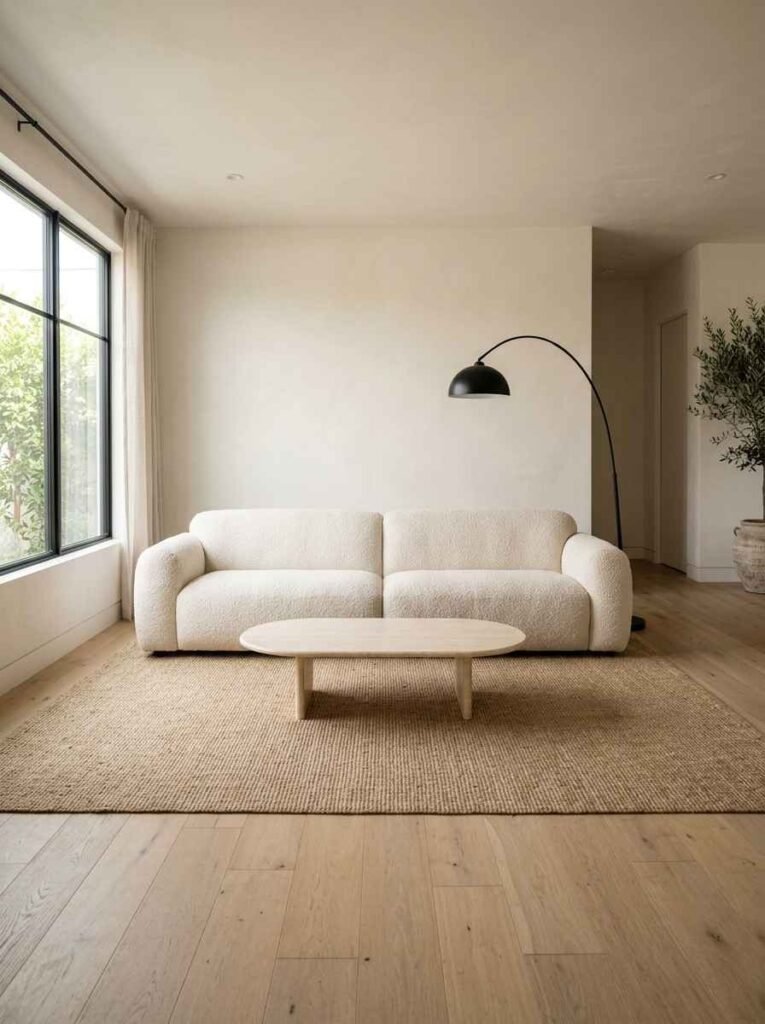
Every great minimalist room has one thing that earns attention. A slouchy linen sofa in oat. A low-profile walnut coffee table.
A vintage rattan chair in the corner. Pick yours, then build around it rather than trying to make six things compete for the spotlight.
I went with a boucle sofa as my anchor piece and genuinely have not regretted it for a single second.
It’s the kind of piece where you stop caring about having eight decorative pillows because the sofa itself is already the statement.
3. Embrace the Power of Negative Space
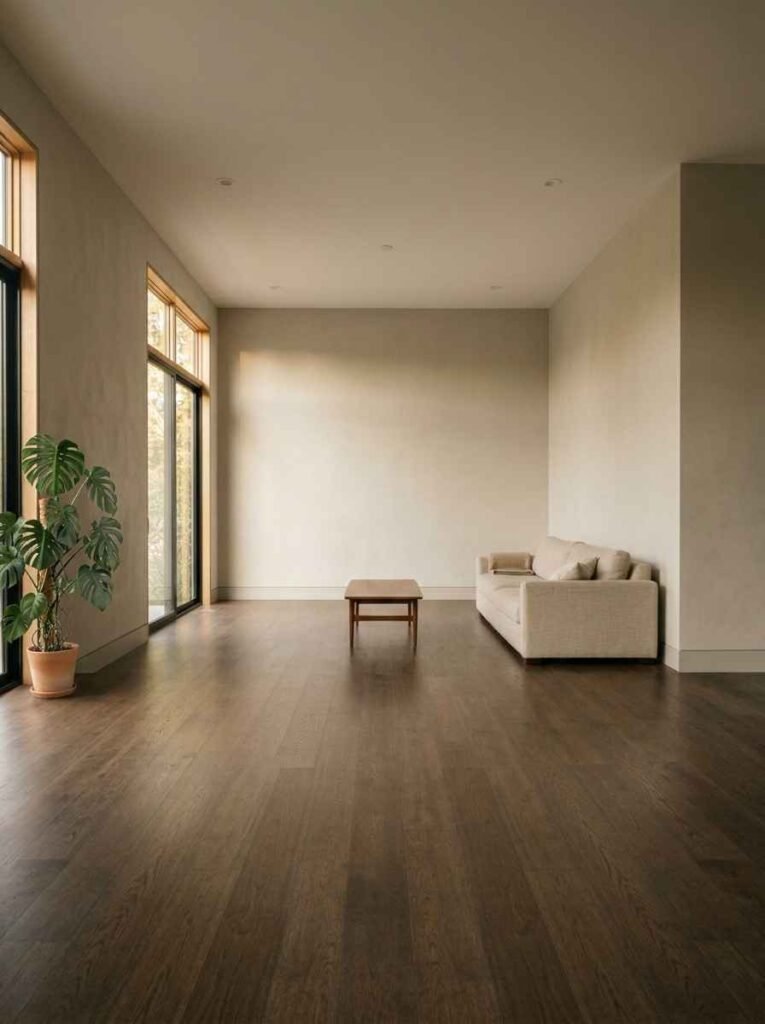
Here’s something nobody tells you when you’re starting to strip a room back: the empty space is doing work.
Leaving wall space bare, keeping a coffee table with just one object on it, letting a corner breathe, these things aren’t signs of an unfinished room. They’re intentional decisions that make your eye rest instead of scramble.
Negative space is basically free decor. And it pairs perfectly with good furniture arrangement principles that prioritize flow over filling.
4. Use a Tight, 3-Color Palette
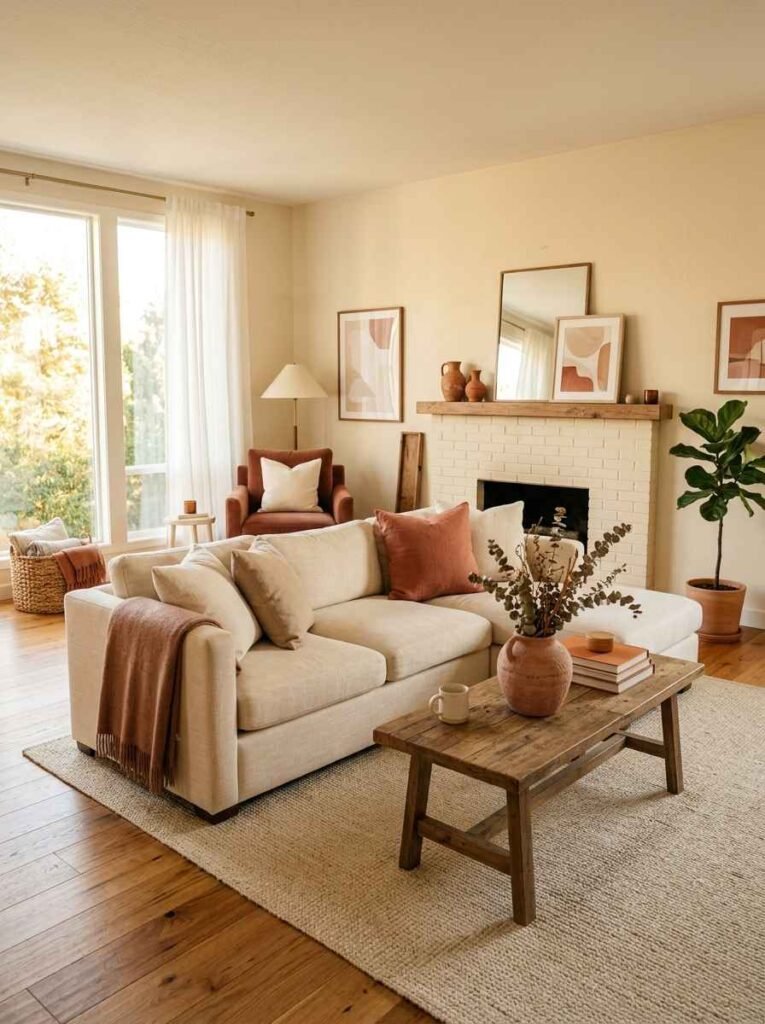
Minimalist doesn’t mean monochrome. You can absolutely have color, but keep it to three: a dominant neutral, a secondary warm or cool tone, and one accent. That’s it. For something cozy, try:
- Dominant: warm white or cream
- Secondary: terracotta, dusty sage, or warm taupe
- Accent: deep rust, navy, or muted olive
Stick to that and the room will feel cohesive even before you’ve styled a single shelf.
5. Invest in Linen (Seriously, Just Do It)
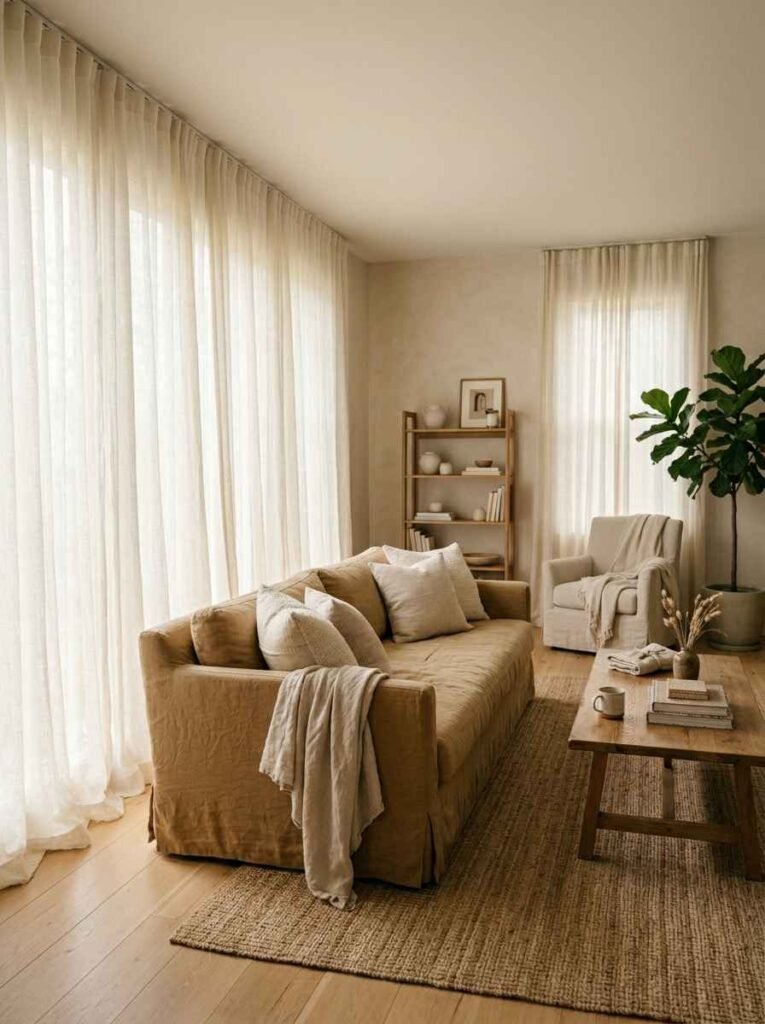
Linen is having its well-deserved moment and I’m fully on board. Linen curtains, linen throw covers, linen pillow cases. The texture reads as luxurious without trying hard, it softens the look of a very clean room, and it photographs beautifully (which matters if you’re a Pinterest person, and if you’re reading this, you probably are).
Go unlined on the curtains if you want that gauzy, light-filtering effect that makes your room look like a Scandinavian lifestyle account on a Saturday morning.
6. Go Low With Your Furniture
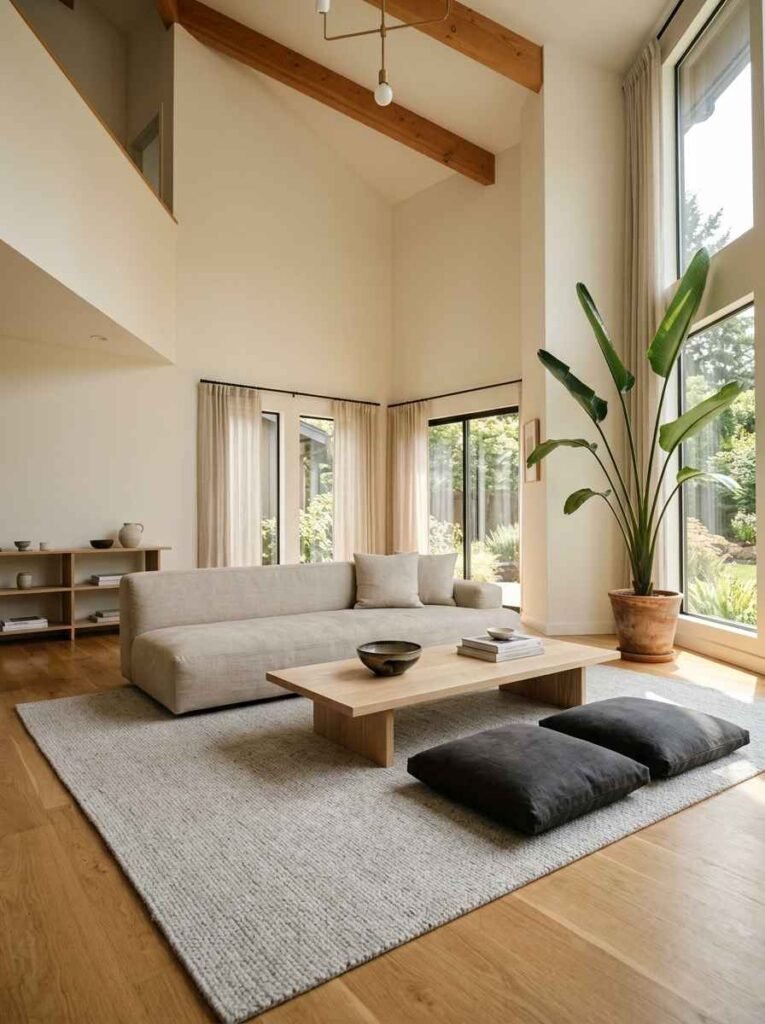
Low-profile furniture makes ceilings look taller and rooms feel more spacious. A low sofa, a floor-level coffee table, cushions you could slide onto from the ground, this aesthetic has a very Japanese, wabi-sabi quality to it. It’s casual without being sloppy, and it works in small apartments just as well as larger living rooms.
Check out resources like Japandi design guides for the full philosophy behind this kind of furniture proportion thinking.
7. Choose Wood Tones That Actually Match
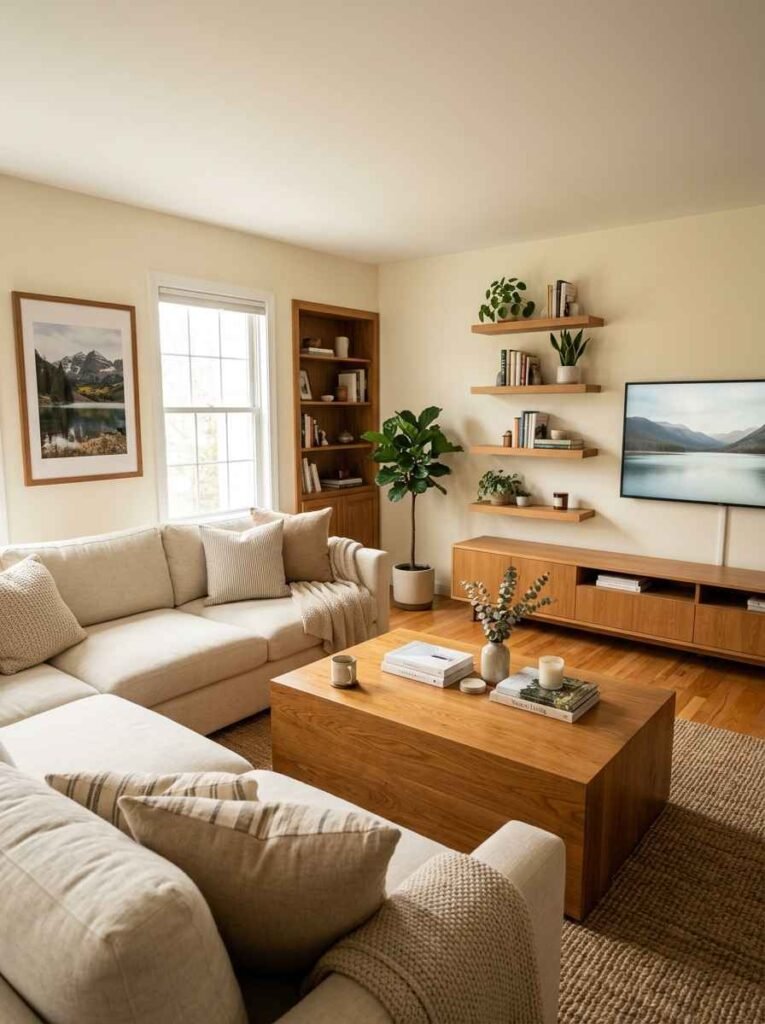
Mixing wood tones is fine, but mixing them badly is the silent killer of otherwise decent rooms. The general rule: stay in the same temperature family. Light ash and pine can hang together. Dark walnut and mahogany can work. But don’t put an IKEA blonde birch shelf next to a very dark espresso TV unit and wonder why it looks chaotic.
If you’re not sure, just go all warm mid-tone. Medium oak goes with basically everything.
8. Add Texture With a Chunky Knit Throw
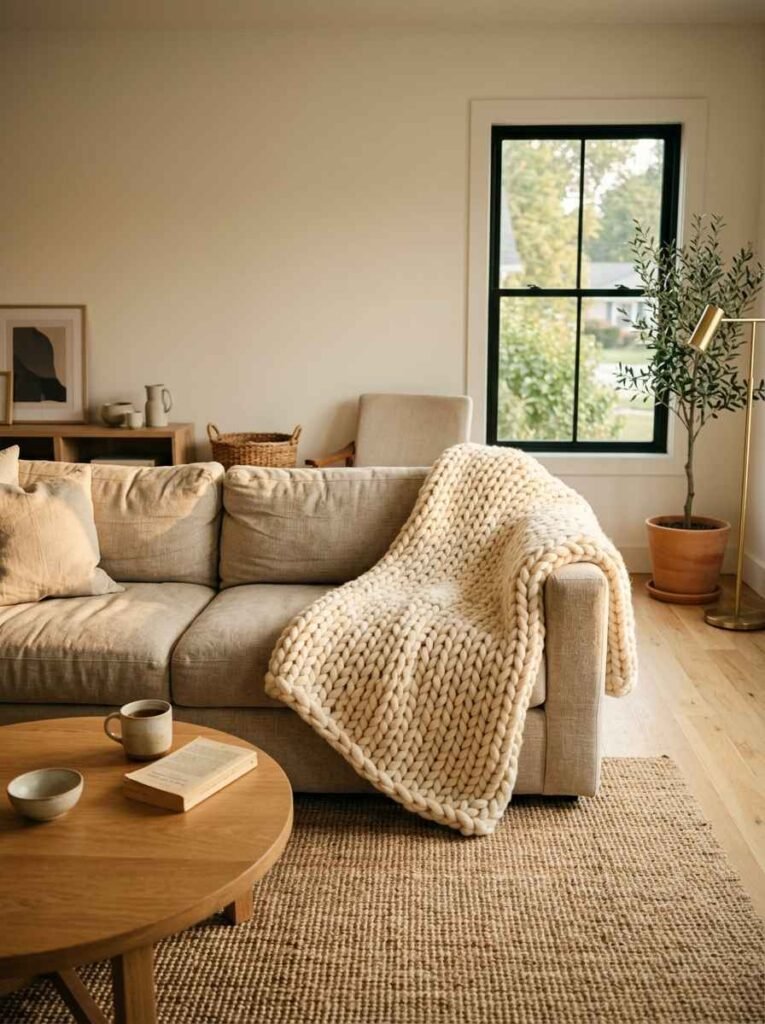
This is the easiest cozy upgrade that costs under $40. A chunky knit throw draped over the arm of your sofa (casually, like you just put it there and didn’t spend 4 minutes adjusting it) adds instant warmth to a very clean room. It signals “people actually live here” without adding visual noise.
9. Try a Statement Rug That Grounds the Space
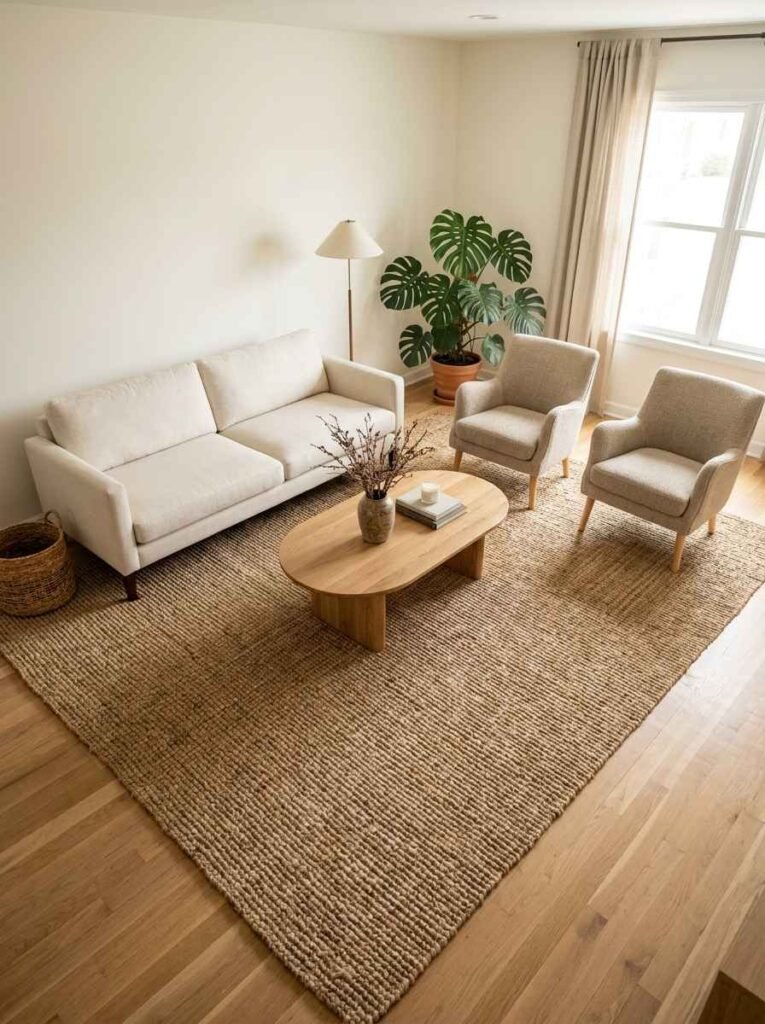
In a minimalist room, the rug often does more heavy lifting than any single piece of decor. Go bigger than you think you need. A rug that all four sofa legs can sit on (or at least the front two) anchors the seating area and makes the room feel pulled together instead of like furniture that just ended up in the same place.
Natural fiber rugs, jute, sisal, wool, tend to work best for this aesthetic. They add texture without adding pattern chaos.
10. Bring in Exactly One Large Plant
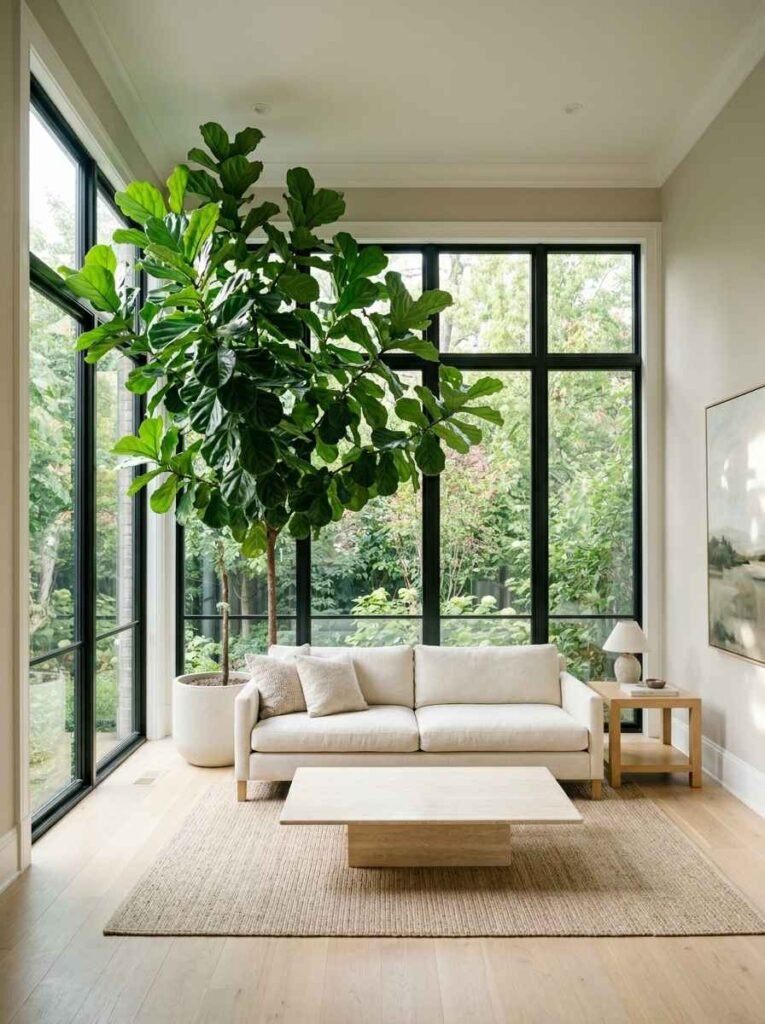
Not a shelf of succulents. Not a collection of propagations in mismatched vessels. One big plant. A fiddle leaf fig, a monstera, an olive tree, a Bird of Paradise. Something with actual presence that fills a corner and lives at eye level.
One large plant reads as architectural. Twelve small ones reads as “I am running a propagation station.” Both are valid hobbies. Only one of them is cozy minimalism.
11. Use Ambient and Task Lighting, Not Just Overhead
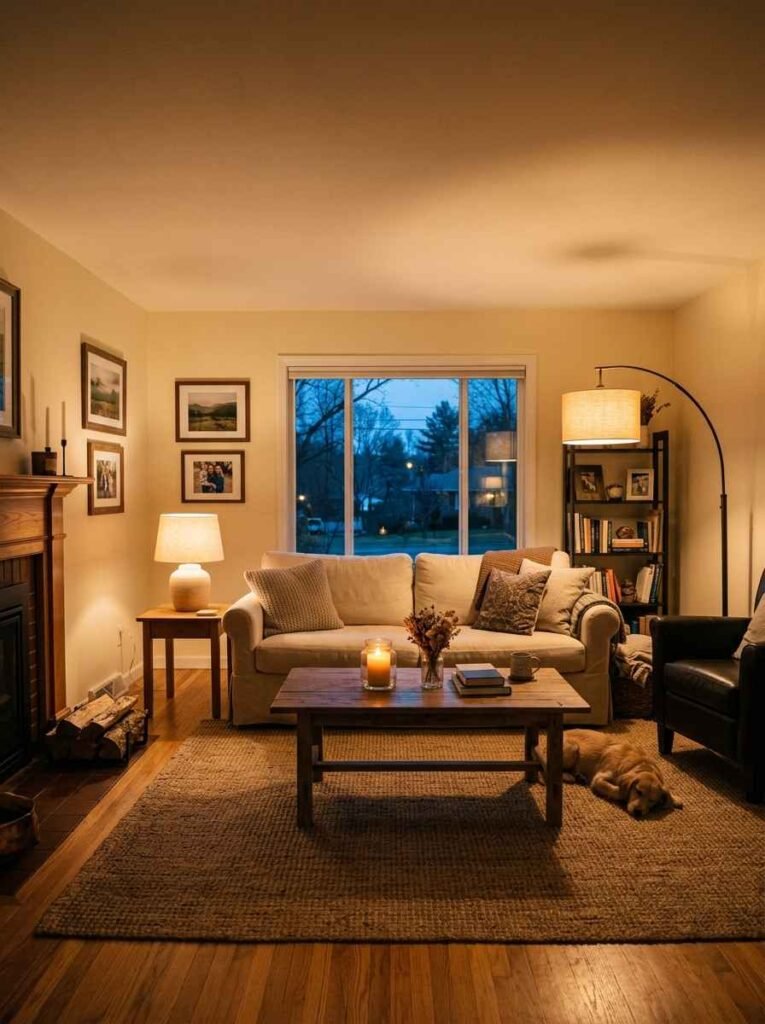
Overhead lighting alone is the enemy of a cozy atmosphere. This is not up for debate. Layer your lighting with a floor lamp in one corner, a table lamp on a side table, maybe a small lamp on a console, and use your overhead light only when you need it for practical tasks.
Warm bulbs (2700K or lower) make a massive difference. Cool white light makes everything feel like a dental office.
Okay, quick side note before we continue: I once helped a friend rearrange their entire living room for three hours, only to realize afterward that the real issue was their light bulbs were 5000K cool white. We switched to warm bulbs and the room was transformed in about 45 seconds. Sometimes the fix is genuinely that simple. 🙂
12. Style Shelves With the Rule of Three (Then Break It)
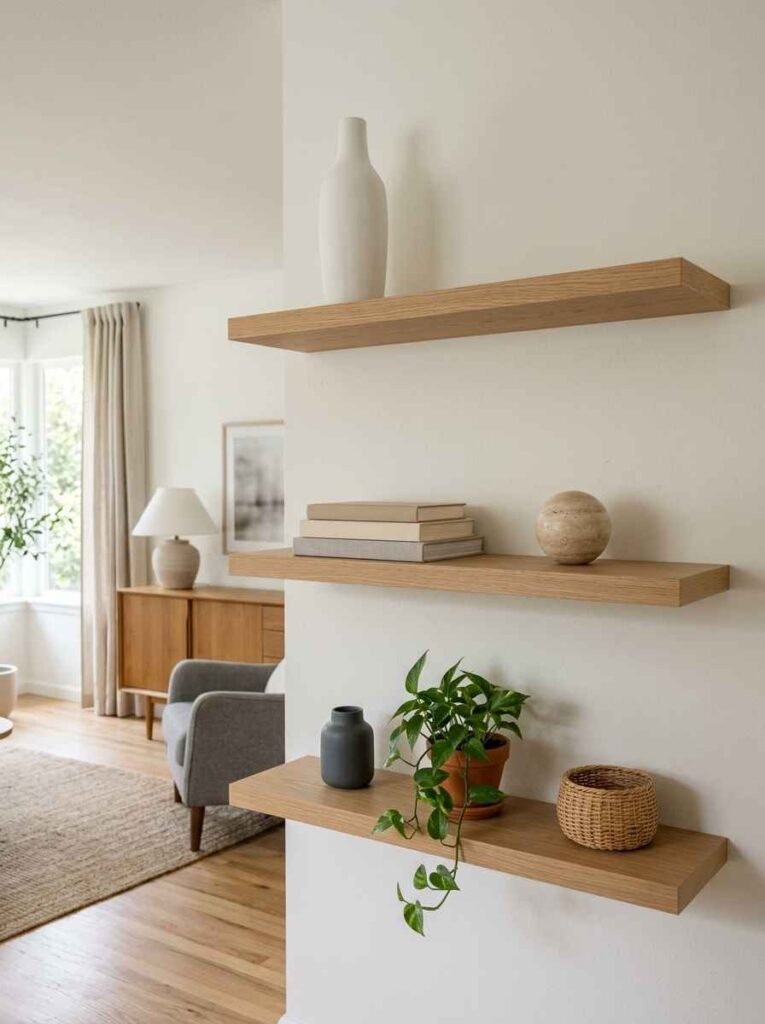
The classic shelf-styling rule says group objects in odd numbers, vary the heights, and mix textures. It works. But once you’ve got the hang of it, break it on purpose. Two objects instead of three. One single tall vase on an entire shelf. Restraint, done with confidence, reads as taste.
13. Choose Curtains That Pool Slightly on the Floor
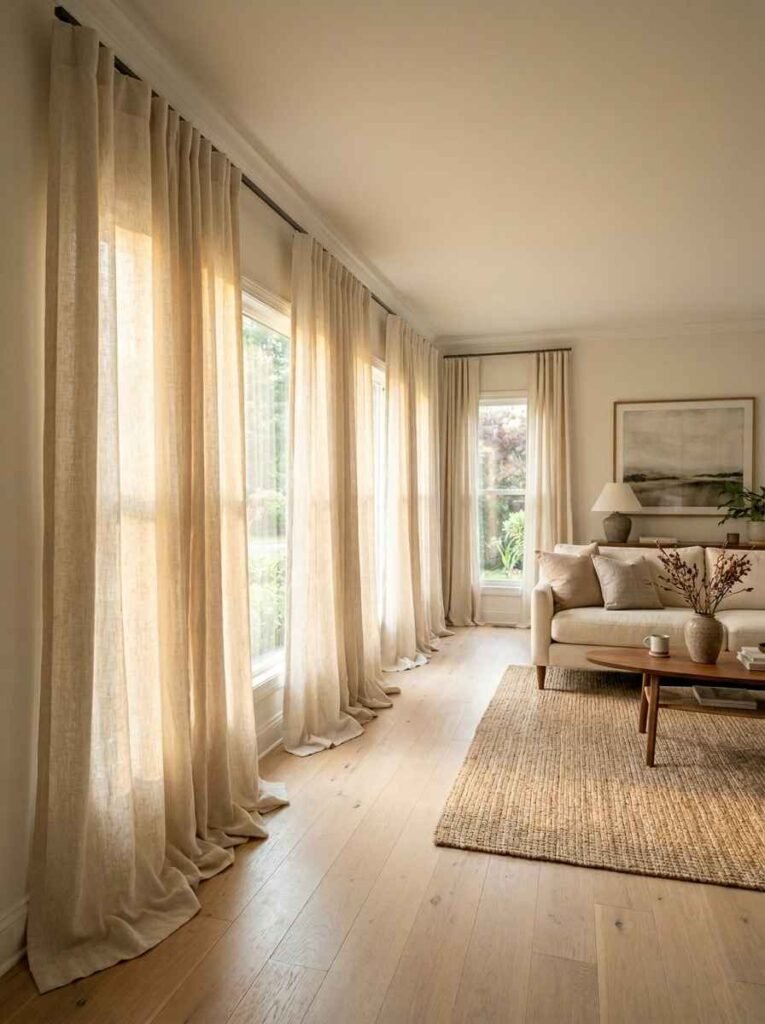
Floor-length curtains that brush or just slightly pool on the floor make a room feel taller and more finished than curtains that hover an inch above the ground like they’re afraid of commitment. Go for panels that are at least 96 inches long for standard 8-foot ceilings, hung as close to the ceiling as possible.
14. Mount Your TV to Free Up Surface Space
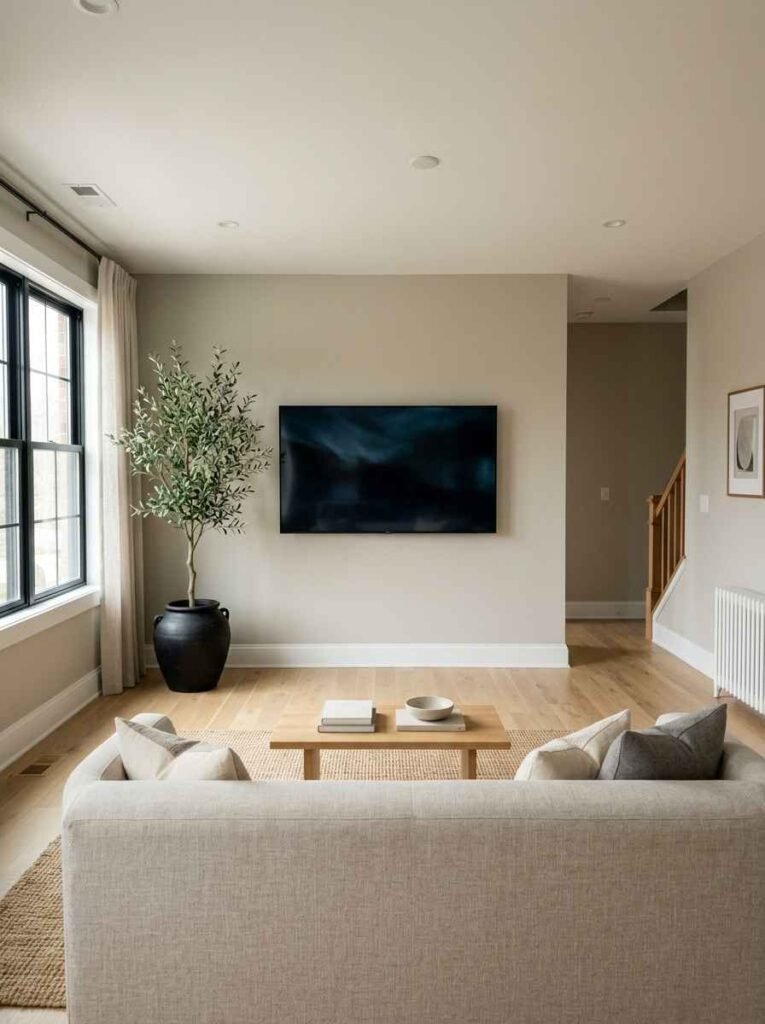
A TV on a bulky stand eats floor space and draws attention in the worst way. Mounting it on the wall, even if the wall is a neutral color, lets you eliminate the unit underneath and use that floor space for something intentional, or for nothing at all.
If you hate visible wires (and you should), in-wall cable management kits are cheap and the single best upgrade you can do post-mount.
15. Add a Simple Console Table Behind the Sofa
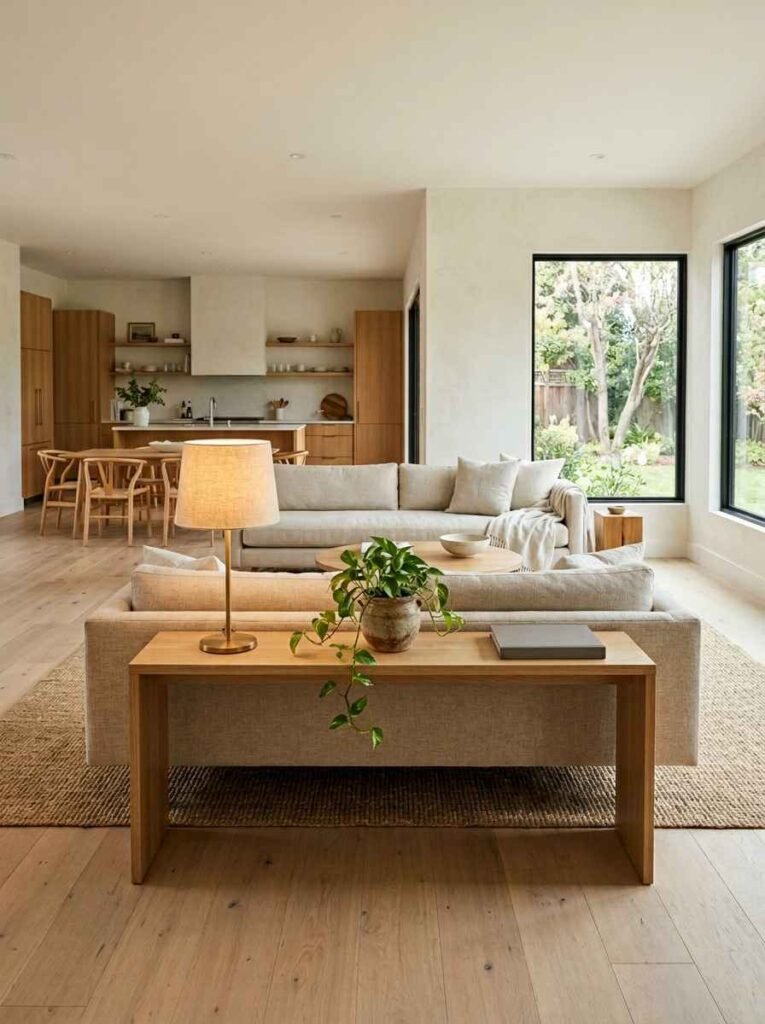
If your sofa floats in the room rather than sitting against a wall, a narrow console table behind it gives the seating area a sense of definition. Style it minimally: a lamp, a small plant, one book.
This trick also works as a subtle room divider in open-plan spaces.
16. Try Japandi Accents for That Calm, Collected Look
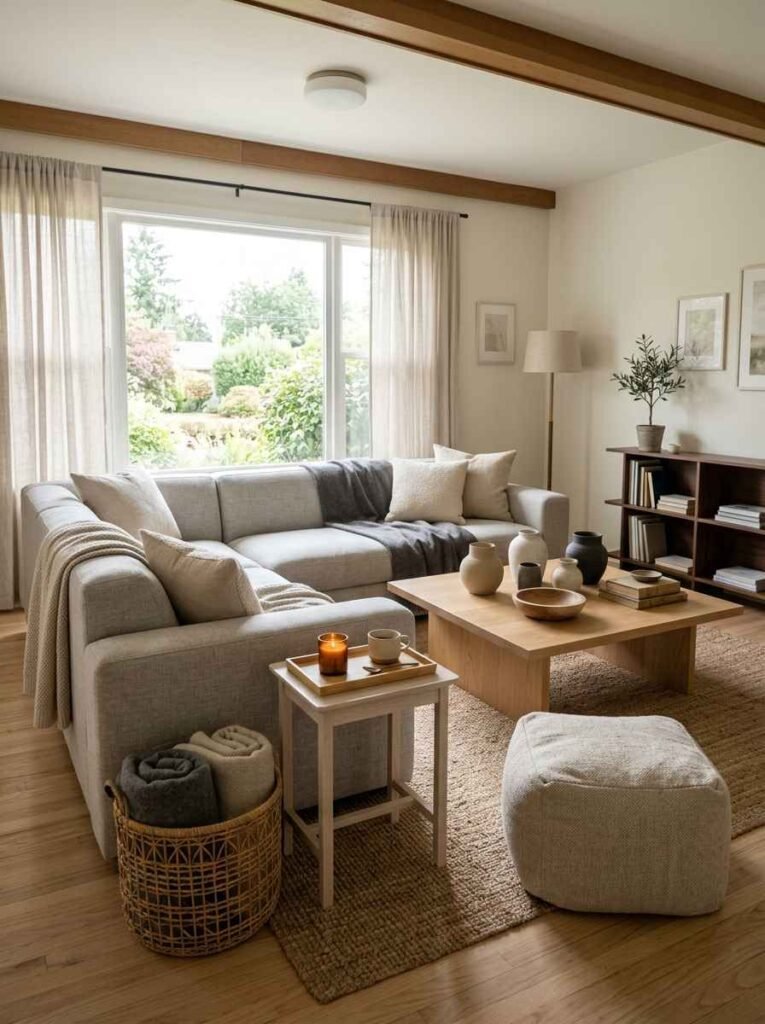
Japandi, the hybrid of Japanese and Scandinavian design, is basically the visual language of cozy minimalism. It leans into natural materials, functional objects that are also beautiful, and a respect for simplicity. A few specific accents that hit this note:
- Handmade ceramic mugs and vessels
- Woven baskets for storage
- Simple bamboo trays
- Linen or cotton poufs
None of these cost a fortune, and all of them quietly improve the feeling of a room.
17. Use a Daybed or Chaise for a Relaxed Reading Corner
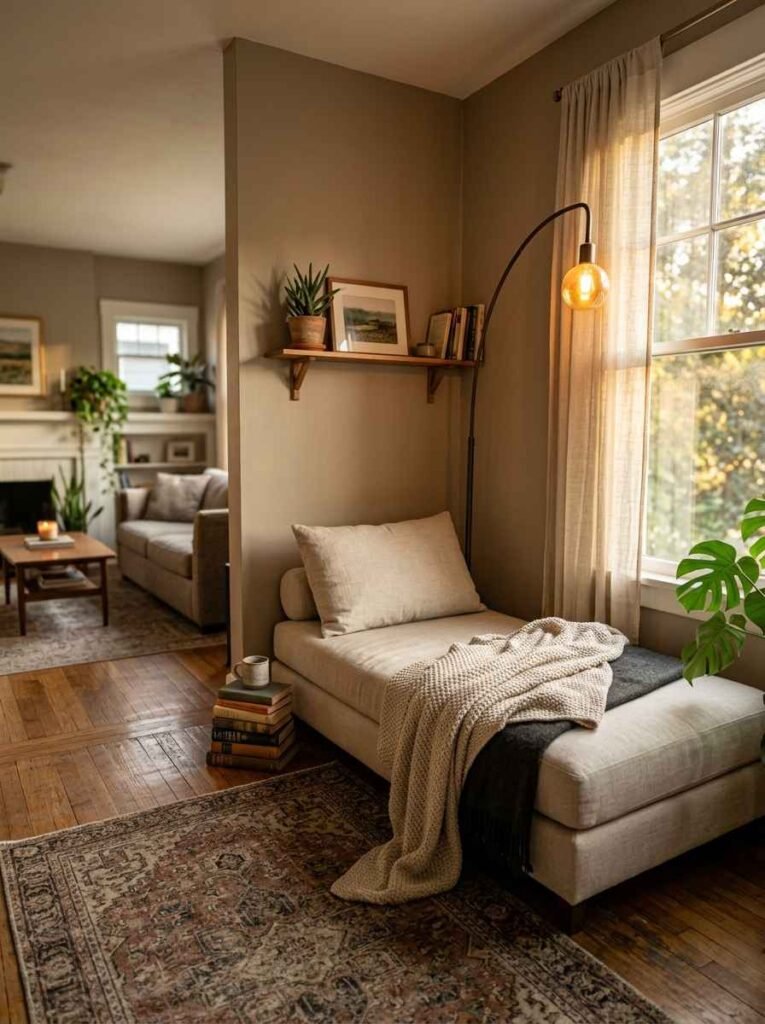
A chaise lounge or a simple daybed tucked into a corner with a floor lamp beside it turns an unused area into a destination. It says “this room has a reading nook” without requiring a whole separate room. It’s also, I will fully admit, where I do 90% of my actual work because it’s infinitely more comfortable than my actual desk setup.
18. Paint an Accent Wall in a Muted, Deep Tone
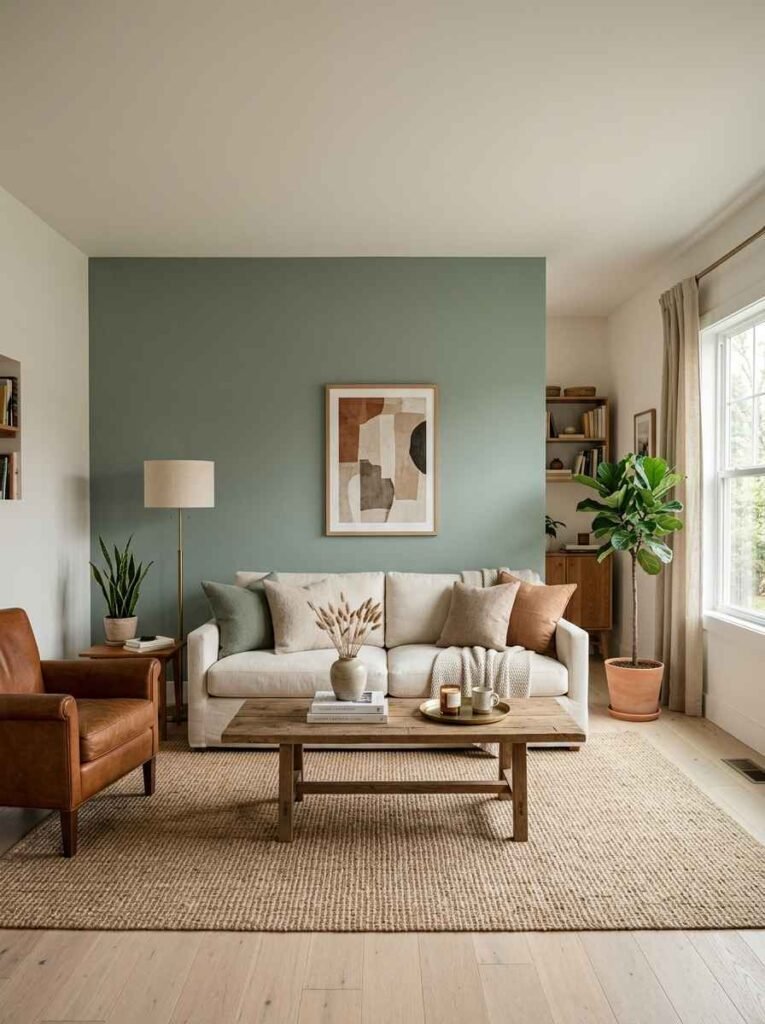
If you want some depth without cluttering the room, a single accent wall in a moody, desaturated color does it. Dusty sage, warm charcoal, deep terracotta, muted teal. The key word is muted. Avoid anything too saturated; it’ll fight the calm vibe you’re building.
Keep the other three walls your neutral base and let that one wall create the depth.
19. Edit Your Surfaces Every Season
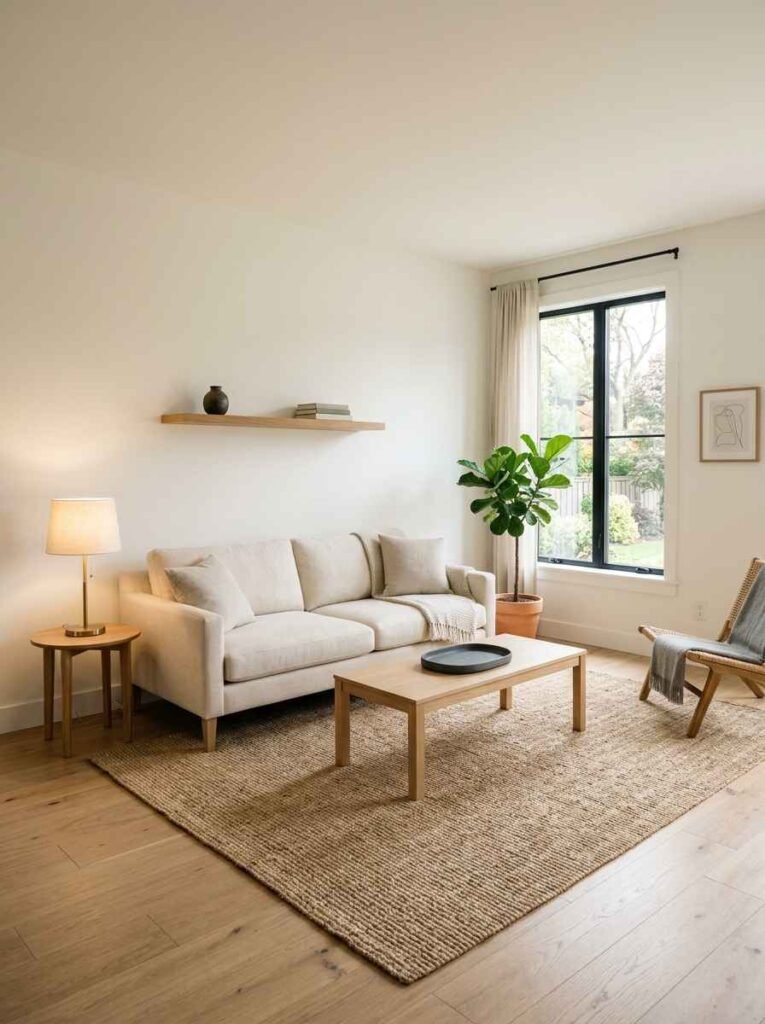
Here’s one of those things that sounds small but makes a big difference: once a season, clear off every surface in your living room completely. Every table, shelf, console, windowsill. Then only put back what you actually want there. Not everything that drifted there over the last three months, just the things you chose.
Wow, the first time I did this, I found four TV remotes, a lip balm from 2019, and a book I’d been looking for. Cozy minimalism requires active curation, not just initial setup.
20. Pick Art That You Actually Love, Not Art That “Goes”
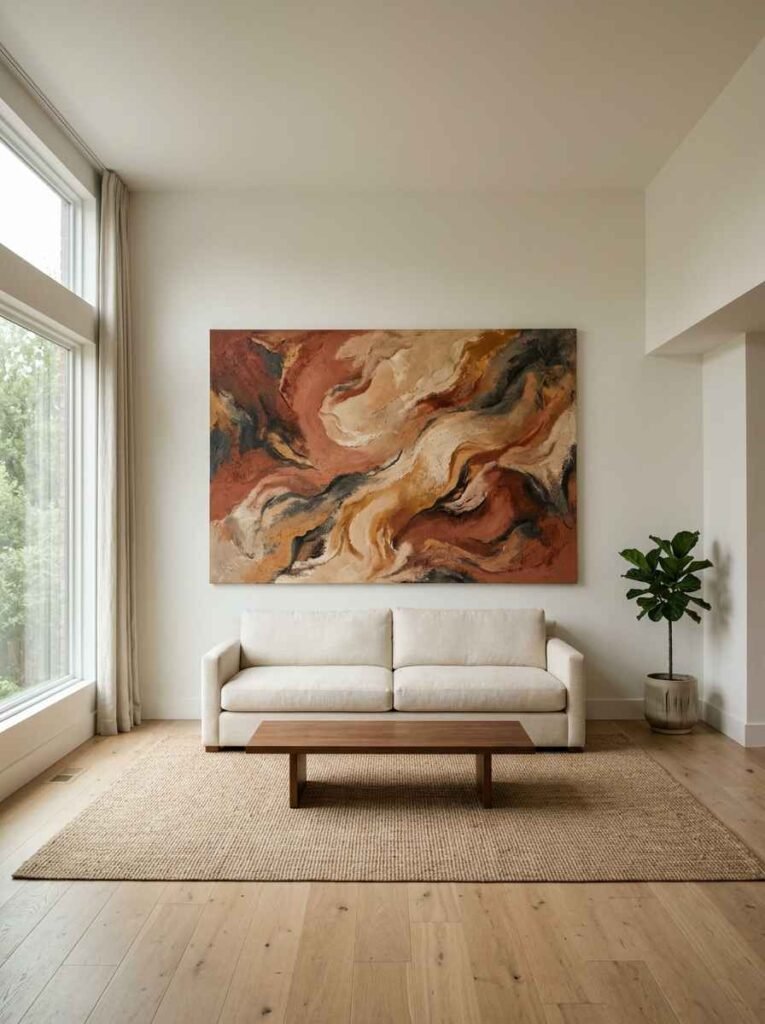
Minimalist rooms don’t need to have bland or generic art. They just need fewer pieces. One large canvas or print that genuinely moves you is worth infinitely more than a gallery wall of things that match the throw pillow.
Abstract art with earthy tones is a safe starting point if you’re unsure. Look at independent print shops on Etsy or Society6 for affordable originals that feel personal.
21. Use a Neutral Linen or Velvet Sofa Cover to Refresh Without Replacing
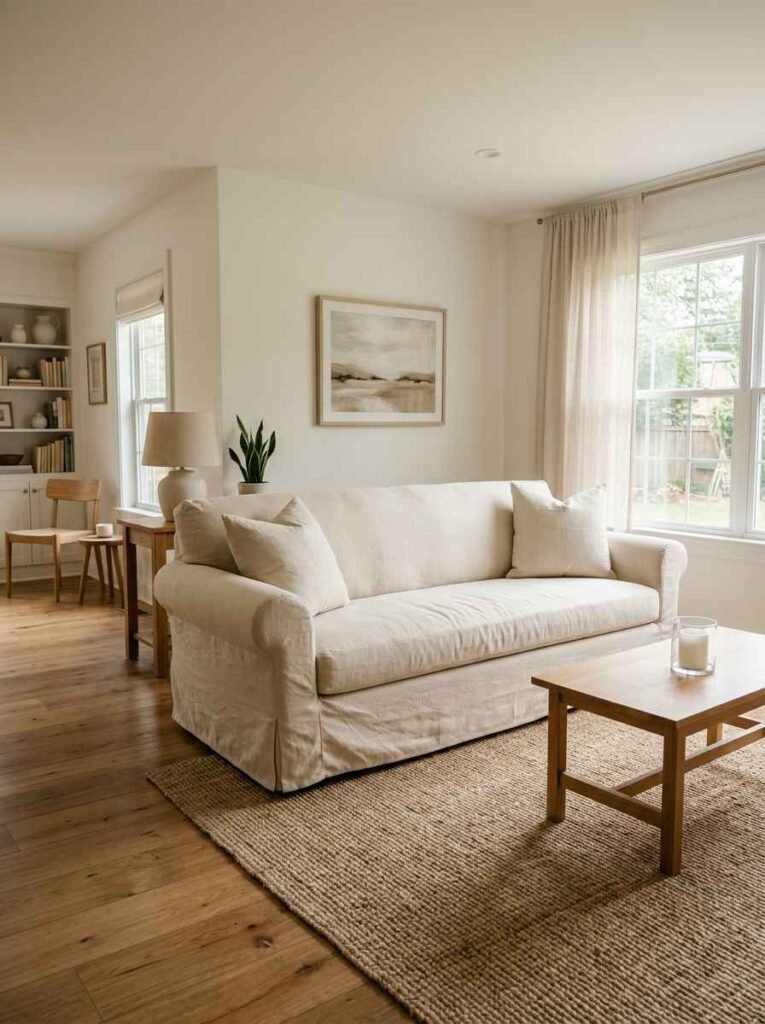
If you love your sofa but hate how it looks, a good quality slipcover or sofa cover can completely reframe it. This is especially useful if you’re renting and can’t do major changes, or if you’re working with a limited budget. Go for linen in a warm cream or grey; it hides imperfections and photographs beautifully.
22. Incorporate Woven and Rattan Details
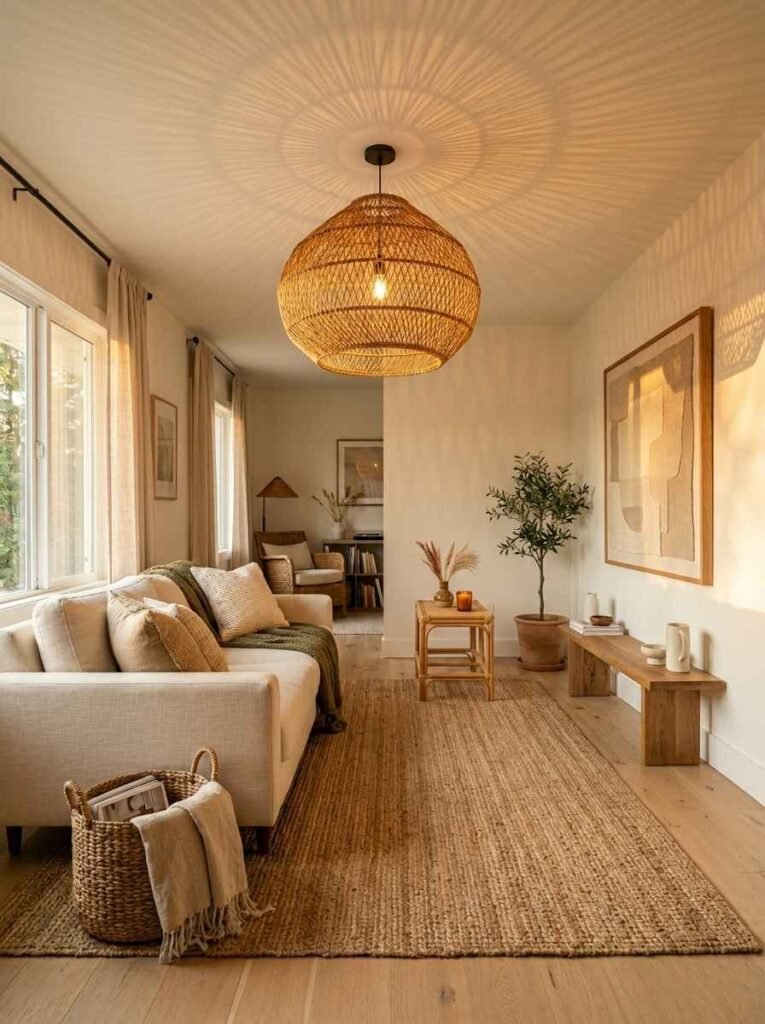
Rattan and woven details add the kind of organic warmth that keeps a minimalist room from feeling sterile. A rattan side table, a woven pendant light, a seagrass basket used as a storage solution. These materials introduce texture and natural color without adding visual weight.
| Material | Best Use | Vibe It Adds |
|---|---|---|
| Rattan | Side tables, frames | Relaxed, organic |
| Jute | Rugs, baskets | Earthy, grounded |
| Linen | Curtains, cushions | Soft, airy |
| Boucle | Sofa, chair upholstery | Cozy, textural |
23. Let Your Books Be Decor
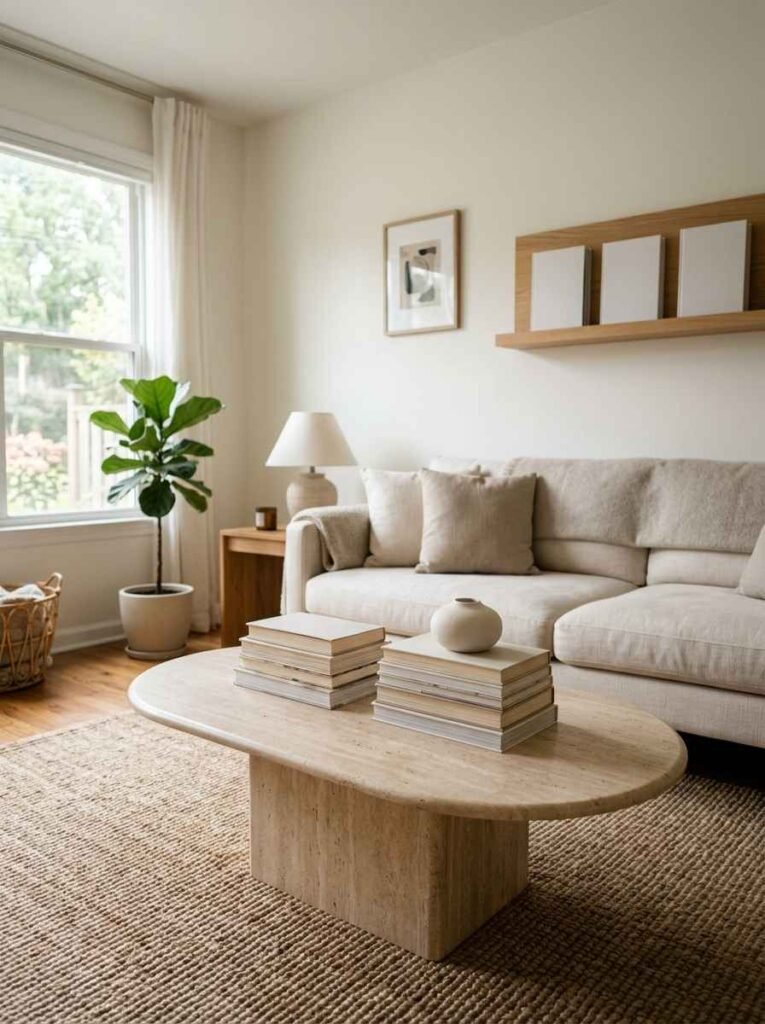
A small, curated stack of books on a coffee table or a few on a shelf isn’t clutter. It’s character. The trick is editing: keep the ones that either mean something to you or have spines that don’t visually shout. Turning books backward (spines facing in, pages facing out) is a popular minimalist trick for instant visual calm, though I’ll admit it makes finding what you want mildly inconvenient.
24. Use Scent as an Invisible Layer of Coziness
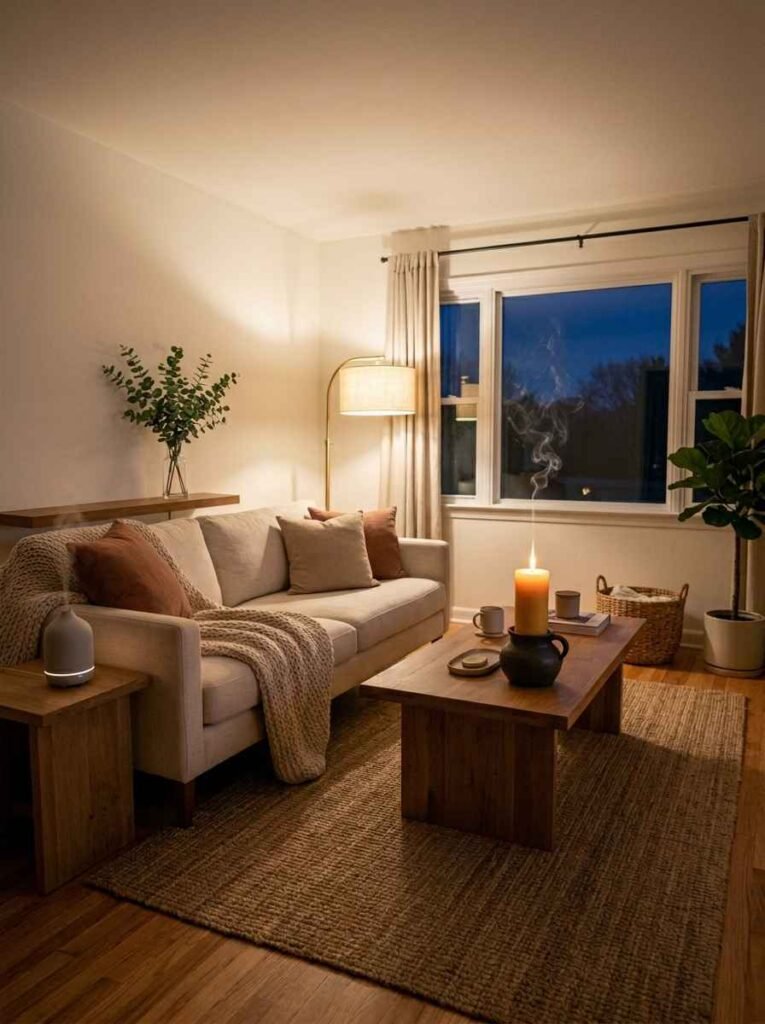
A candle, a diffuser, or even just fresh eucalyptus in a vase adds to the sensory experience of a room without adding visual clutter. Scent is massively underrated in interior design conversations. A room that smells like cedar and clean linen will feel cozy even if it’s not perfectly styled.
Pick one signature scent for your living room and stick with it. It becomes part of the room’s identity.
25. Keep Your Coffee Table Styling to Three Items Max
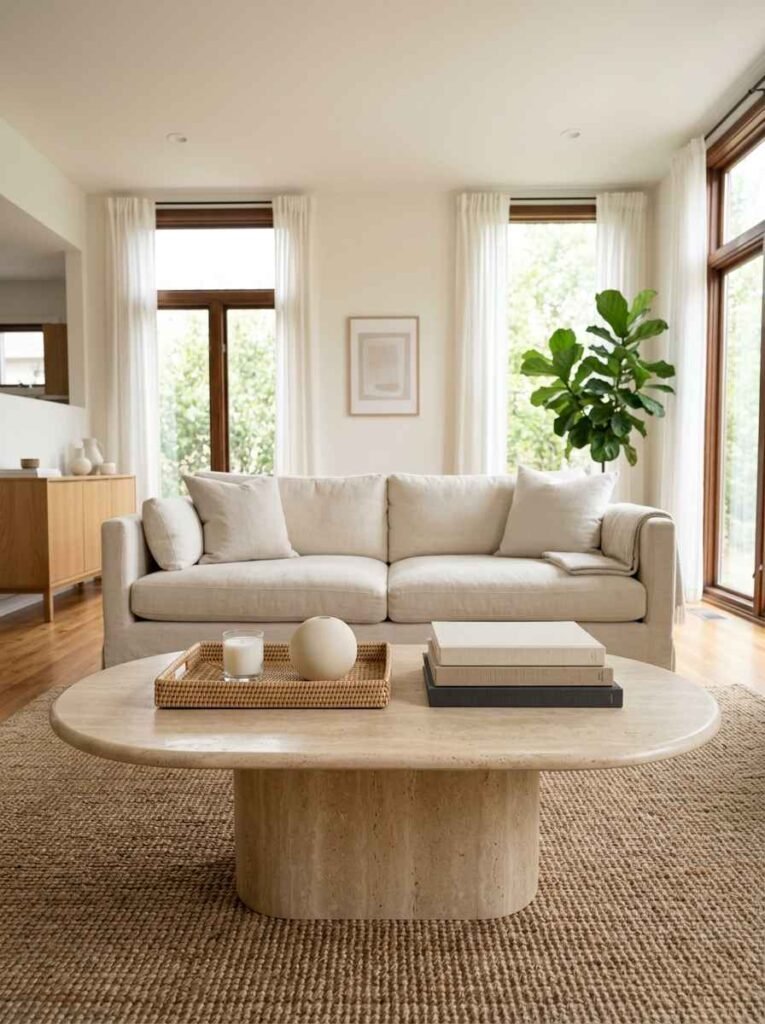
One tray. One stack of books or a small plant. One candle or decorative object. That’s the coffee table formula. Anything more starts to tip into cluttered. Anything less and it looks like you forgot to style it (unless you’re going for a very deliberate empty-surface look, which can also work).
The tray matters because it visually contains the other items and makes the arrangement look considered rather than accidental.
26. Commit to the Edit
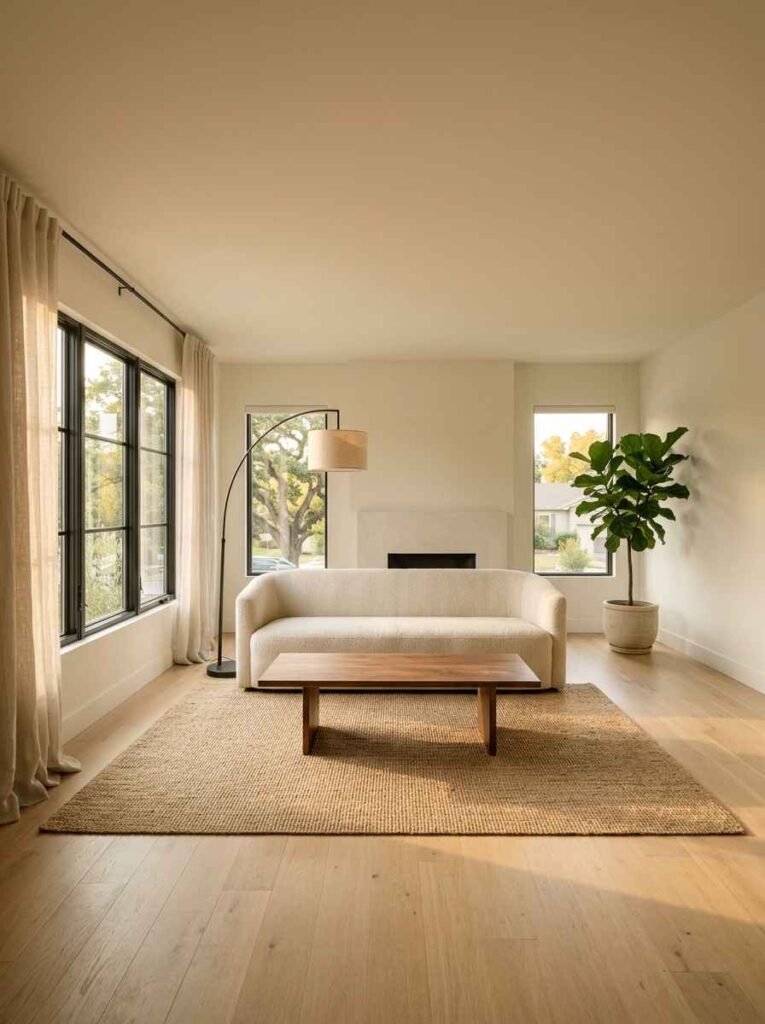
This last one isn’t really a decor idea, it’s the practice underneath all the other ideas. Cozy minimalism isn’t a style you achieve once and maintain effortlessly. It requires regular editing, resisting the impulse to buy things just because they’re pretty, and being honest about what’s actually adding to the room versus what just drifted in.
FYI, the rooms that consistently look calm and beautiful on Pinterest are maintained by people who ruthlessly put things away, donate things they no longer love, and resist the temporary dopamine hit of random decorative purchases. That discipline is the actual aesthetic.
Quick Comparison: Cozy Minimalist vs. Traditional Minimalist
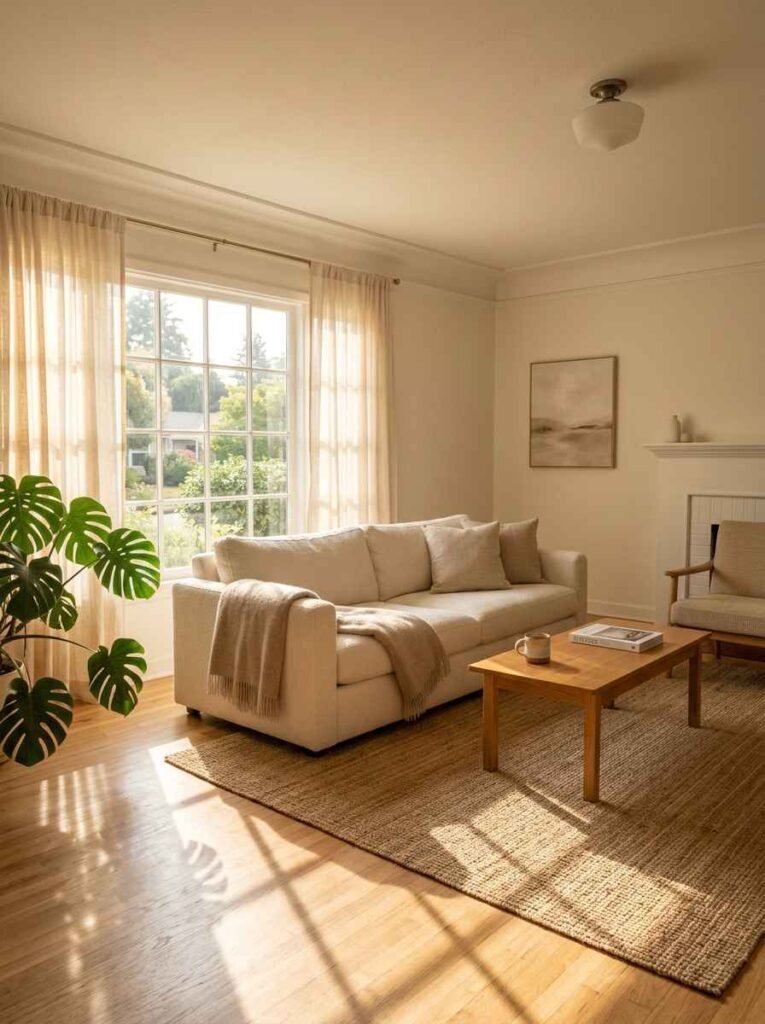
| Feature | Cozy Minimalist | Traditional Minimalist |
|---|---|---|
| Color Palette | Warm neutrals, earthy tones | Cool greys, stark whites |
| Textures | Layered: linen, boucle, jute | Smooth, hard surfaces |
| Feel | Warm and livable | Clean and architectural |
| Flexibility | Easier to adapt | Less forgiving of imperfection |
Frequently Asked Questions
Q: How do I make a minimalist living room feel warm instead of cold? A: The fastest fix is lighting and textiles. Swap cool white bulbs for warm 2700K bulbs, add a chunky knit throw, and bring in at least one natural material (wood, rattan, jute). Warm neutrals on the walls instead of stark white also shift the whole temperature of the space.
Q: Can I do cozy minimalism on a budget? A: Absolutely. The biggest moves, editing your current stuff, rearranging furniture, swapping light bulbs, cost nothing. Beyond that, a good rug, a floor lamp, and a linen throw cover are the highest-impact purchases you can make for under $150 total if you shop second-hand or at stores like H&M Home, IKEA, or Target’s threshold line.
Q: How many decorative items is too many in a minimalist room? A: There’s no magic number, but a useful test is this: if you can see everything in the room in one glance and your eye doesn’t know where to rest, you probably have too much. Aim for a few deliberate focal points rather than an even distribution of stuff everywhere.
A Final Thought
Cozy minimalism is really just the art of choosing things carefully and then having the discipline to stop. Your living room should feel like somewhere you actually want to be, not a showroom and not a storage unit.
If you try even 3 or 4 of these ideas in your space, I’d genuinely love to know what shifted for you. Which one made the biggest difference? Drop it in the comments or save this to your Pinterest boards and come back to it when you’re ready for the next round of edits. And hey, if your room already looks like this, teach the rest of us your ways.
