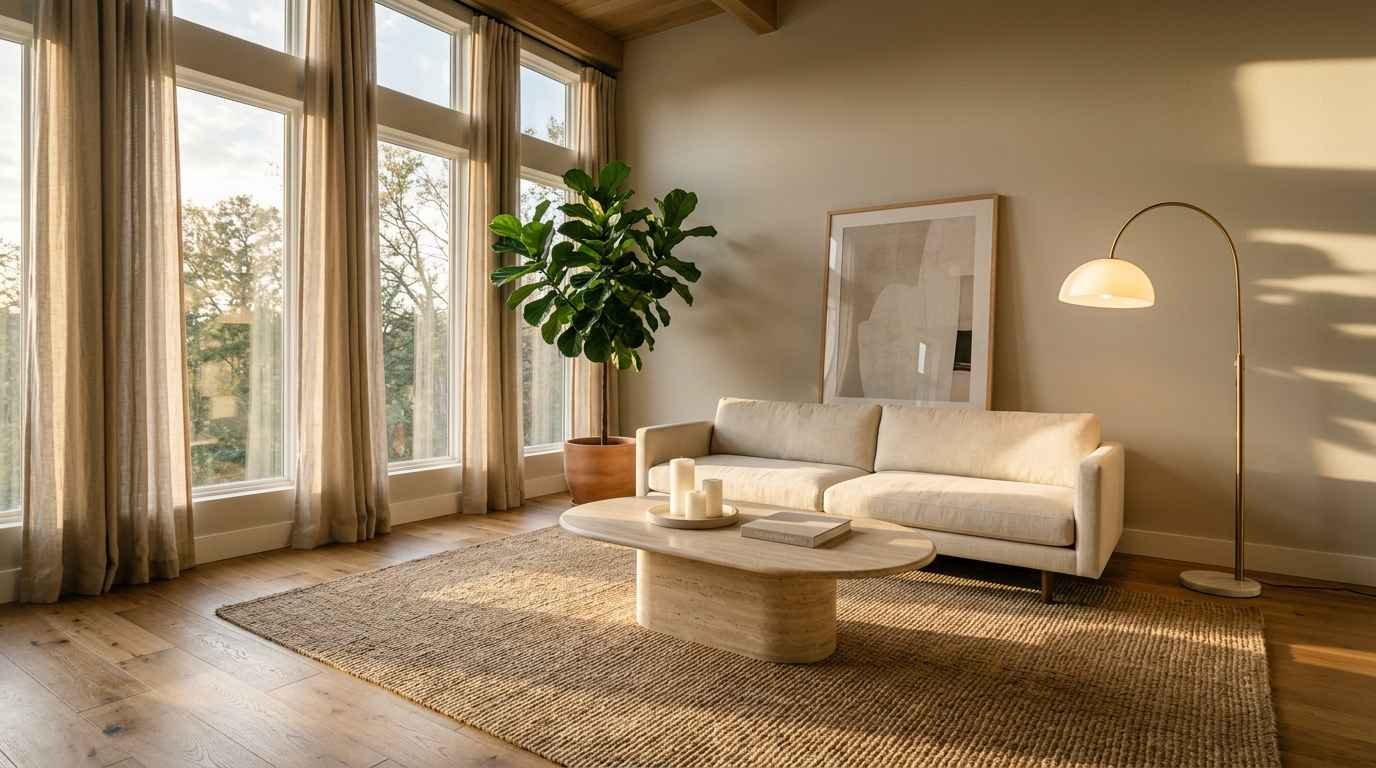
My first attempt at a “cozy minimalist” living room looked like a waiting room at a dental clinic.
White walls, one sad succulent, a couch I found on Facebook Marketplace. I thought I was being minimal. I was just being bleak.
The thing is, cozy minimalism is a very specific skill. You’re trying to hold 2 things at once: the calm of an uncluttered room and the warmth of a space that actually feels like home.
Too far in either direction and you lose the plot entirely. I’ve now spent the better part of 3 years fine-tuning this, and I can tell you, it clicks once you stop thinking about removing things and start thinking about choosing things.
These 30 ideas are what actually moved the needle for me.
Start with the walls: your most underused canvas
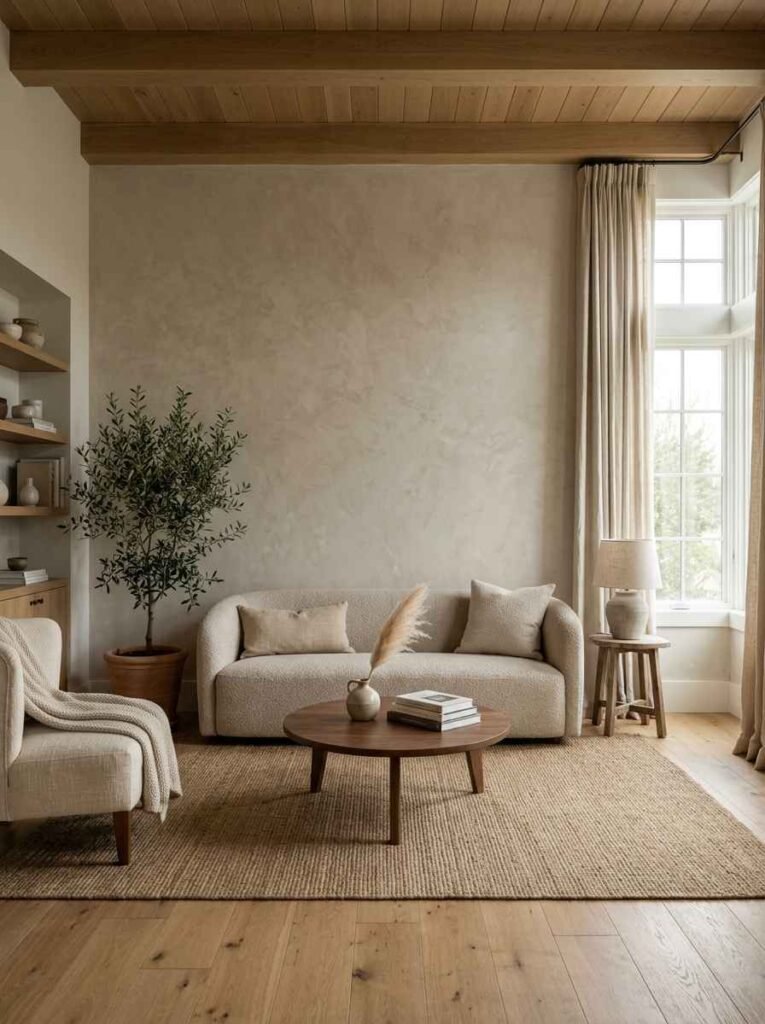
Most people pick paint last. They furnish everything, hang a few things, then paint whatever’s left visible. Wrong order.
Your wall color sets the emotional temperature of the whole room, and in a minimalist space where you have less stuff competing for attention, that color does a LOT of work.
I’d strongly recommend looking at Farrow & Ball’s neutral palette before you commit to anything.
Their “Elephant’s Breath” and “Pavilion Gray” have a warmth that standard builder’s white simply doesn’t.
1. Go warm white, not bright white
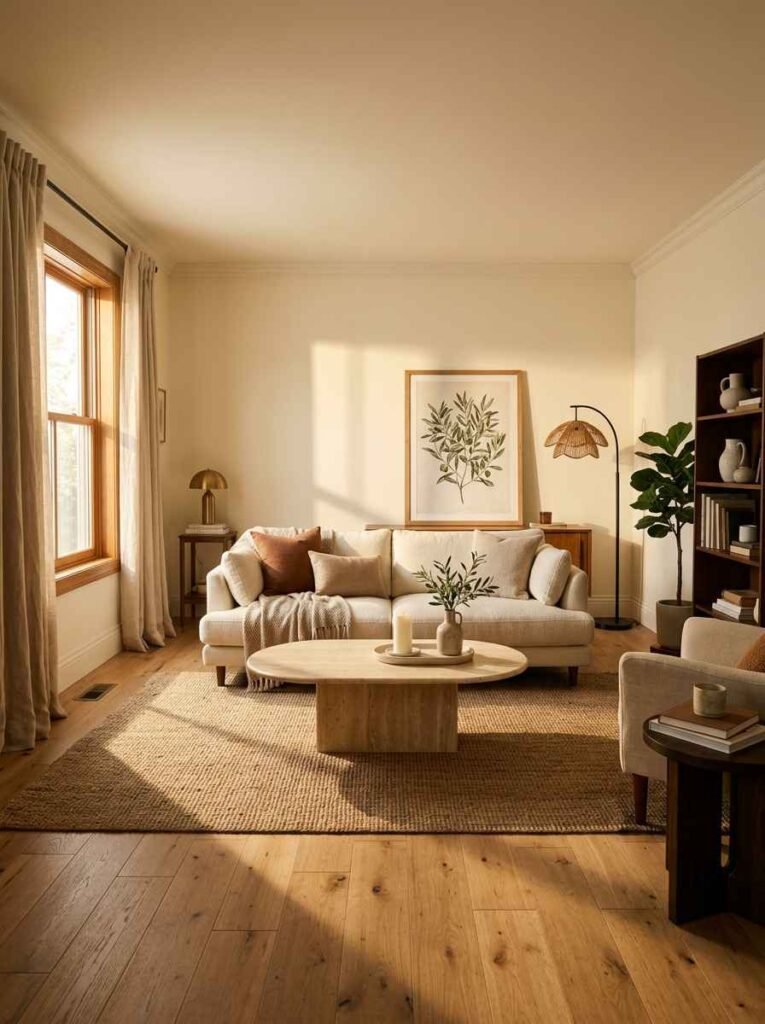
Bright white is sharp. It photographs well but it doesn’t hug you when you sit down.
Warm whites (think cream, linen, aged paper) absorb light differently, especially in late afternoon sun, and the room reads as intentional rather than sterile.
2. Try limewash for texture without clutter
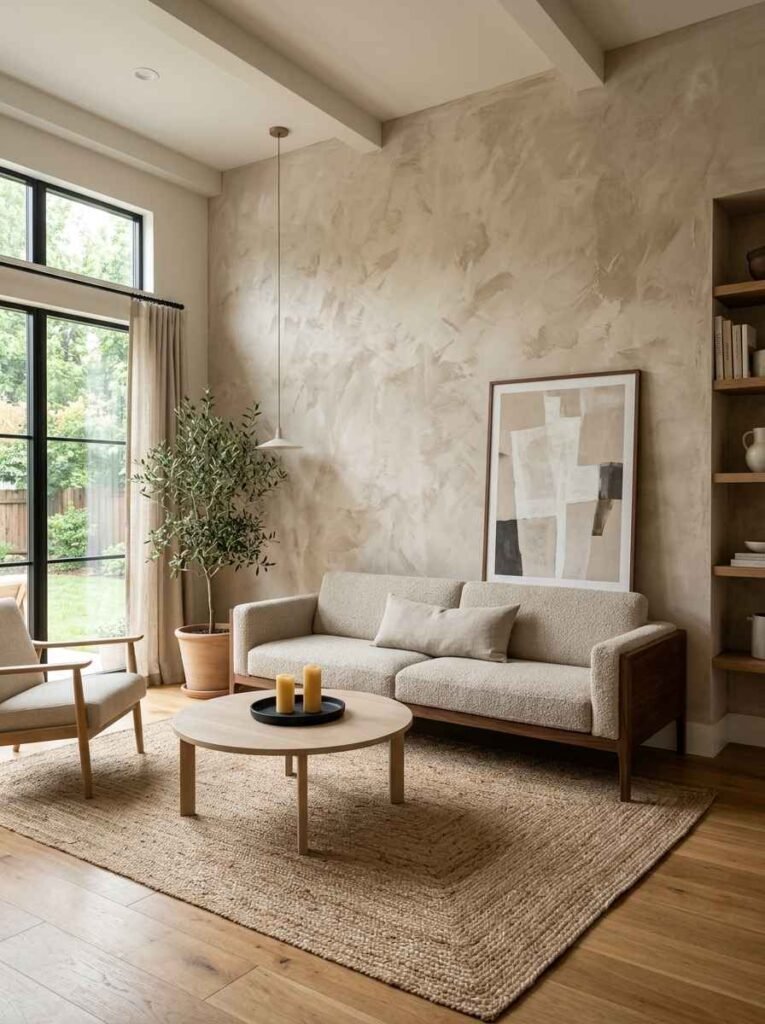
Limewash paint is having a full moment, and honestly, it deserves it. It adds texture and dimension to a flat wall, so the room feels layered even when you have barely anything on the shelves.
One accent wall done in limewash can completely shift a room’s personality.
3. Use a single moody tone in a reading corner
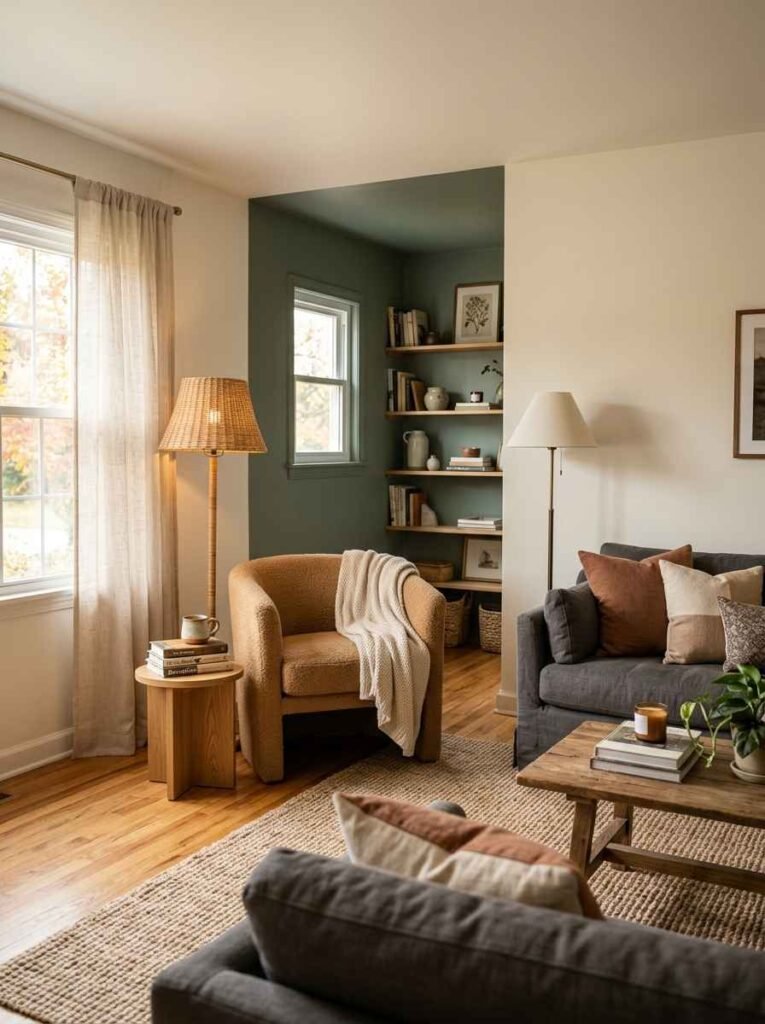
Paint one corner (just one, please) in something deeper. A dusty sage, a muted terracotta, or a warm slate.
It creates a visual destination and makes the rest of the room feel even lighter by contrast.
The sofa situation
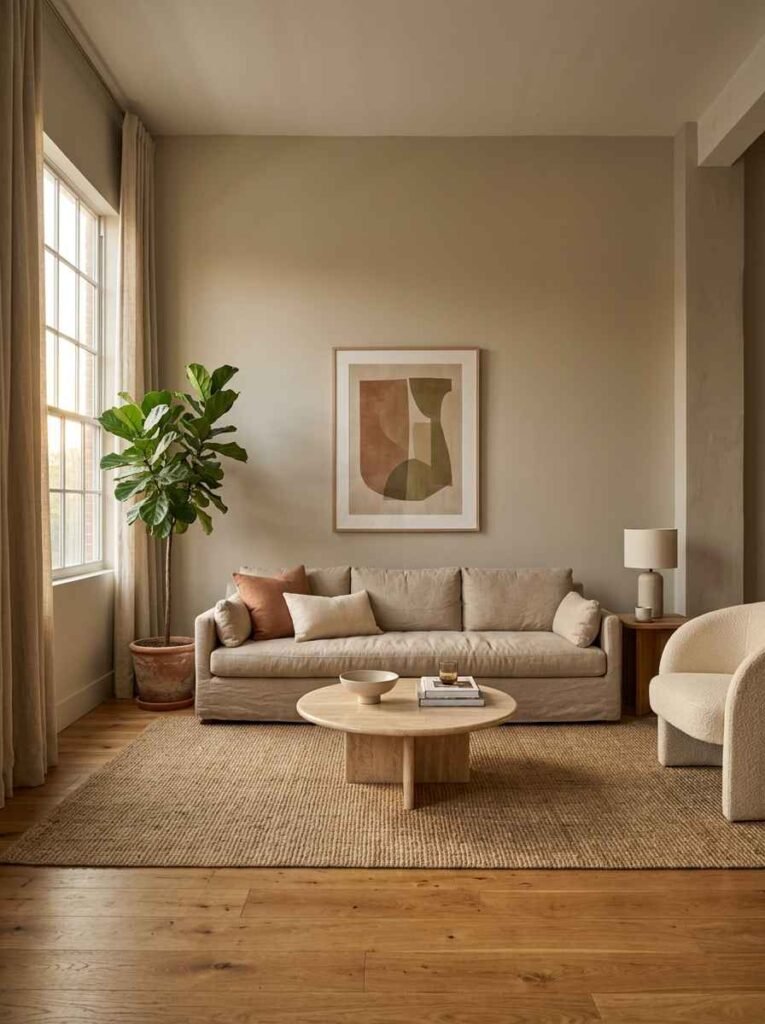
Your sofa is probably the biggest decision you’ll make in this room. And in a cozy minimalist space,
you don’t want more than 1 large sofa plus maybe a single accent chair. The temptation to add a loveseat, an armchair, an ottoman, two side chairs… resist it.
4. Linen or boucle, always
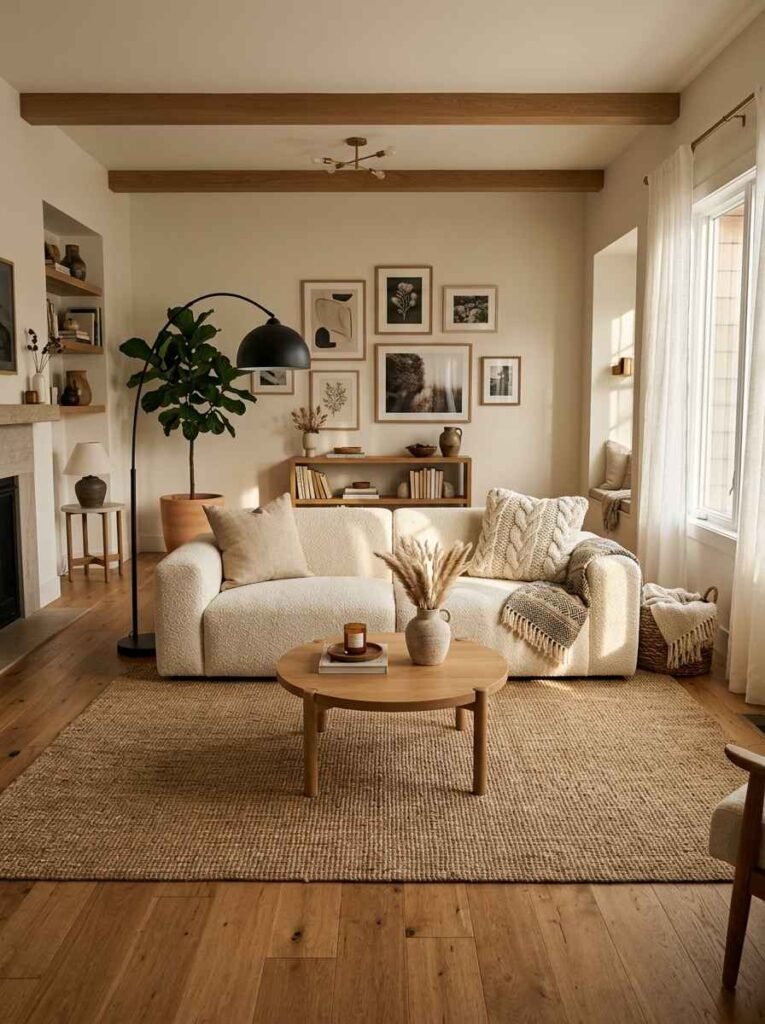
These 2 fabrics are doing the heavy lifting for cozy minimalism right now. Linen breathes, wrinkles beautifully, and ages well.
Boucle is softer and more textural. Both photograph extraordinarily well for Pinterest, FYI, which I’m guessing matters to you since you’re here.
5. Neutral tones with one honest texture
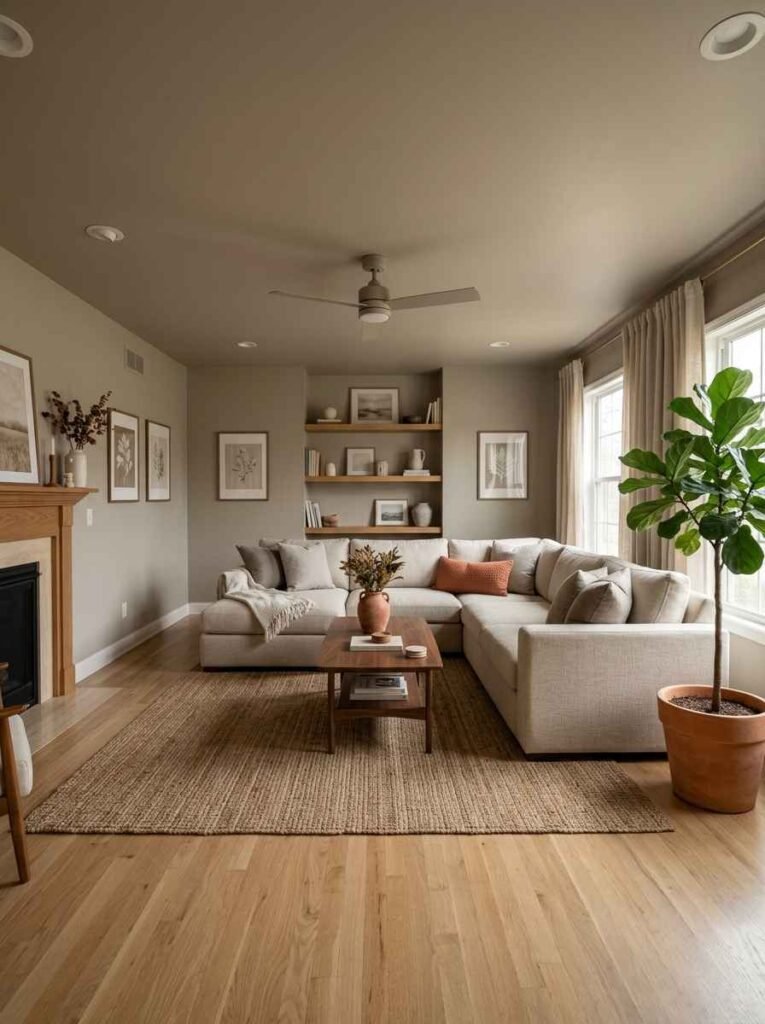
Skip the pattern. A textured solid, whether a chunky weave or a subtle herringbone, gives your eye somewhere to rest without the busyness of print.
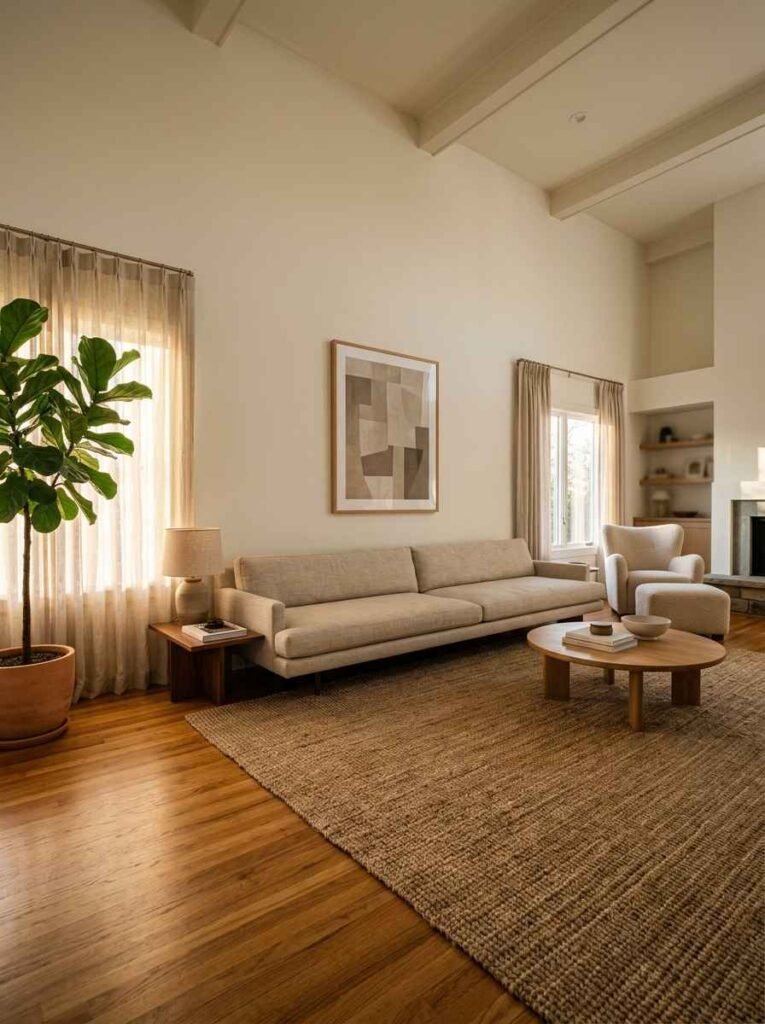
6. Low profile and long
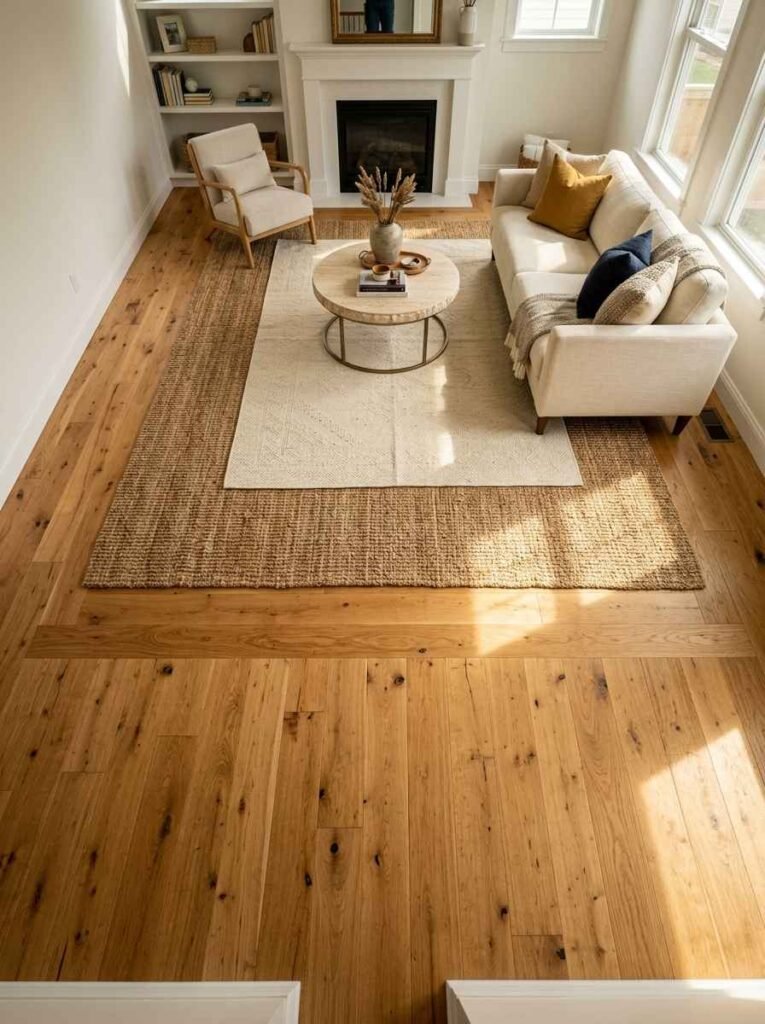
A low, long sofa (think 3 seats minimum) makes a room feel more spacious because it doesn’t interrupt the sight line the way a tall, overstuffed one does.
Brands like Article make decent ones at a non-insane price point.
Flooring and rugs: the stuff underfoot matters more than people think
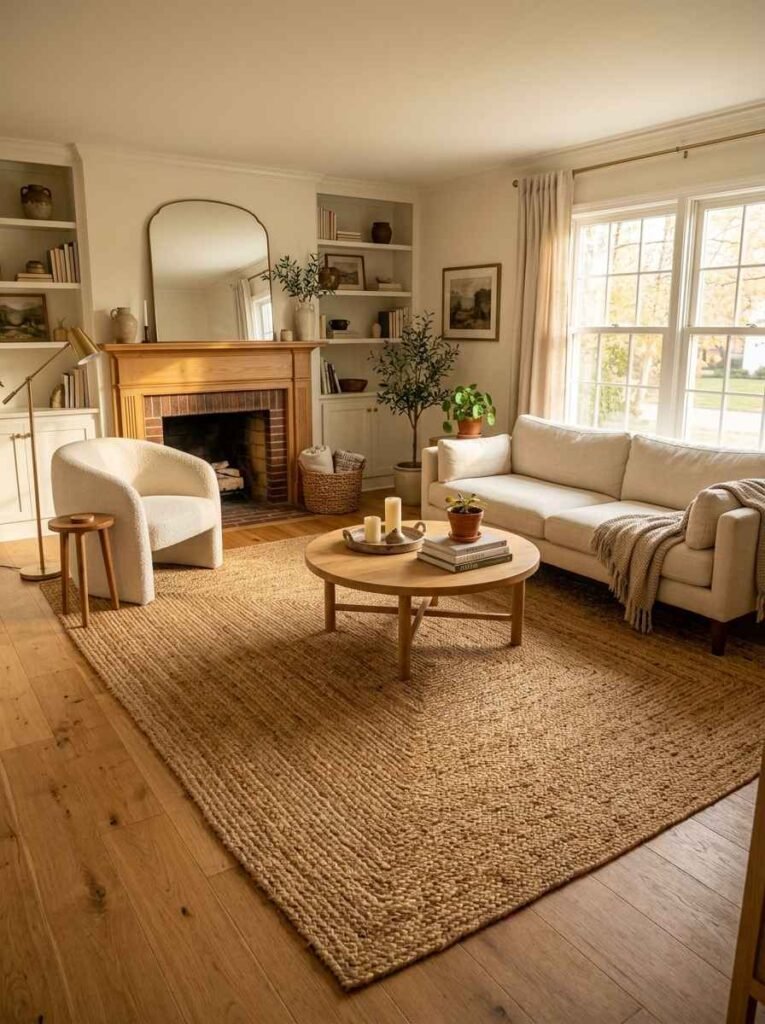
I used to ignore the floor. I’d obsess over a perfect throw pillow and then stand on cold hardwood in socks wondering why the room felt “off.” The floor is 30% of what you see when you walk in. Give it some thought.
7. Natural fiber rugs tie everything together
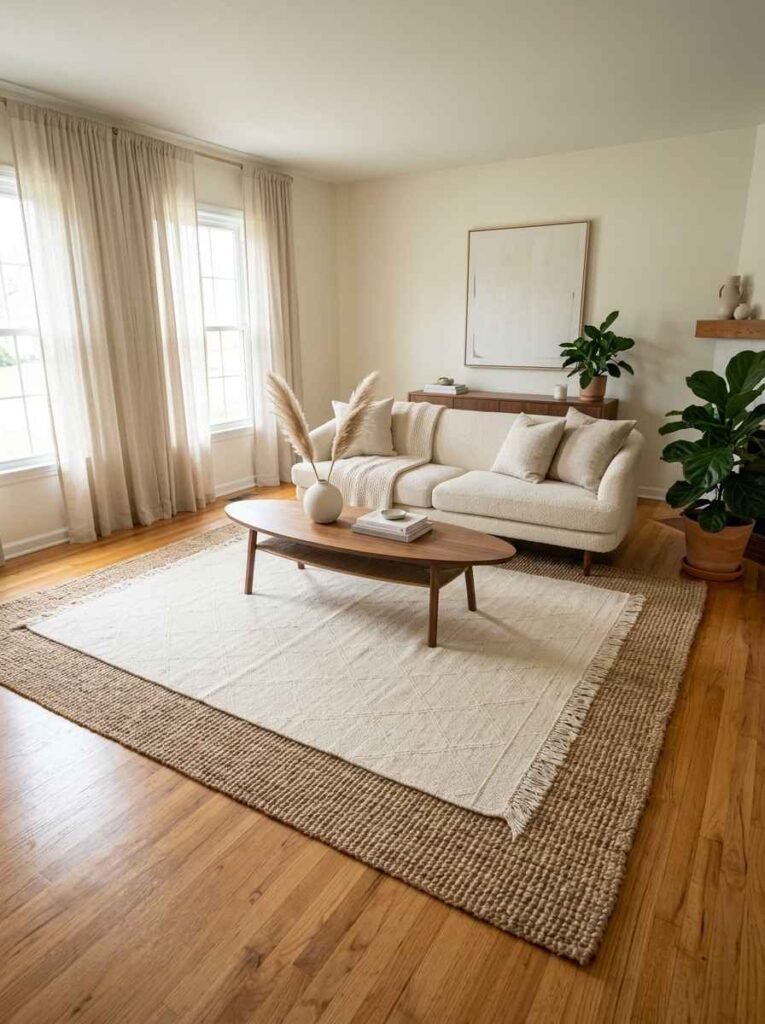
Jute and sisal rugs are the workhorses of cozy minimalism. They’re neutral, they add warmth, and they don’t compete with anything.
A 9×12 jute rug under a sofa and coffee table is probably the single best thing you can spend $200 on in a living room.
8. Layer two rugs for depth
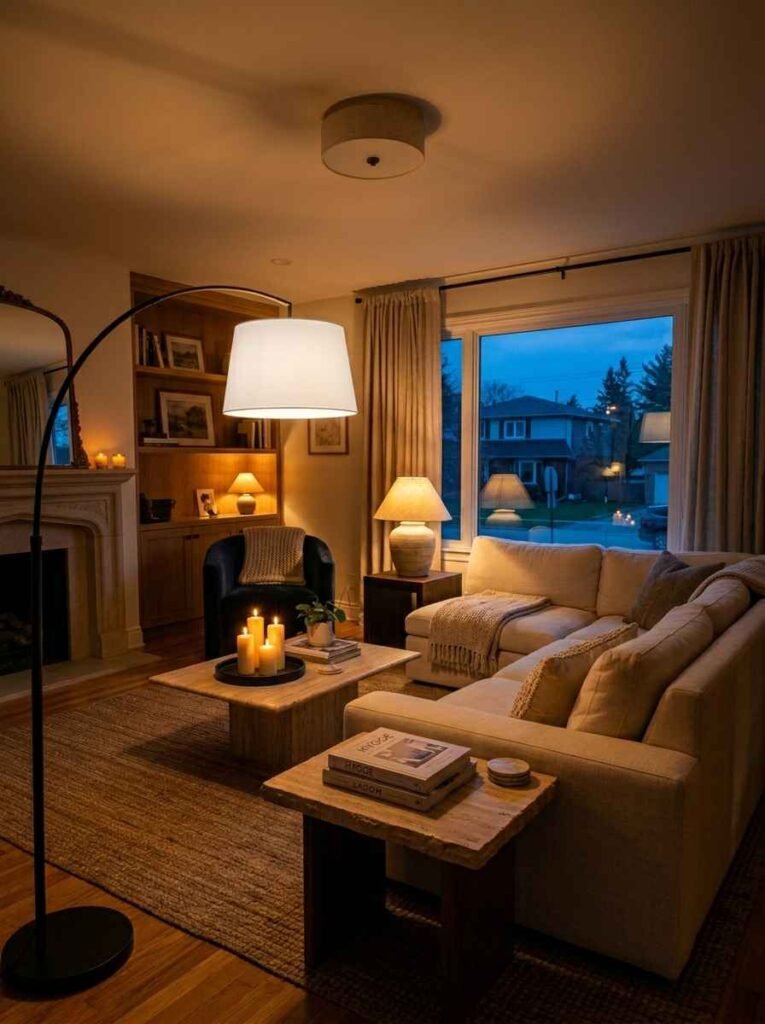
Put a smaller, softer rug (wool, cotton, or a flat weave) on top of the larger natural fiber one. The layering adds visual warmth and the different textures make the floor feel considered rather than just covered.
9. Let hardwood breathe at the edges
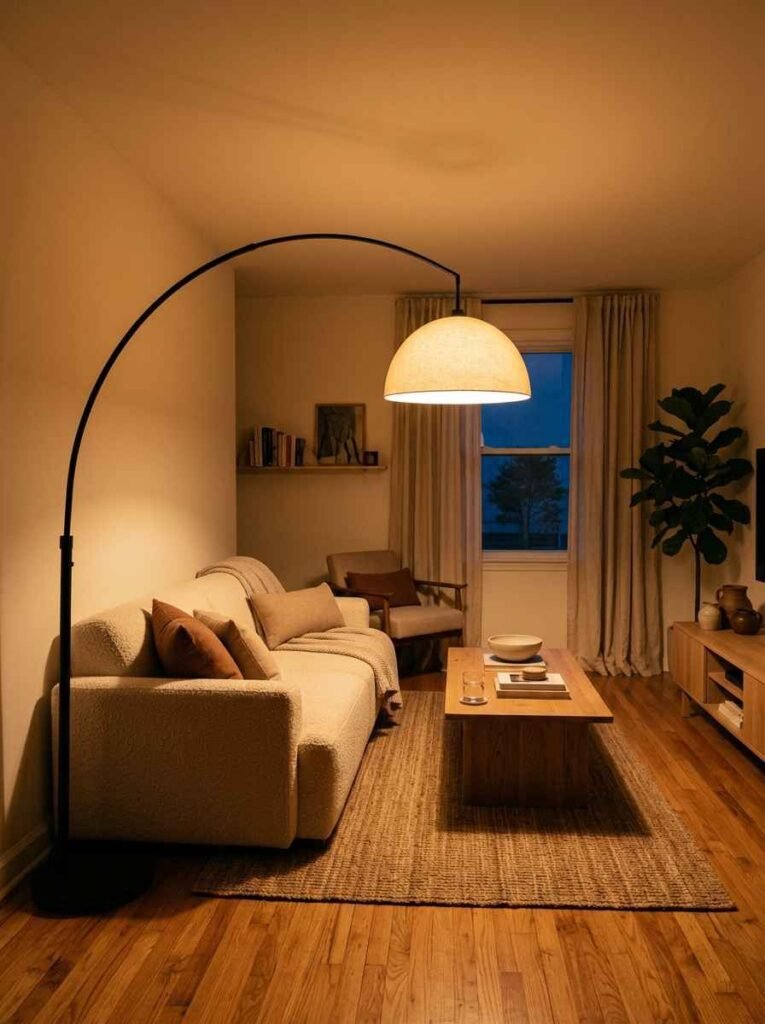
Don’t cover the whole floor. The exposed hardwood around the rug’s perimeter frames the seating area and keeps the room from feeling carpeted-over and heavy.
Lighting: probably the most overlooked part
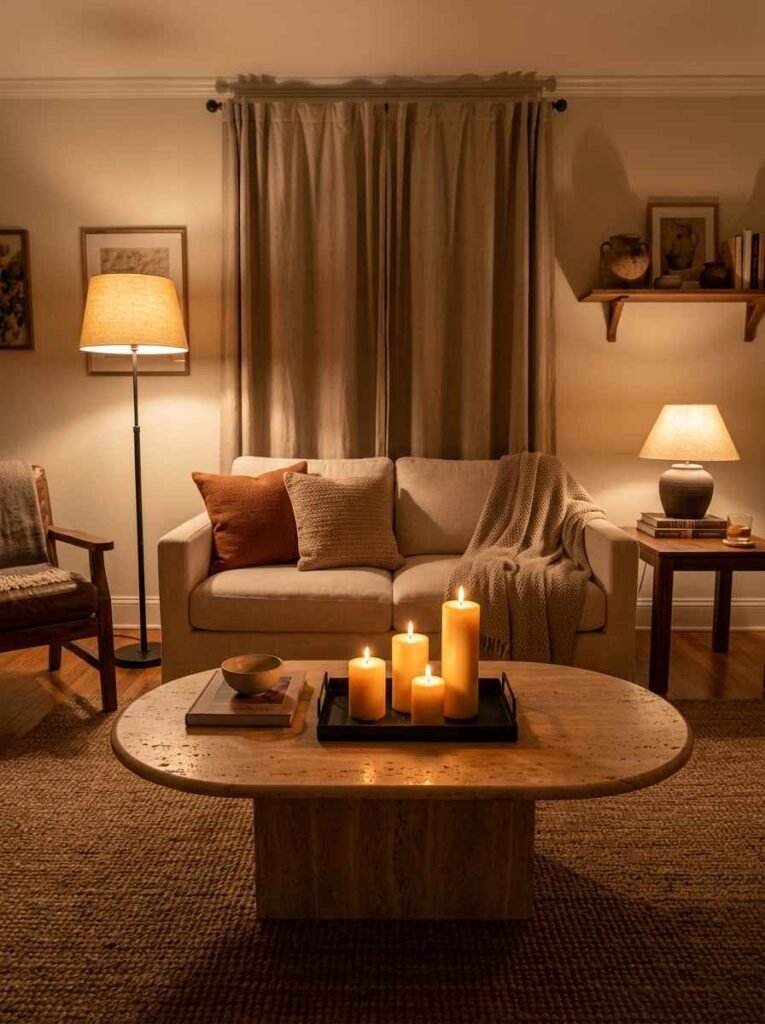
Here’s where I think most living room makeovers fail. The furniture is good, the color is right, but the lighting is still 1 overhead fixture on a dimmer switch, and the room looks like a stage set at half power.
Cozy minimalism needs layered light: something overhead that diffuses softly, something at table level for ambiance, and ideally something on or near the floor.
10. Warm bulbs, always (2700K or below)
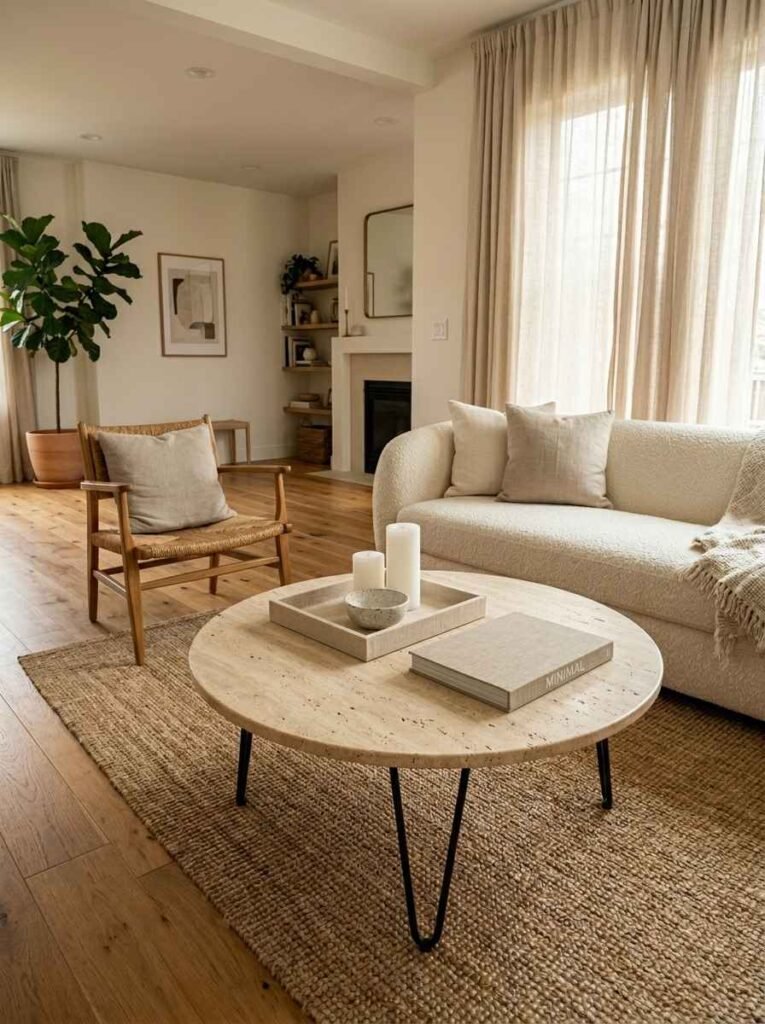
Go buy 2700K LED bulbs right now if you haven’t. Daylight bulbs (5000K+) are for garages and hospitals. You want the warm amber glow that makes everyone in the room look slightly better than they actually do.
11. A sculptural floor lamp over ambient overhead
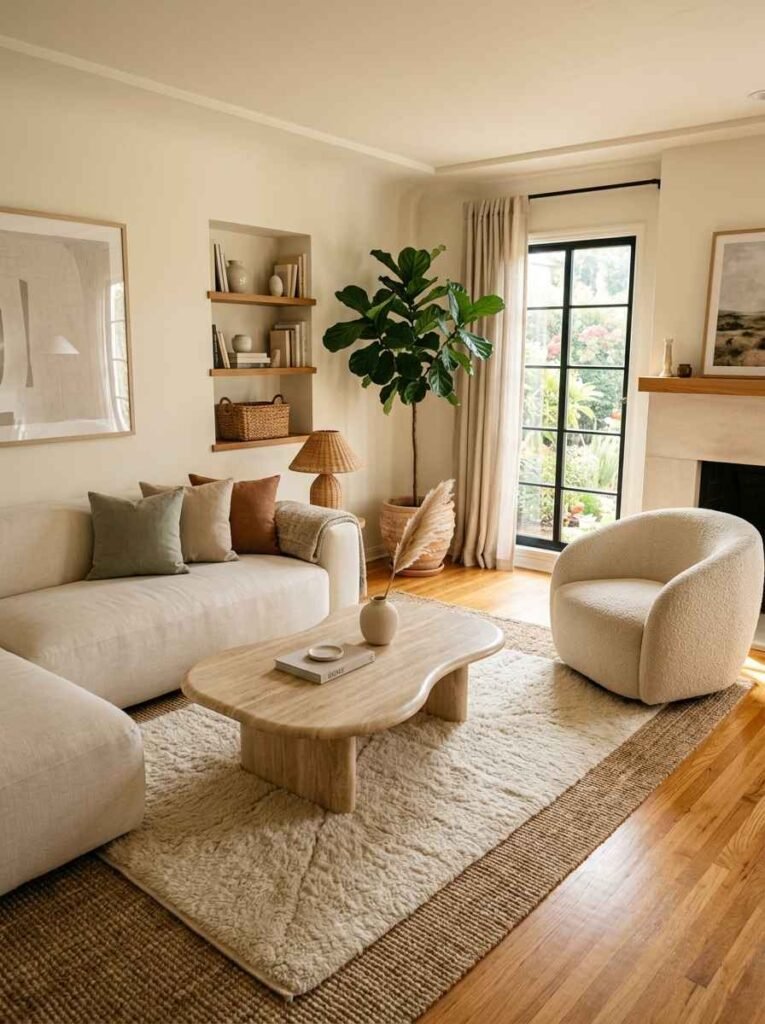
A single, well-chosen floor lamp (arc style, or a rattan drum shade) does more for a cozy living room than a $600 overhead fixture. It creates a pool of warm light at eye level and a sense of intimacy. CB2 has a few consistently good ones.
12. Candles count as decor and lighting
I know this sounds obvious, but grouping 3 or 4 pillar candles of different heights on a tray on your coffee table is both a decor moment AND a lighting source.
Lit in the evening, they shift the room into something genuinely warm and a little cinematic. The unlit version still looks great during the day.
13. Dimmers on everything possible
If your place has standard switches, swap them for dimmers. It takes about 20 minutes per switch if you’re comfortable with basic electrical work. The ability to drop your lights to 40% in the evening is transformational.
Coffee tables and side tables: less surface, more intention
Minimalism collapses fast around flat surfaces.
A coffee table becomes a dumping ground for remotes, books, candles, coasters, a random charging cable, and suddenly it’s chaos on a low platform. The fix is curation, not removal.
14. The “rule” I actually follow: 3 objects per surface
A tray, a candle, and one object with personal meaning (a small sculpture, a found stone, a book you love).
That’s it. The tray contains the first 2, so visually it reads as 2 items. Clean, intentional, warm.
15. Try a curved coffee table
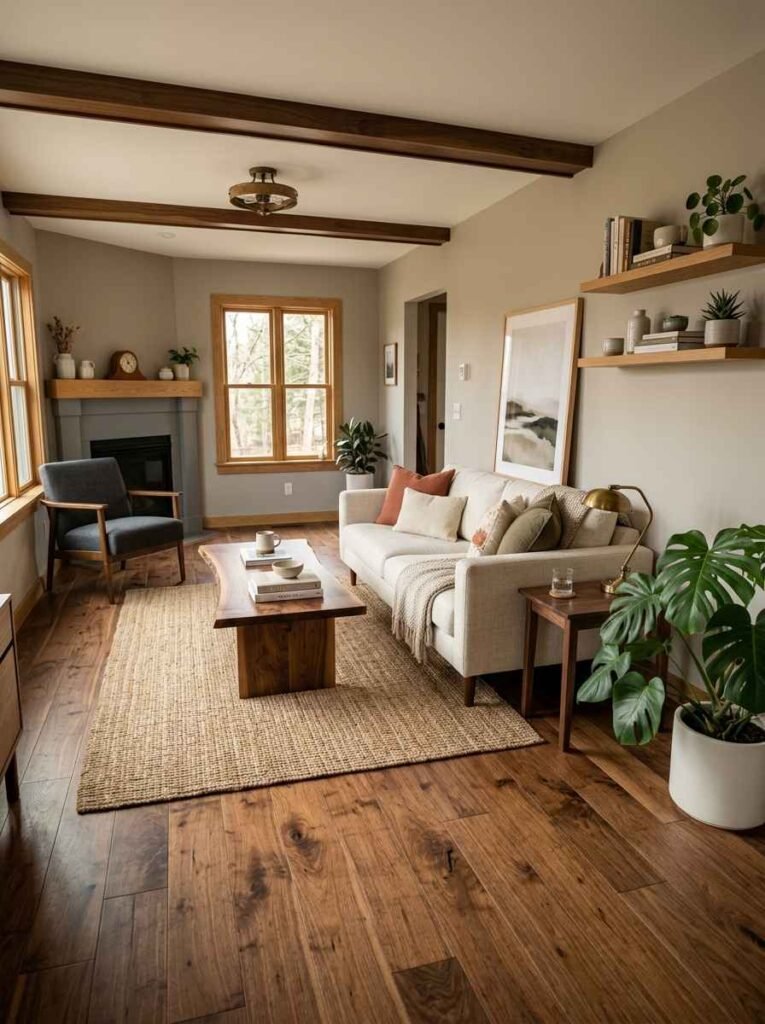
Rectangular coffee tables are everywhere. A round or oval one instantly softens the whole room, and in a minimalist space where you’re already working with few pieces, that softness reads clearly. It also makes the seating arrangement feel less boardroom-like.
16. Open shelving underneath for storage that stays invisible
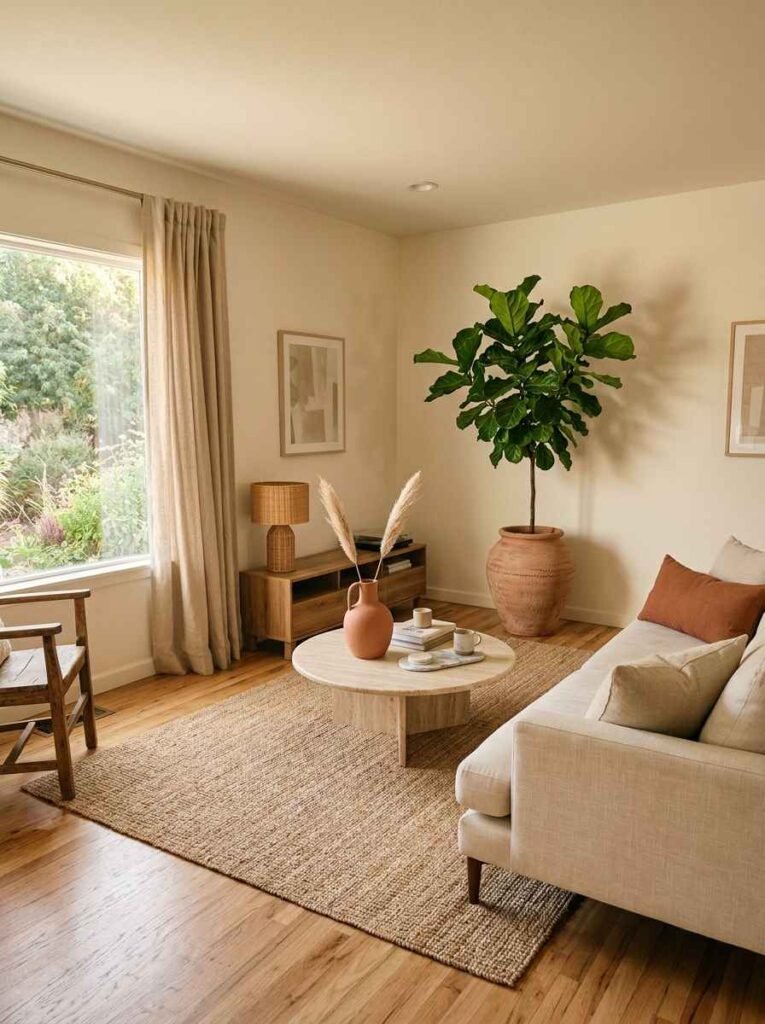
A coffee table with a lower shelf (or open base) lets you store books, a throw, a basket of remotes without visible clutter. The key is keeping it organized because it’s still visible, just lower.
Baskets are your friend here.
Shelving and storage: the real test of minimalist commitment
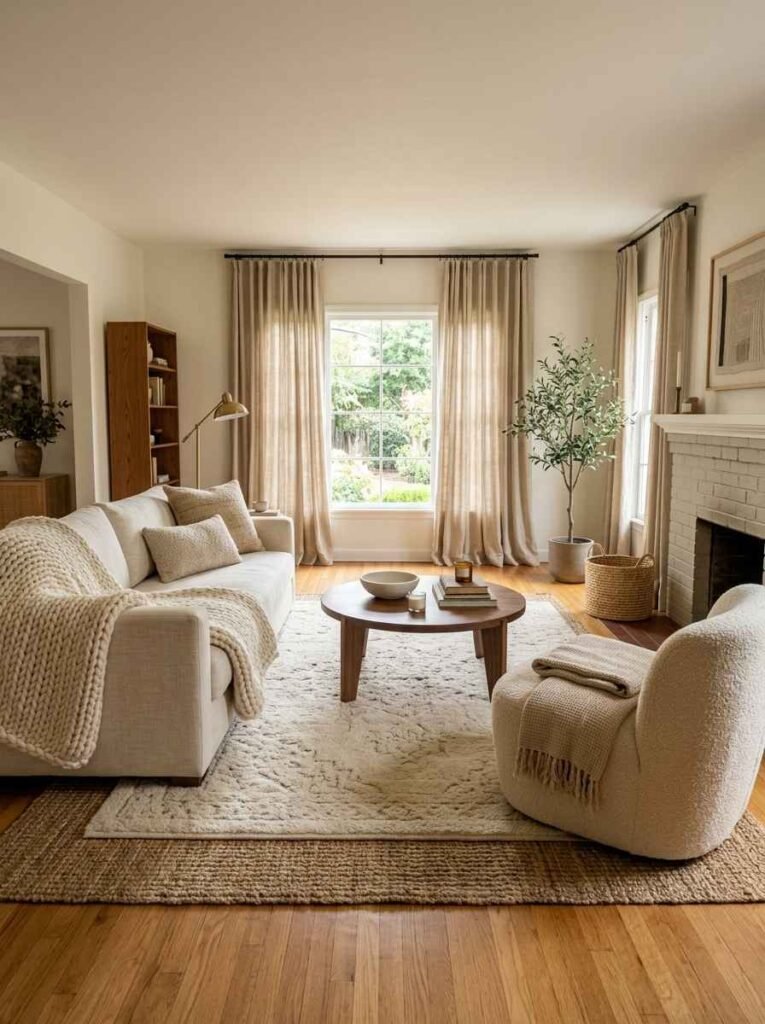
Walk into any “minimalist” room on Pinterest and count the books and objects. I’ll wait. The shelves are always considered. There’s negative space. Things are placed, not stacked.
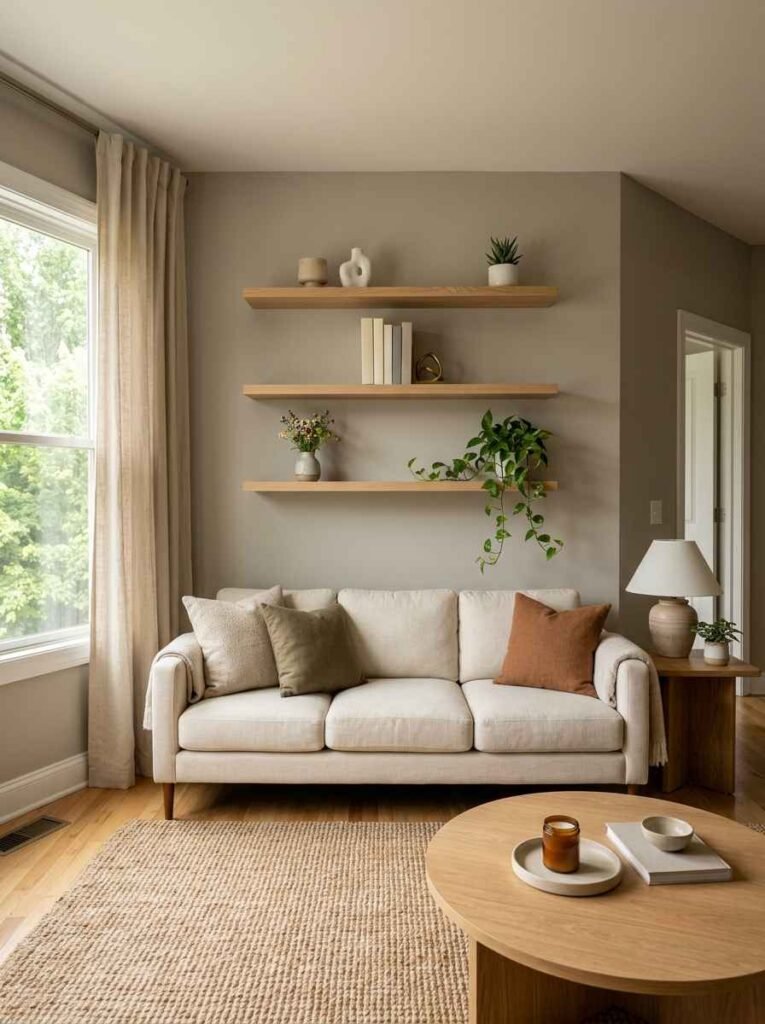
17. Float your shelves high
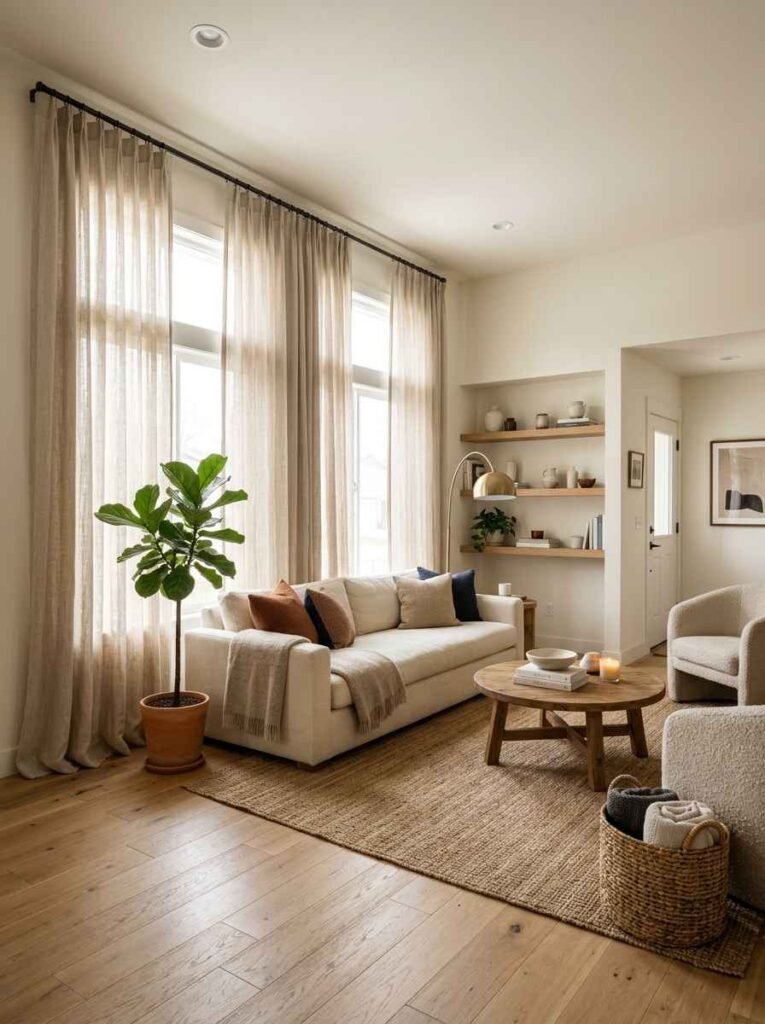
Floating shelves at or above eye level draw the gaze up and make ceilings feel taller. They also keep clutter physically removed from the main sight line.
Style them with 40% empty space, which sounds like a lot until you actually try it and realize it looks intentional rather than sparse.
18. Built-in storage beats freestanding furniture
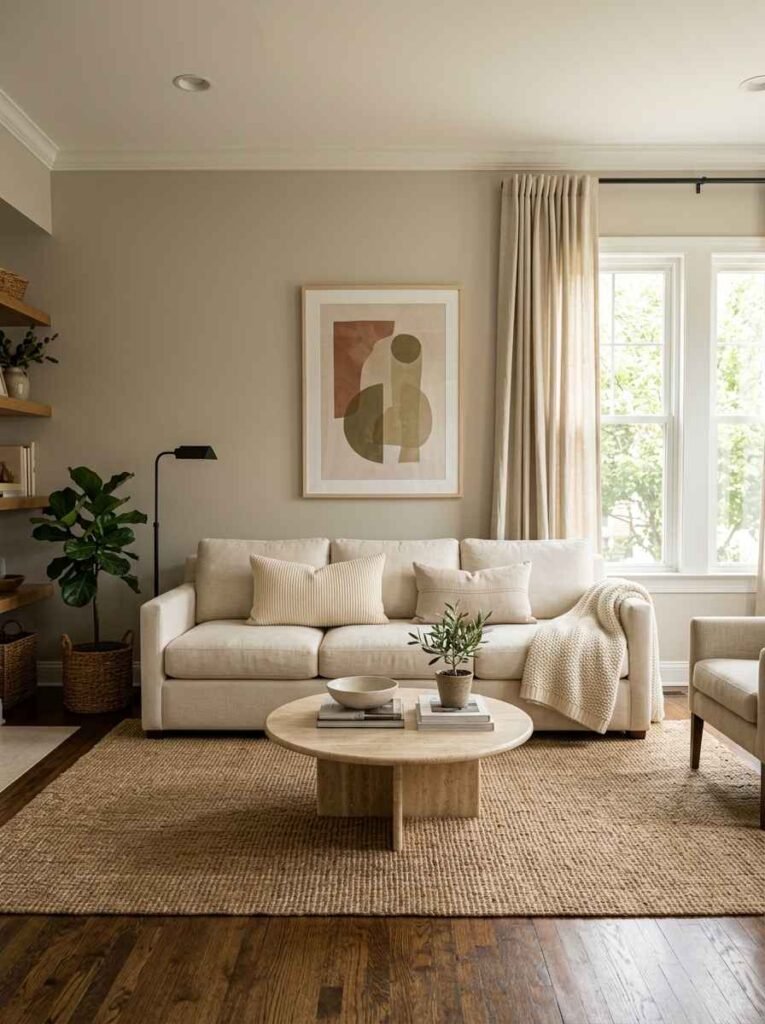
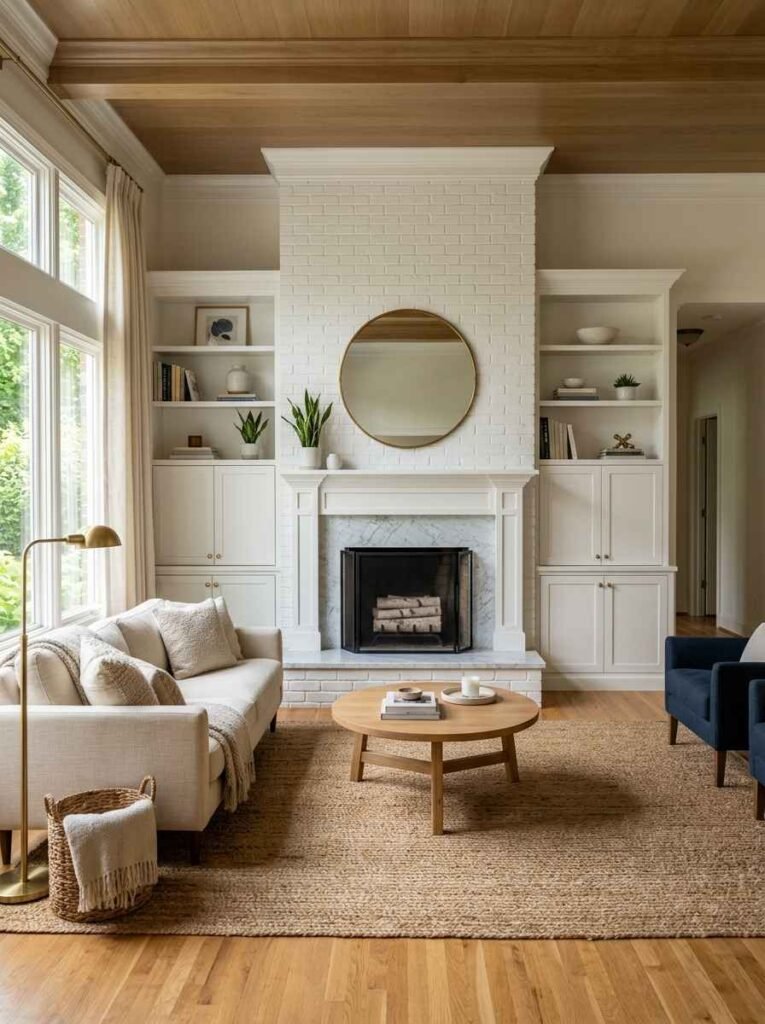
If you’re doing any renovation, built-in cabinets on either side of a fireplace or TV are the single best investment for a cozy minimalist room. Everything hides. The room stays calm. And built-ins read as part of the architecture, not as furniture you accumulated.
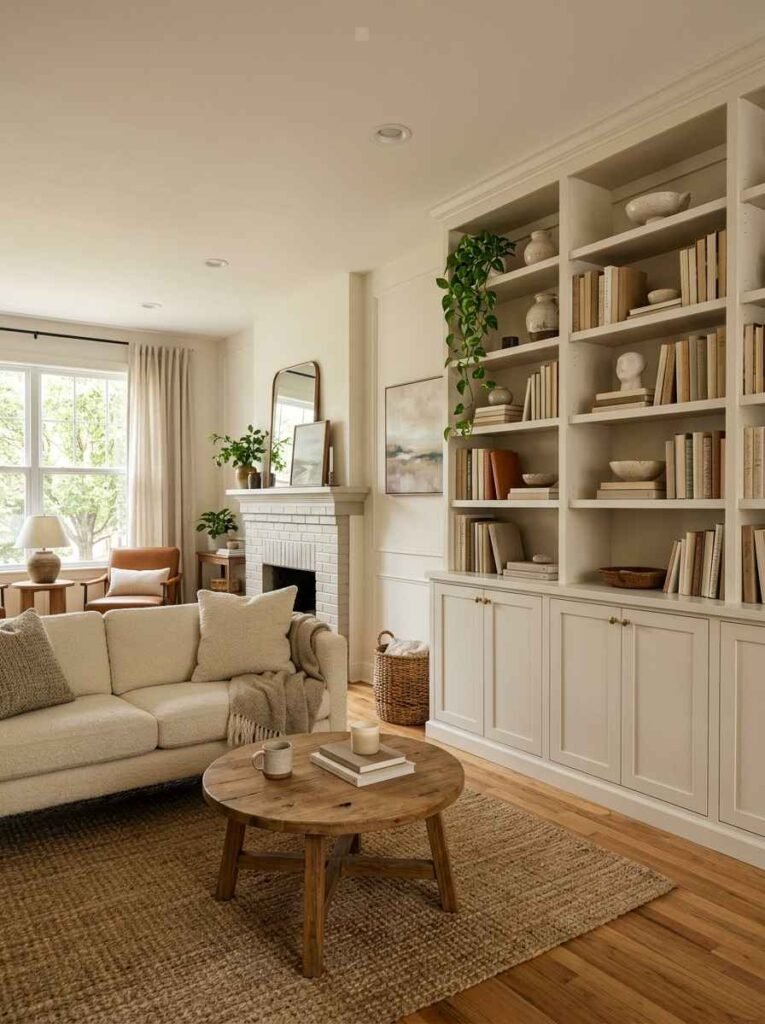
19. One bookshelf, fully committed
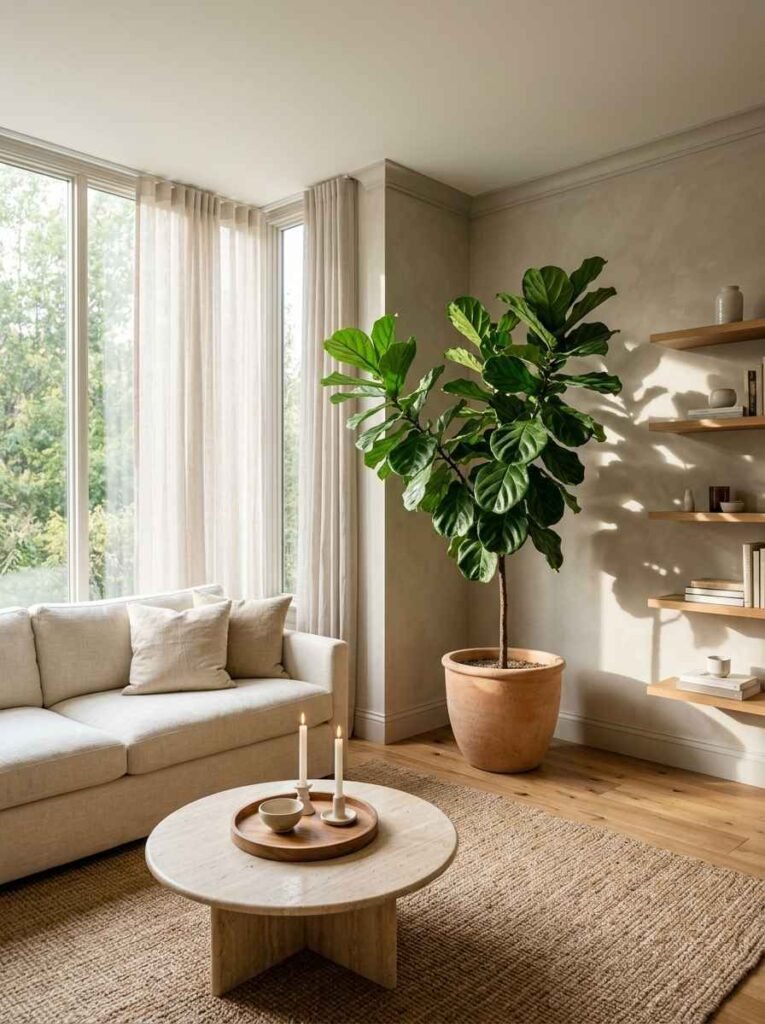
I’m a bit obsessive about this: one great bookshelf styled with books, a few objects, and some breathing room is so much better than 3 understyled ones scattered around.
The IKEA Billy with Oxberg doors gives you a clean front while hiding the chaos inside. Honestly a classic for a reason.
Color palette: the 60-30-10 approach, loosely
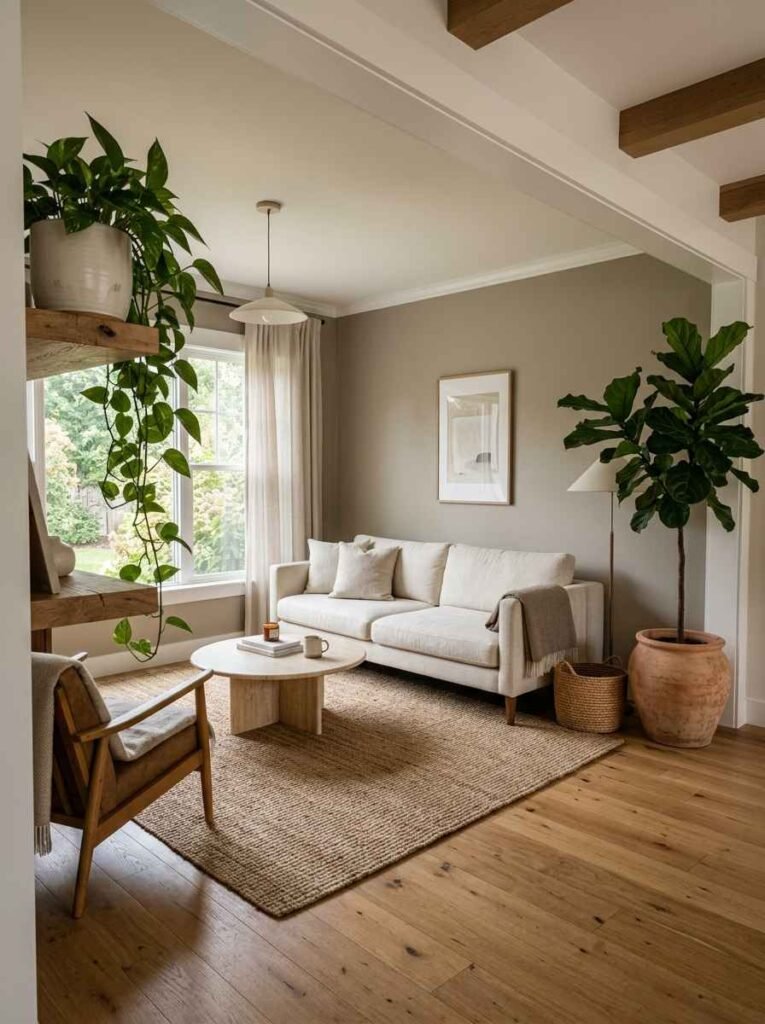
I say “loosely” because rigid rules in decorating tend to produce rooms that feel designed rather than lived-in. But the basic principle is useful.
Quick reference table for cozy minimalist color layering:
| Layer | Percentage | Example |
|---|---|---|
| Base | 60% | Warm white or greige walls |
| Secondary | 30% | Natural wood, linen sofa |
| Accent | 10% | Terracotta pillow, matte black |
20. Warm neutrals as your base
Greige (that gray-beige middle ground) is the most forgiving base for this aesthetic. It reads warm in afternoon light and clean in morning light. You can put almost any accent color against it and it works.
21. Natural wood as your secondary tone
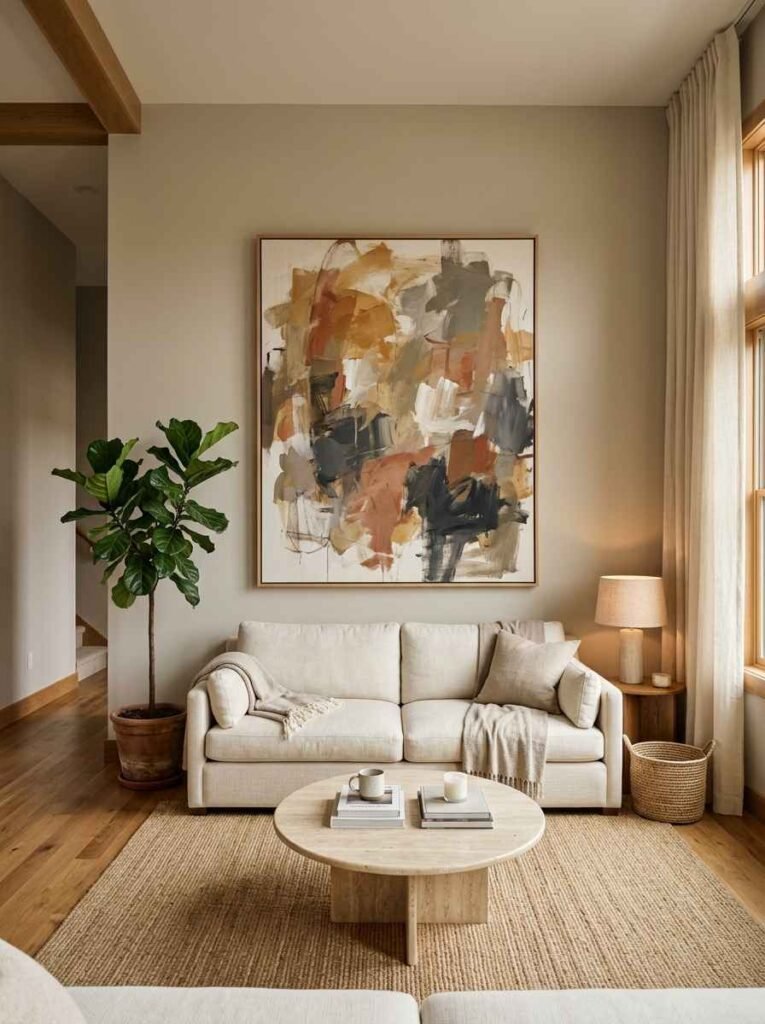
Wood is doing the emotional work here. A walnut coffee table, oak shelving, or even a few small wooden objects scattered around pull warmth into a space that might otherwise read too cool or too gray.
22. One true accent color, max
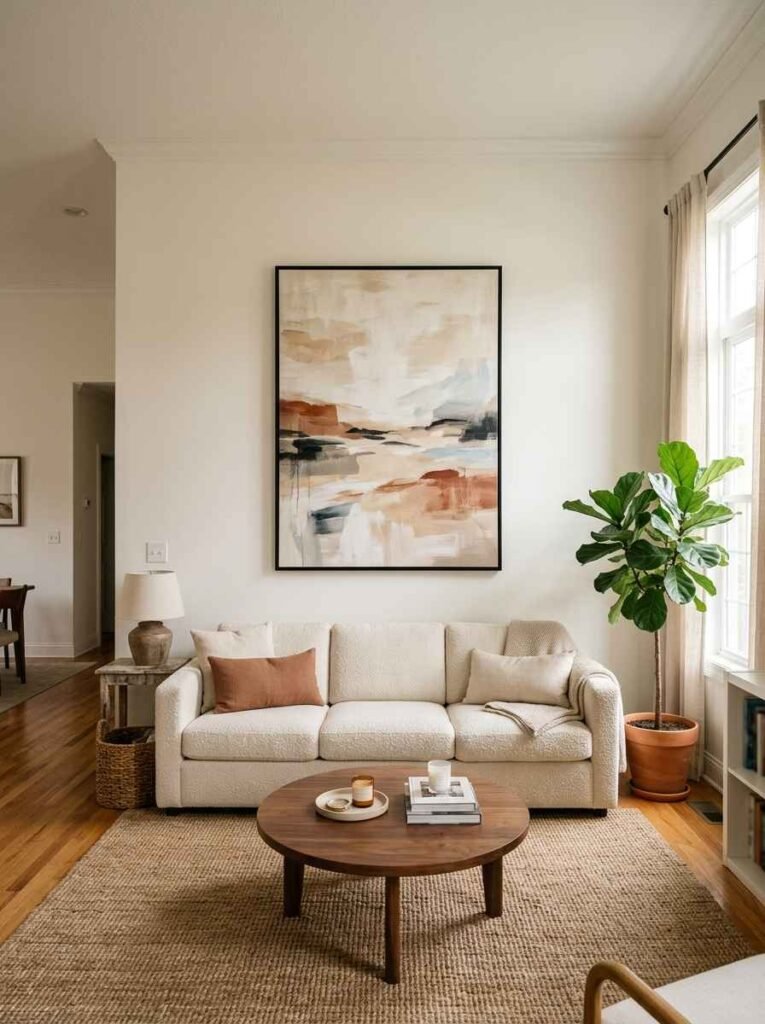
Pick one. Terracotta is currently the most popular (and honestly still looks great). Dusty blue works beautifully. Even a burnt orange can land well. But pick one and repeat it in small doses: a pillow, a vase, maybe the binding of a few books on the shelf.
Textiles: the fastest way to add cozy
Textiles are where a minimalist room earns the “cozy” part of its name. A room with great bones but no textiles feels like a furniture showroom. You need softness.
23. Layer your throws, but edit them down to 2
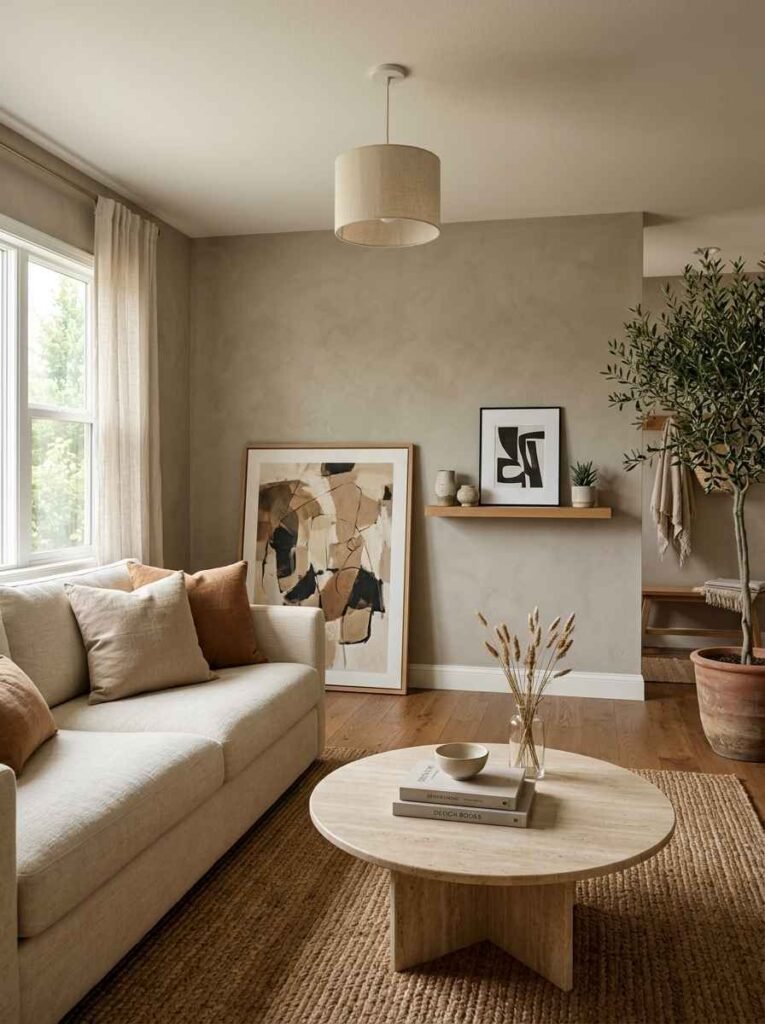
One throw draped over the arm of the sofa, one folded on the end of a chaise or accent chair. Two is the sweet spot. Three starts to look like you’re running a blanket store.
24. Linen curtains floor to ceiling
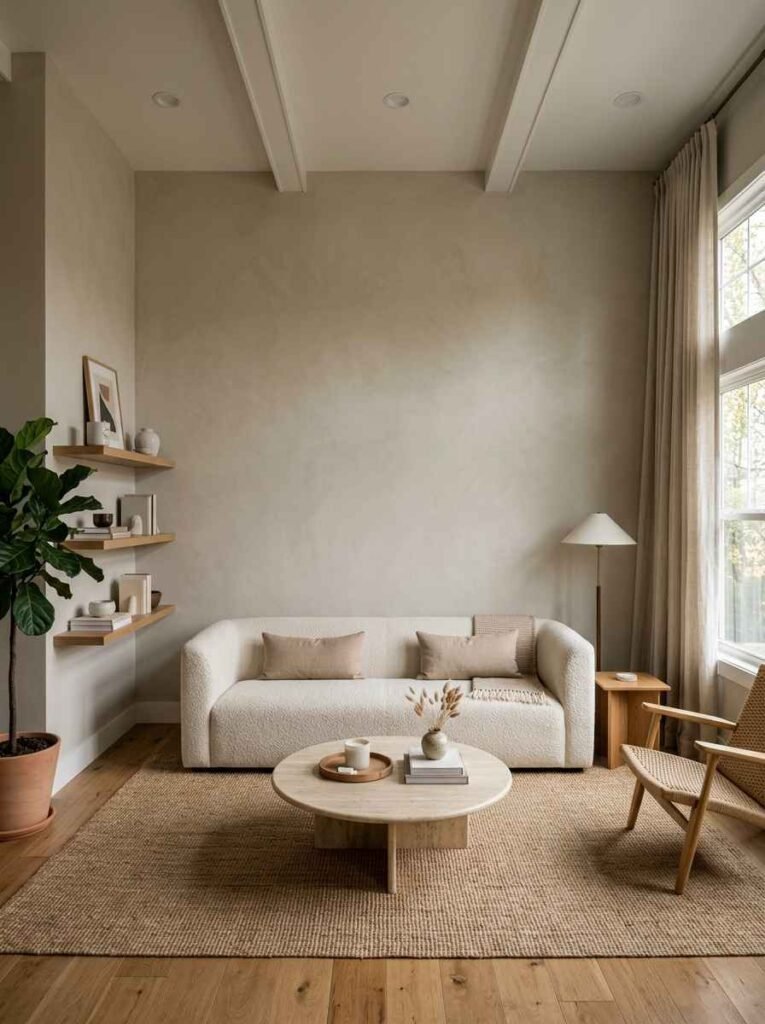
Hang your curtain rod as close to the ceiling as possible, and let the curtains fall to the floor. The unbroken vertical line makes the room feel tall and airy, even if your ceilings are standard height. Natural linen, loosely hung, has a beautiful drape that no synthetic fabric replicates.
25. Lumbar pillows over square throw pillows
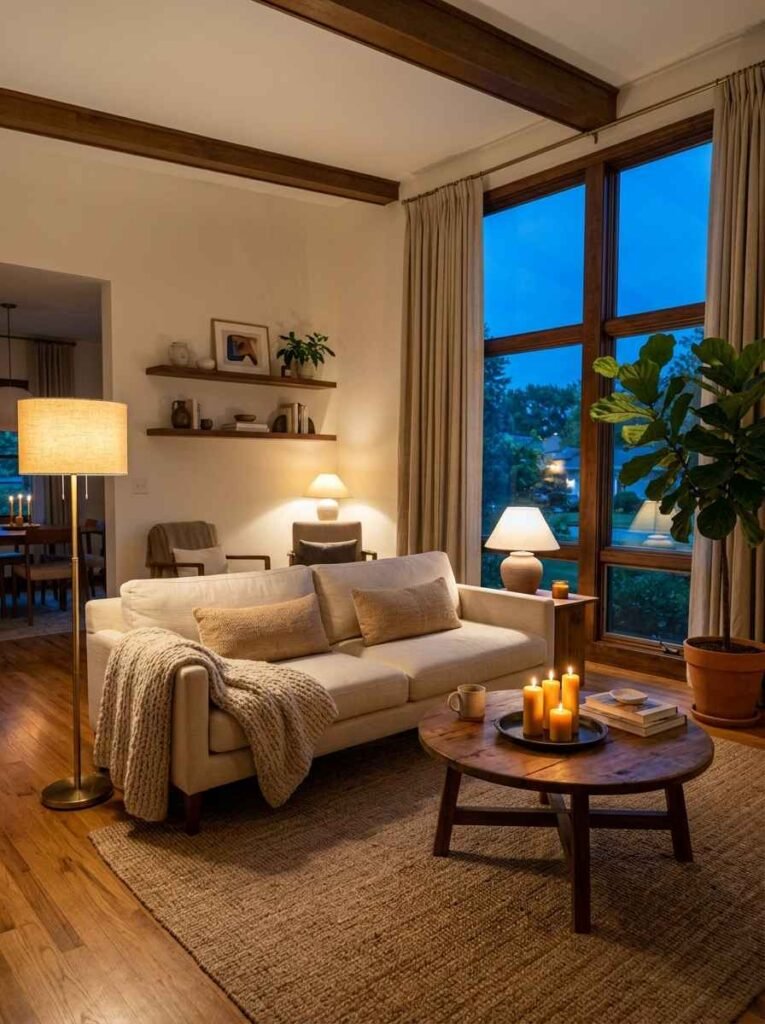
This is IMO the single smallest change with the biggest visual payoff. A lumbar pillow (the long rectangular one) on a sofa reads more considered and less generic than the standard square-pillow-plus-square-pillow-plus-smaller-square arrangement everyone defaults to.
Plants: real ones, not many
I’m going to be direct: fake plants in a cozy minimalist living room look like fake plants. There are about 4 exceptions and most of them are in your local HomeGoods, not actually convincing anyone.
26. One large plant, done well
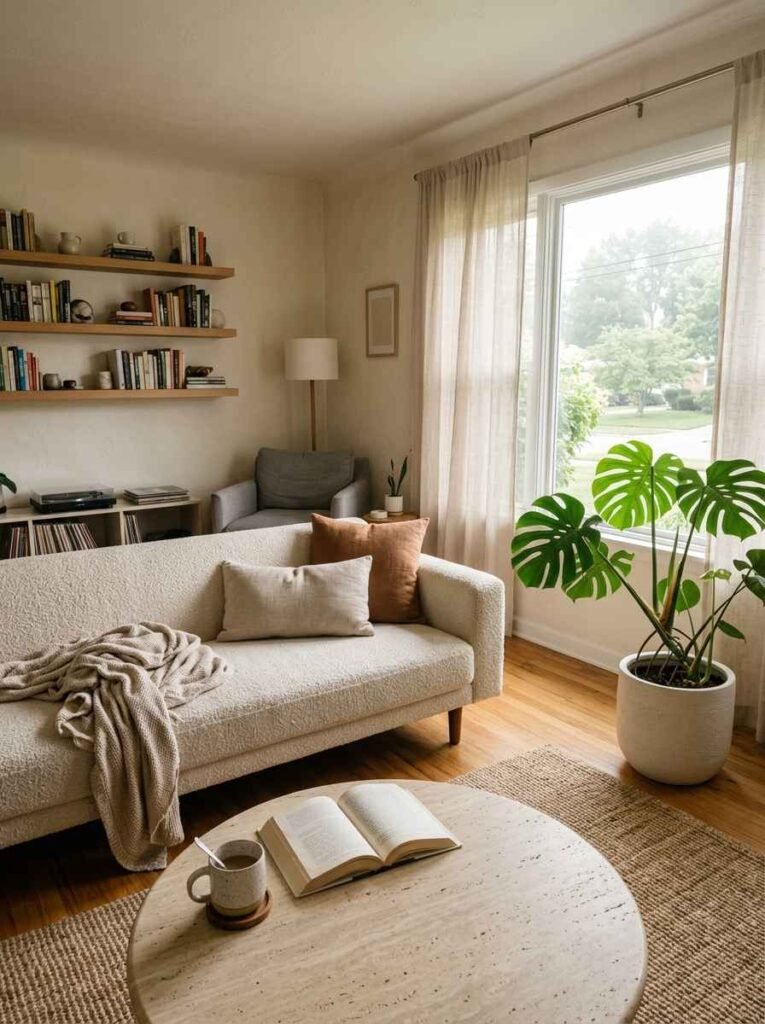
A fiddle leaf fig, a monstera, or a large olive tree in a good pot is worth more to a room than 6 small plants scattered on shelves. Scale matters. One big, healthy plant has presence.
27. The right pot is half the battle
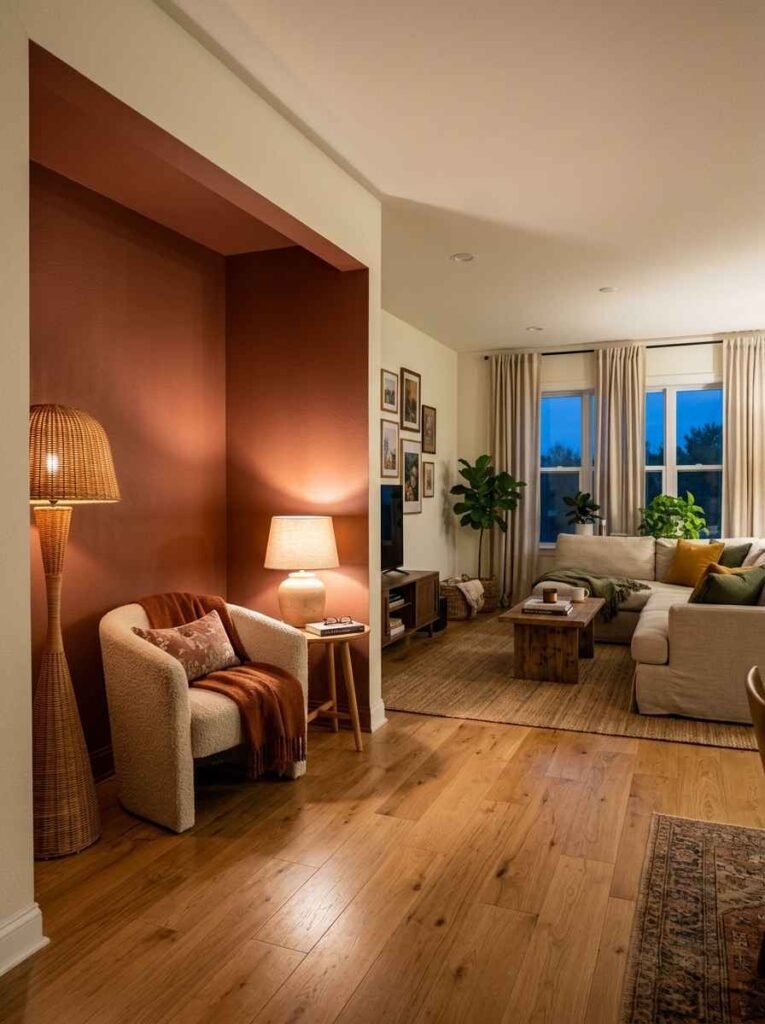
Terracotta (unglazed), matte white, or a hand-thrown ceramic in a warm neutral. That’s the range. Glossy plastic pots undo all the work everything else is doing. The pot is part of the decor.
Art and wall decor: the place where minimalism gets personal
This is where a lot of people freeze. They’re afraid of getting it wrong, so they either hang nothing (too cold) or they buy a 3-panel canvas set from a home goods chain (please don’t). Art is where you earn the “personal” in personal style.
28. One large piece instead of a gallery wall
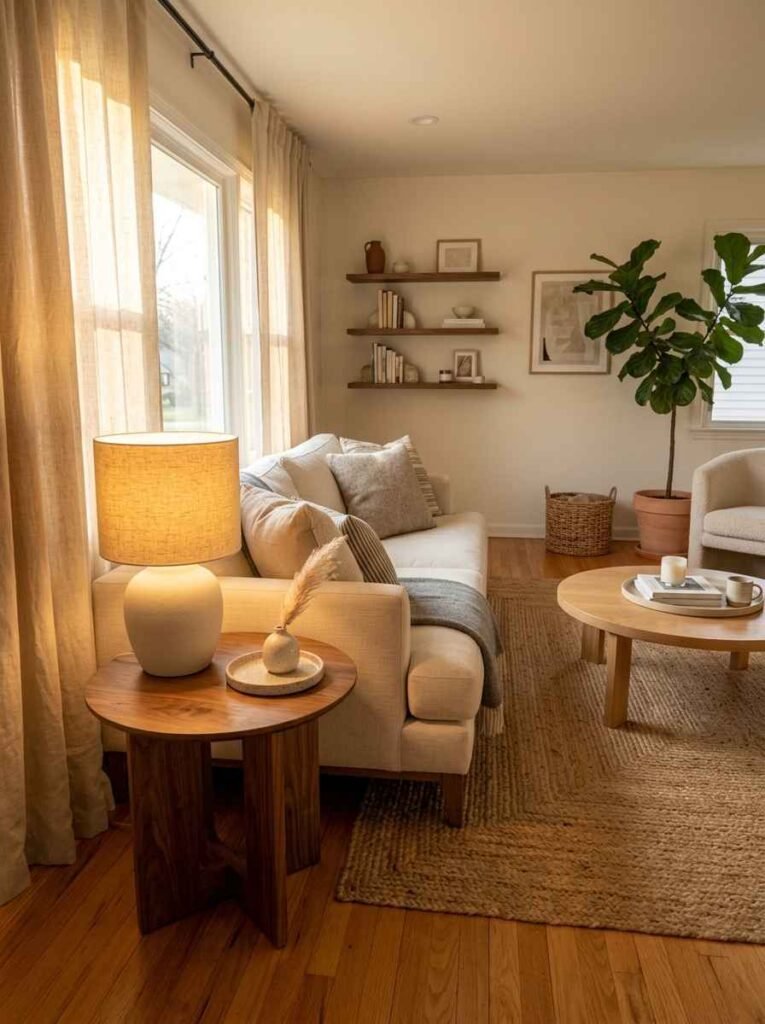
A gallery wall is lovely when done well, and also genuinely hard to do well. One oversized piece (think 30×40 inches or larger) centered on a wall does more for a room than 12 smaller frames that aren’t quite level and never feel finished. If budget is a concern, Desenio has large-format prints at reasonable prices.
29. Lean, don’t hang
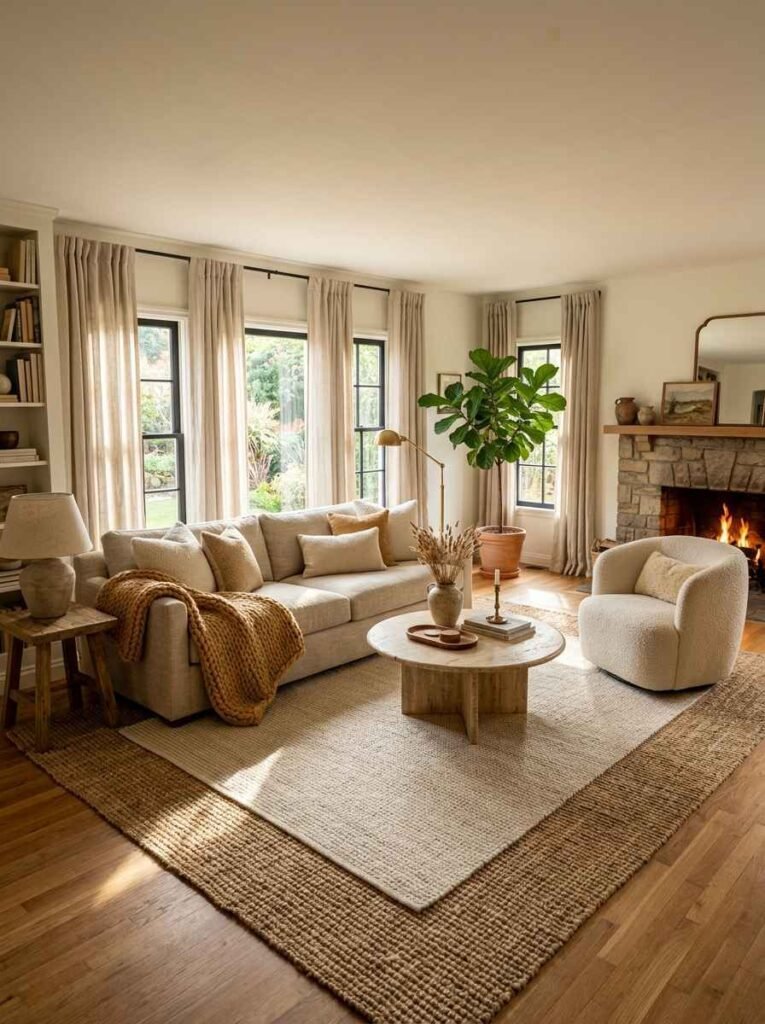
Leaning art against a wall (on a shelf, on the floor behind a sofa, on a mantle) reads more casual and confident than careful hanging. It also lets you change things out without filling your walls with holes.
30. Let one wall stay completely empty
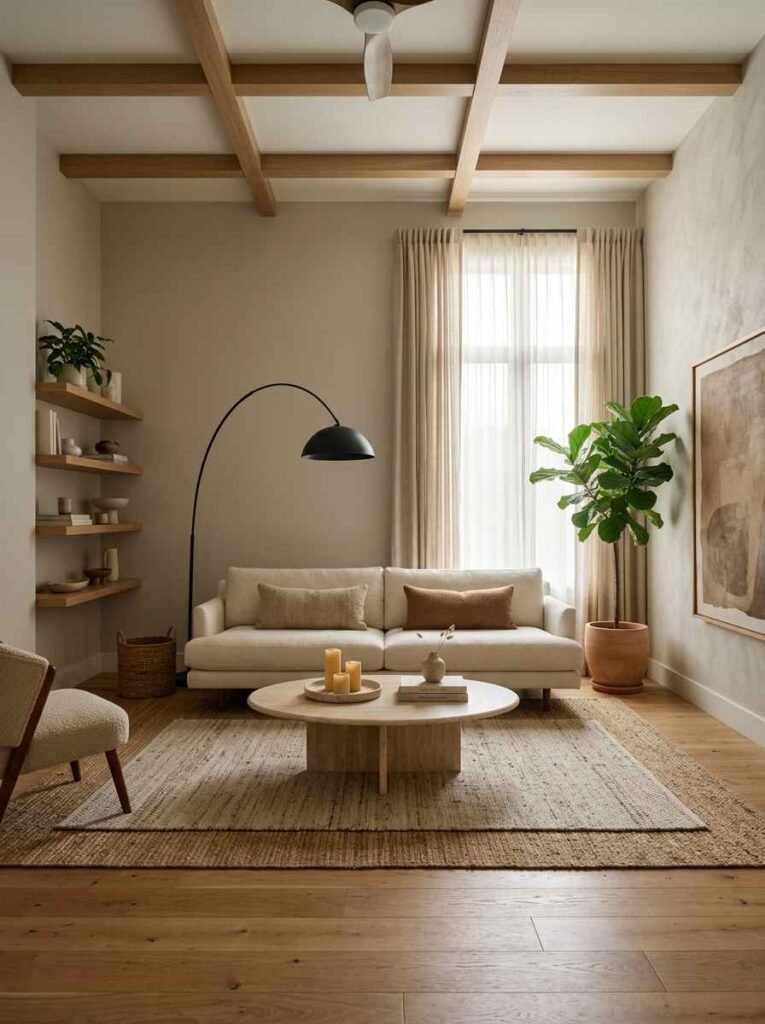
This is hard for people but it’s worth trying. One wall with absolutely nothing on it, in a room that’s otherwise considered and warm, reads as intentional. It gives the eye somewhere to breathe. The room doesn’t feel unfinished; it feels calm.
Wow, typing this out made me realize how much of this comes down to restraint, which sounds obvious until you’re standing in a HomeGoods with a cart full of throw pillows and a rattan mirror and a set of 4 matching vases. The edit is the hard part.
A quick note on the “cozy” part specifically
I want to say something that often gets glossed over in these kinds of articles. The cozy isn’t in the items; it’s in the proportions. A room can have every single one of these ideas and still feel cold if the scale is wrong, if the furniture floats without anchoring, if the lighting is sharp, if there’s no softness at floor level.
Walk into your room in the evening, turn the overheads off, light a candle, sit down. What’s missing? Nine times out of 10, it’s warmth at eye level, a surface too bare, or a light source doing all the wrong things. Fix that first.
Cozy minimalist living room: style at a glance
| Element | Cozy minimalist choice | What to skip |
|---|---|---|
| Sofa fabric | Linen, boucle, wool bouclette | Velvet in dark colors |
| Wall treatment | Warm white, limewash | Bright white, busy wallpaper |
| Rug | Jute, wool, natural fiber | Synthetic with loud pattern |
| Lighting | Layered, warm (2700K) | Single overhead, cool white |
Frequently asked questions
Q: Can a cozy minimalist living room work in a small apartment?
Yes, and it often works better in small spaces. The reduced furniture count feels appropriate rather than sparse, and the warm neutral palette makes tight rooms feel more open. The 1 large plant rule, the leaned art, the linen curtains mounted high: all of these scale down beautifully.
Q: How do I make a minimalist room feel warm without adding more stuff?
Change the lighting first. Swap to 2700K bulbs, add a floor lamp, put candles on the coffee table. Warmth is mostly light and texture, not objects. A chunky knit throw and a jute rug will do more than any amount of additional decorative items.
Q: What’s the biggest mistake in cozy minimalist decorating?
Buying everything in one shopping trip. The rooms that look genuinely good are built over time, with pieces added when they’re right, not when the room needs filling. A room with 3 perfect things and some breathing room is better than a room stuffed with 20 things bought in an afternoon at HomeGoods. Patience is actually the design strategy here.
Final thought
If you’re building a cozy minimalist living room and you feel like something is missing, it probably is. The goal isn’t to keep removing things until the room is empty; it’s to keep only the things that genuinely earn their place.
So what’s in your living room right now that you’re keeping out of habit rather than love? That’s probably the first thing to move.
