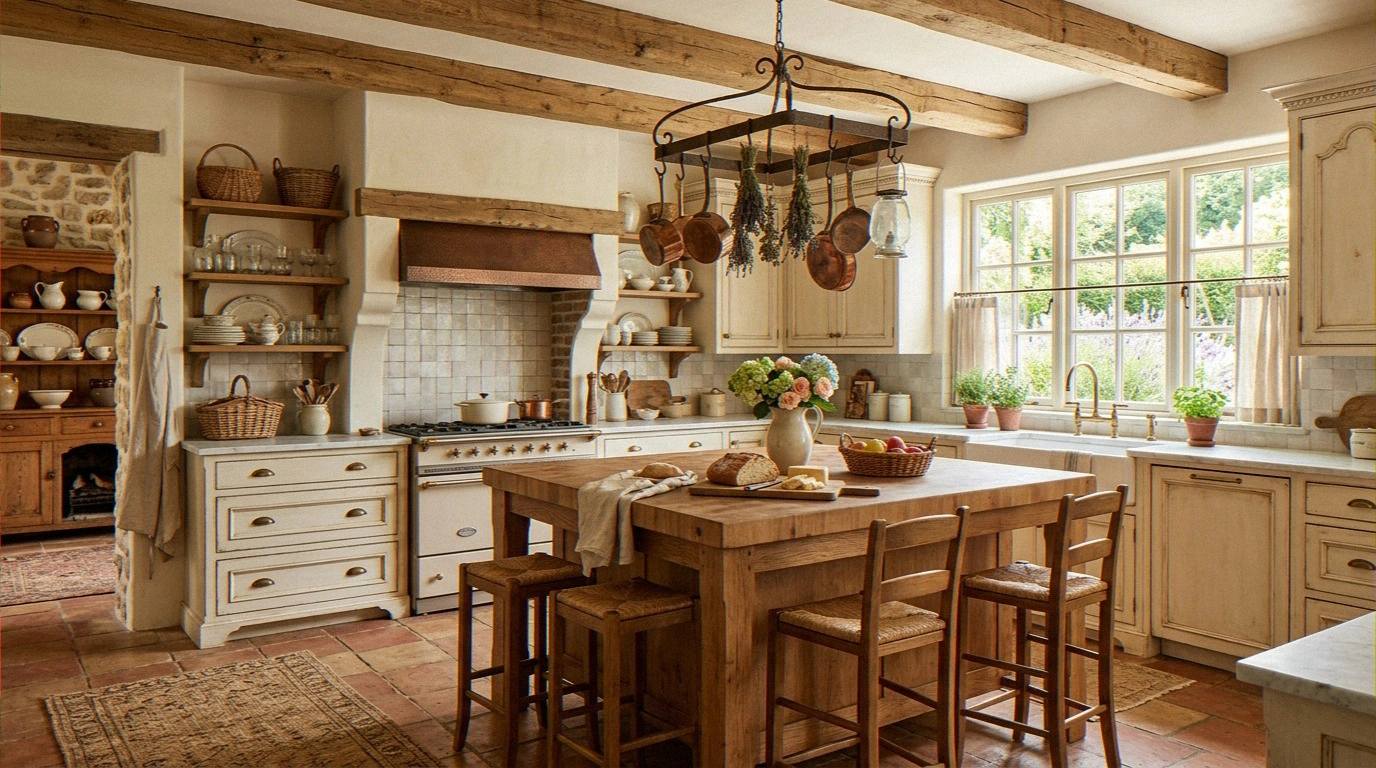
You know that gut-punch feeling when you walk into someone’s kitchen and immediately never want to leave? That’s a French country kitchen doing its thing. It’s warm, slightly worn-in, loaded with character — and no, you absolutely do not need a stone farmhouse in Provence to pull it off.
I’ve been obsessed with this style for years, and after reworking my own kitchen around these principles, I can tell you: this is one of the most livable, genuinely satisfying design directions you can go.
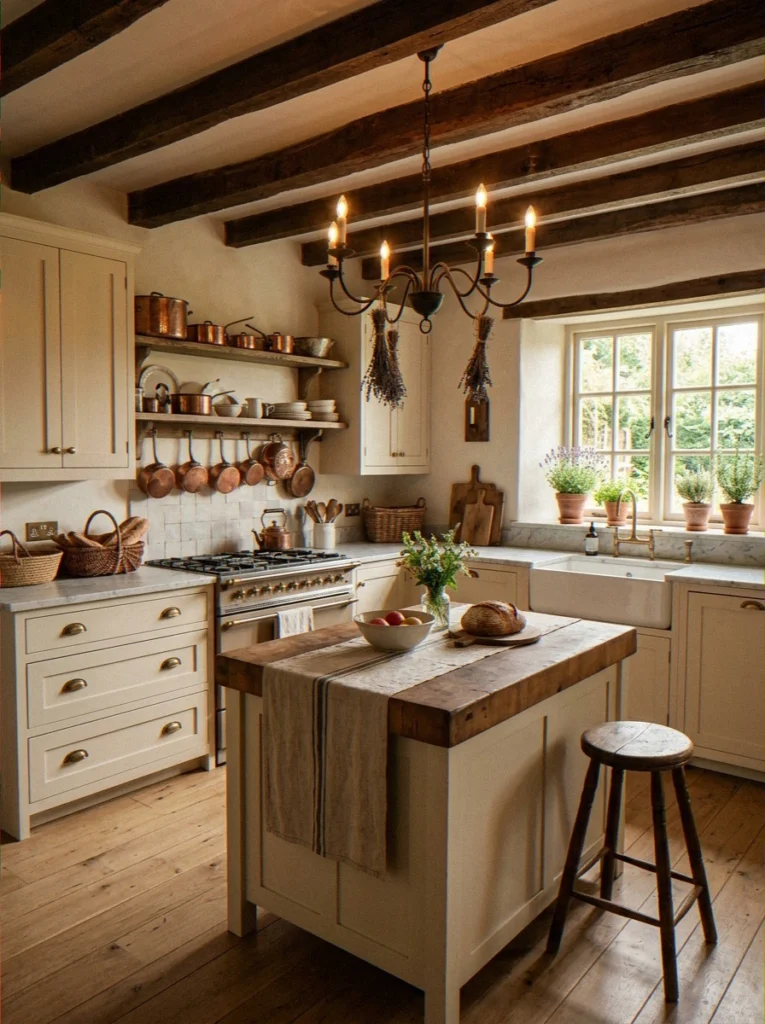
These 46 ideas will help you, whether you want to completely redo your space or just give it a new look with some carefully chosen accessories.
I’ve tried some of them myself. A few didn’t work for me. I’ll tell you the truth about both. Let’s get started.
What Actually Makes a Kitchen “French Country”?
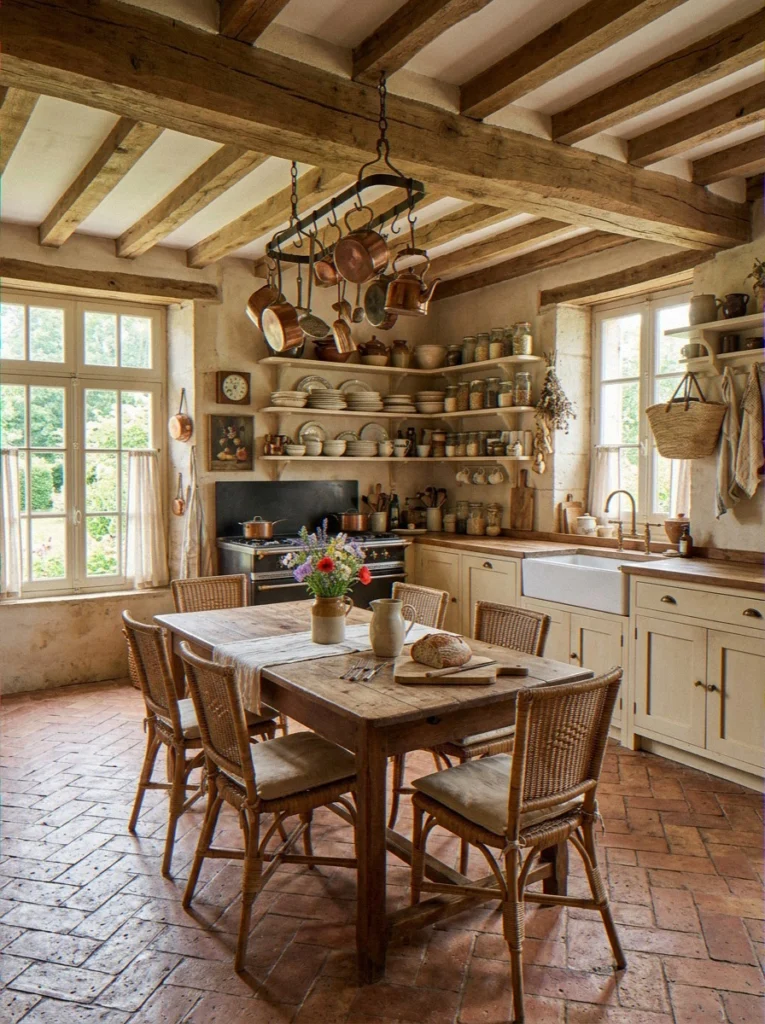
Before anything else, let’s get on the same page about what this style actually is — because people throw the term around loosely.
French country (also called French Provincial) draws from the rural homes of Southern France: Provence, Burgundy, the Loire Valley.
Think less Paris-chic, more sun-bleached farmhouse with copper pots hanging from the ceiling and a wooden table that’s seen a thousand family dinners.
The core hallmarks:
- Warm, muted palettes — cream, sage, terracotta, dusty blue
- Natural materials through and through: stone, aged wood, linen, wrought iron
- Open shelving that actually displays things
- Distressed or antiqued finishes — imperfection is the point
- Floral and toile patterns used with restraint
- That rare mix of old and new that feels curated, not staged
Honestly, the thing I love most about this style? It gets better the more you live in it. A few paint chips and a well-worn butcher block counter only add to the story. IMO, no other design aesthetic rewards actual living quite like this one does.
1. Start With a Warm, Earthy Color Palette
Creamy Whites and Off-Whites
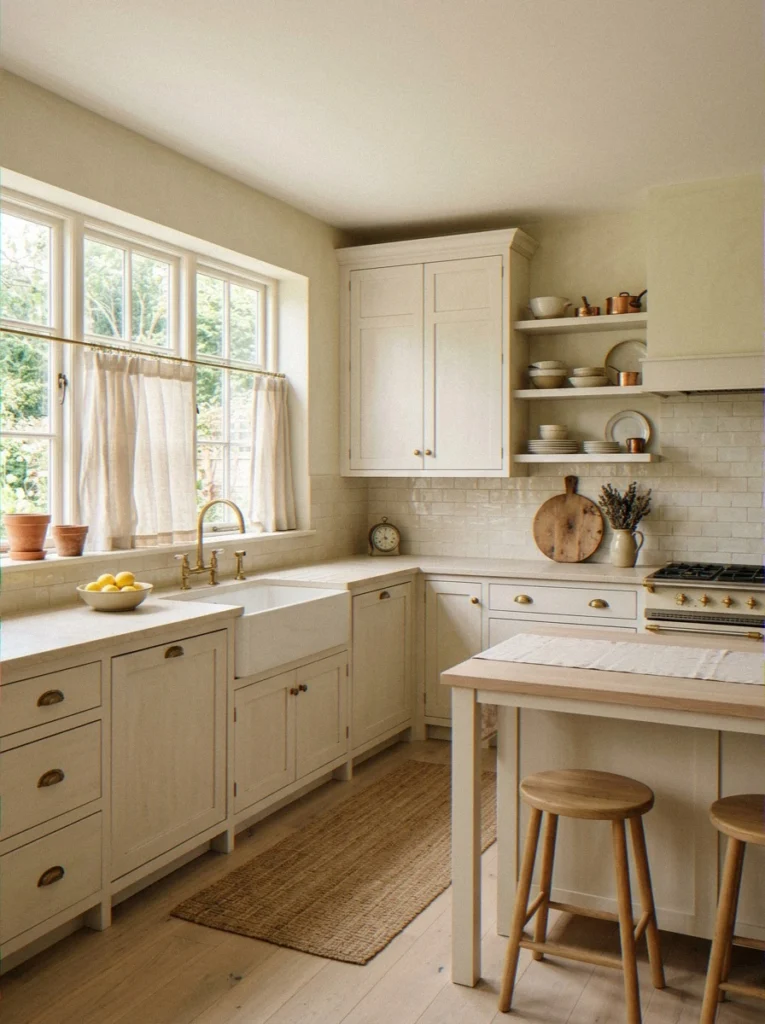
Get rid of the stark white and go for a warmer color. This is really the easiest and most effective thing you can do. For good reason, Benjamin Moore’s “White Dove” and Farrow & Ball’s “Pointing” are two of the best.
I chose a warm linen white for my own kitchen, and the difference was shocking. The bones were the same, but the feel was completely different.
These creamy colors are warm without being yellow, and they look great with stone countertops and natural wood.
You don’t have to be afraid to go a little deeper on lower cabinets, either. A parchment tone on the base with a lighter cream above gives the look of being grounded and layered, which makes it look like you really thought about it instead of just going with the default.
Sage Green and Dusty Blue
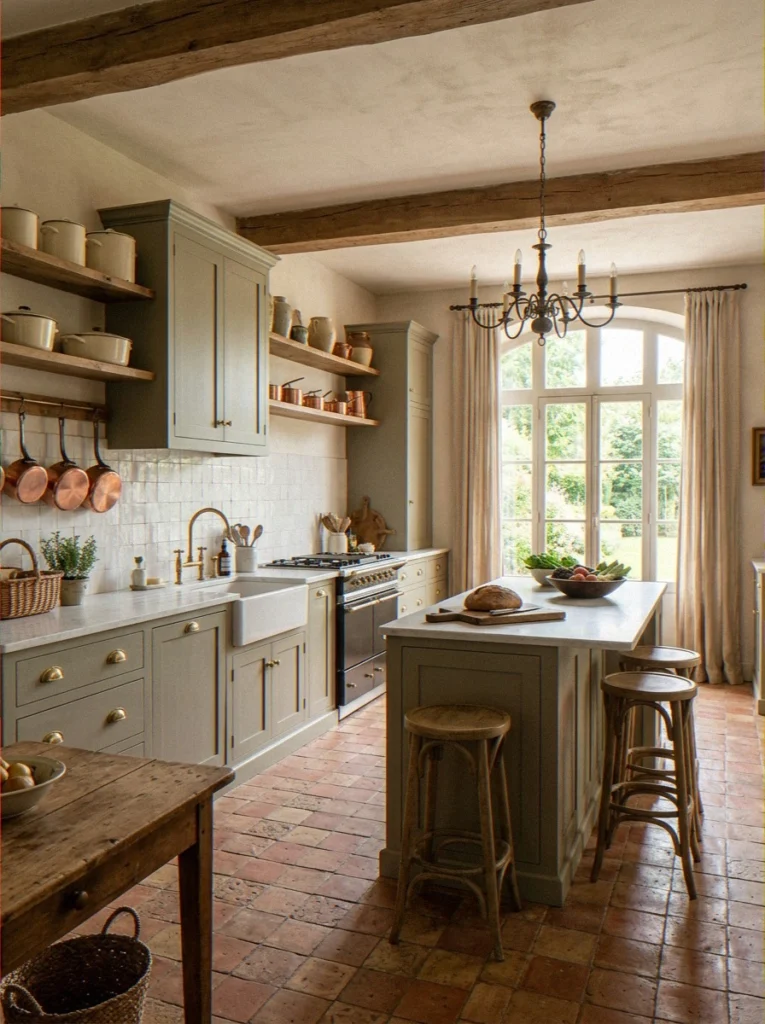
If white feels too safe for you — and honestly, fair — sage green is the move. It’s become the defining color of the French country kitchen revival and for excellent reason: it’s earthy but fresh, calm but interesting.
Pair it with unlacquered brass hardware and you’ve got something genuinely stunning without even trying that hard. Wow! 🌿
Dusty blue is the other great option — think of the color of old French shutters that have been baking in the sun for thirty years.
Not navy, not teal. Softer. Chalky. Sherwin-Williams has great options in their muted blue range that hit exactly this note.
Terracotta and Warm Ochre Accents
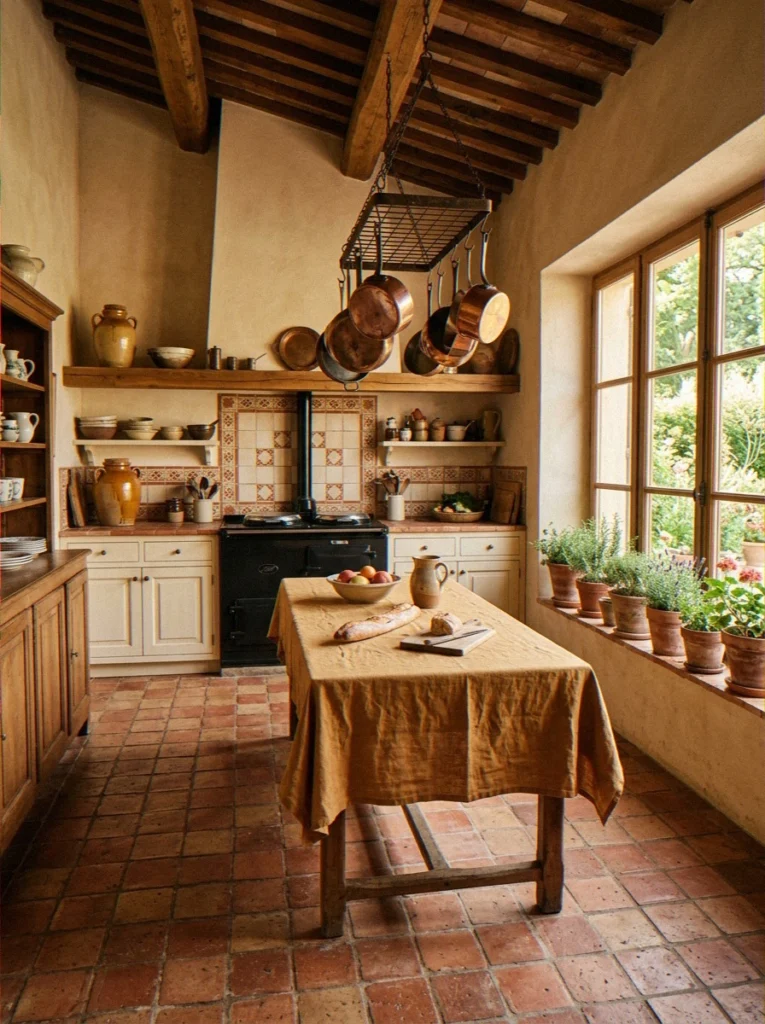
These don’t have to dominate — even a terracotta tile backsplash or a strip of ochre-toned linen as a table runner does serious work in warming up a space.
Warm earth tones are the secret ingredient that keeps a French country kitchen from sliding into cold or clinical territory. A single terracotta pot on a windowsill can pull an entire room together. Sounds dramatic, but trust me on this one.
2. Choose Cabinetry That Has Some Personality
Shaker Cabinets — But Make Them Feel Special
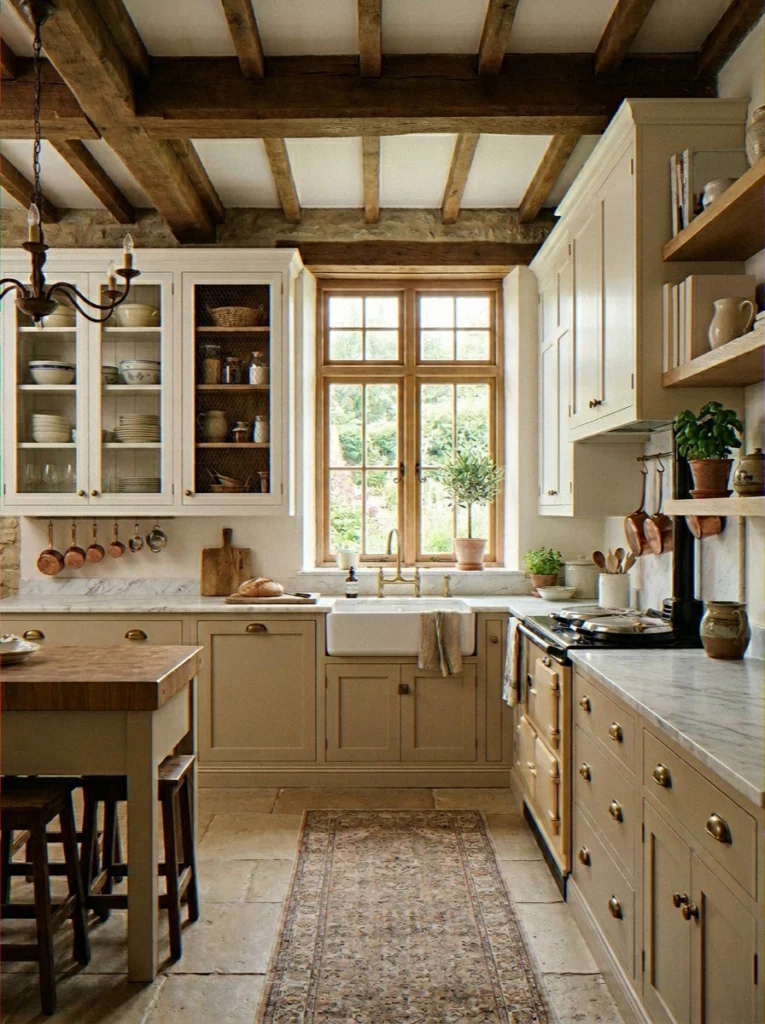
Shaker-style cabinets are the main part of this look. They work because they are simple and clean enough to never go out of style, but they also let everything else shine.
A slightly thicker door frame, a routed edge profile, or a gently antiqued paint finish can turn a basic shaker from “builder-grade rental” to “French countryside home.” It’s not about the shape; it’s about the finish and how it feels.
Glass-Front Upper Cabinets
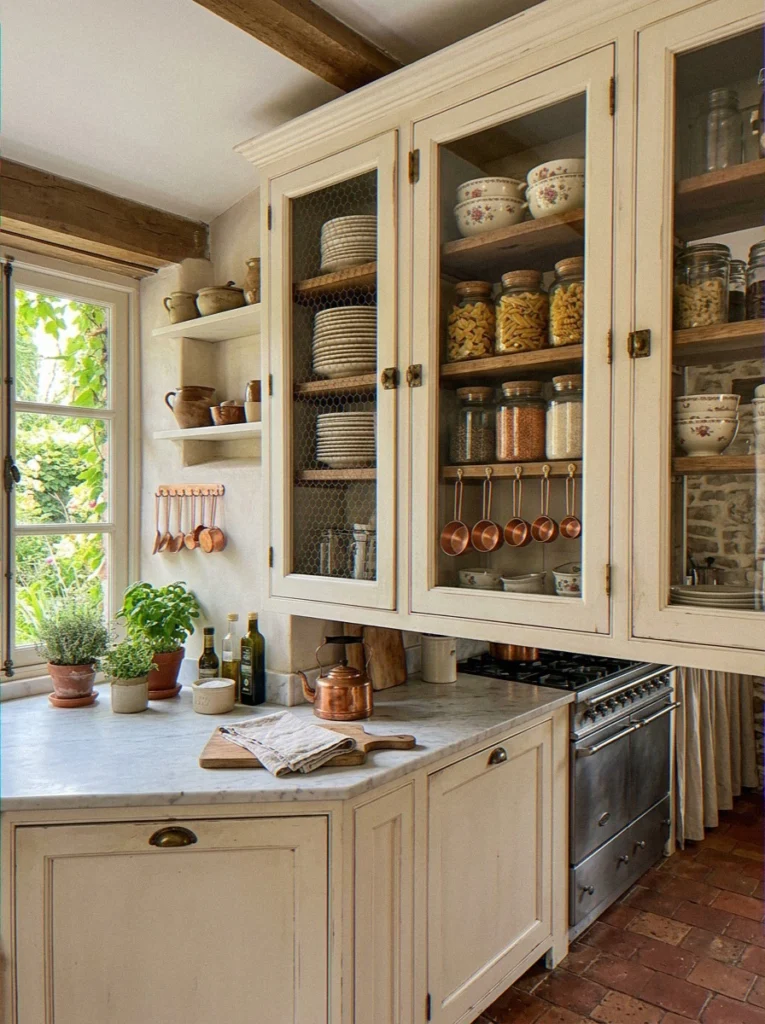
If there’s one thing I’d genuinely push you toward — it’s glass-front upper cabinets. At least a couple of them.
They break up the visual weight of solid cabinetry, give you a reason to curate your dishware, and add that “collected over decades” quality that French country interiors absolutely depend on.
Chicken-wire inserts are a cooler, slightly more rustic alternative to clear glass — they let light through while hiding the chaos of whatever you’ve actually got stacked in there. 😄
Open Shelving for Real Display
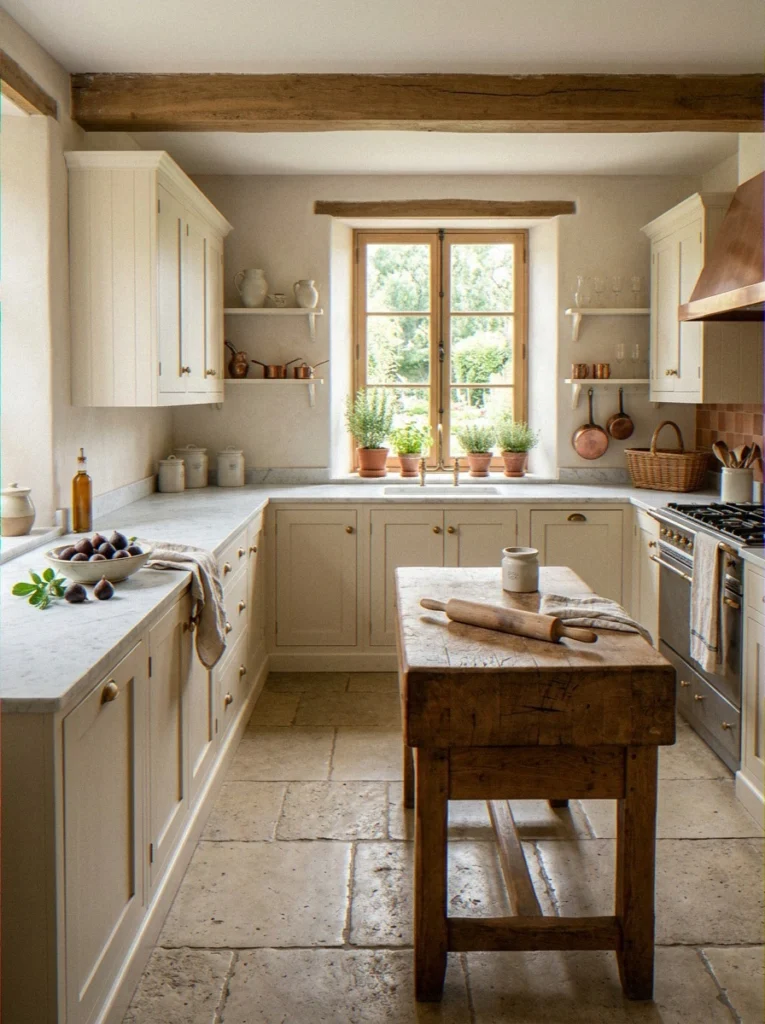
Open shelving in a French country kitchen isn’t a trend — it’s a tradition. Wooden shelves lined with copper pots, stacked vintage plates, mason jars full of dried pasta, and a few cookbooks with broken spines — that’s the whole vibe right there.
I’ll be honest: open shelving can go from charming to chaotic very fast if you’re not a naturally tidy person. I tried it in one section of my kitchen and loved it.
In another section? Total mess within a week. Know yourself. Floating reclaimed wood shelves are my personal favorite when it works — the grain and natural variation of old timber adds something no new shelf can replicate.
3. Countertops: Go Natural or Go Home
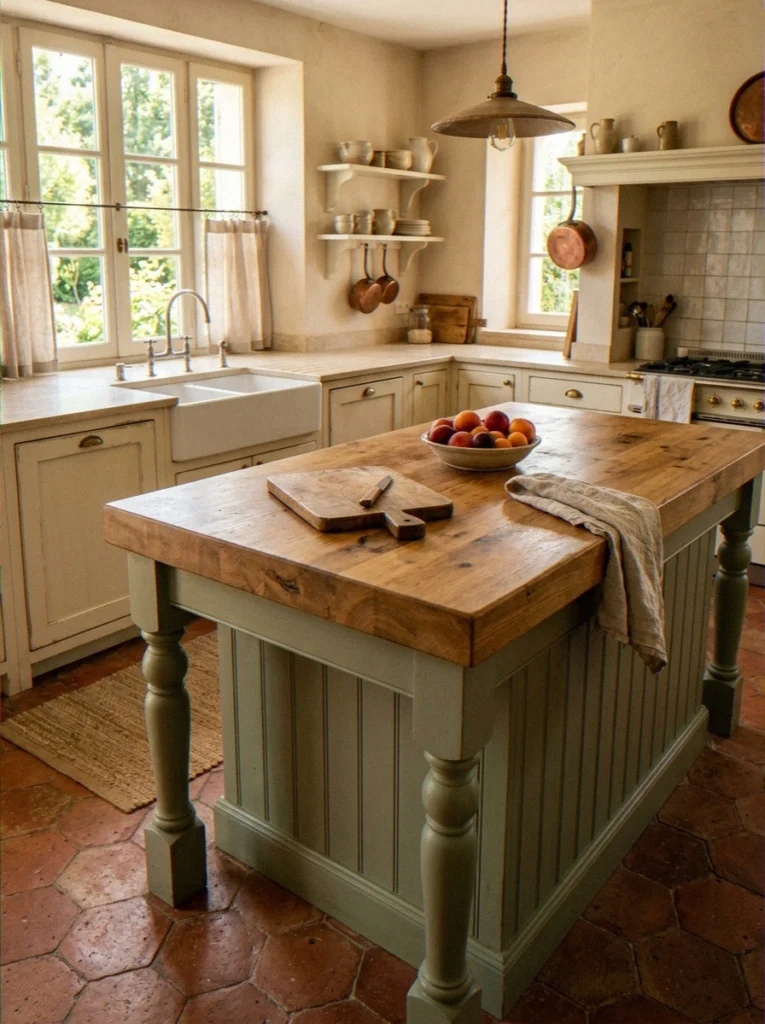
Honed Marble
It’s fine to have polished marble. For this look, polished marble is better. The matte finish doesn’t feel as valuable and lived-in, and you won’t have a heart attack every time someone puts a glass down without a coaster.
The soft gray veining in the honed Carrara marble against the cream cabinets is, in my opinion, one of the most beautiful combinations of materials I’ve ever seen in a real kitchen. It costs a lot, but it pays for itself every day.
Butcher Block
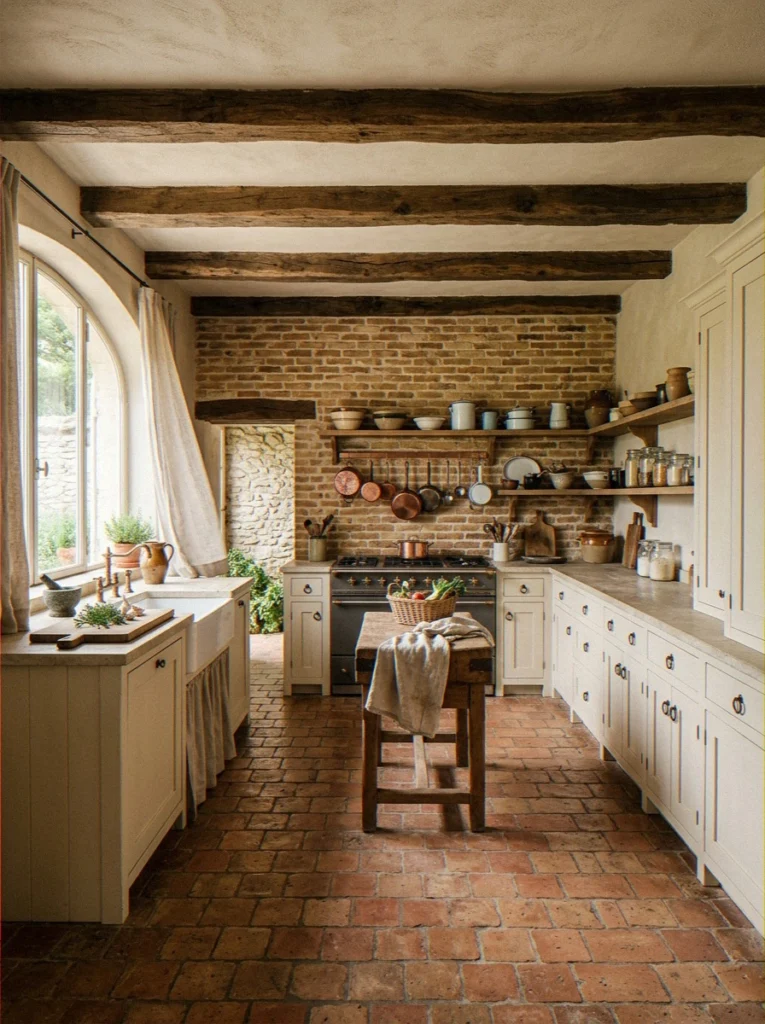
If marble feels like too much — budget-wise, maintenance-wise, or anxiety-wise — butcher block is the most authentically French country material you can choose.
It’s warm, it ages beautifully, it smells incredible when you oil it, and there’s something deeply satisfying about chopping vegetables on a surface you’ve maintained yourself.
I use a mix: butcher block on the island, honed stone on the perimeter. That combination of materials is a killer design move in this style.
Limestone and Soapstone
Limestone has that soft, chalky, almost powdery look that looks great in pictures and even better in real life. Soapstone, on the other hand, is dark, matte, and dramatic, and it is almost impossible to break.
It doesn’t get hot, it doesn’t get stained, and it doesn’t get bacteria. A lighter kitchen would look great with this contrast material.
| Material | Vibe | Durability | Budget |
|---|---|---|---|
| Honed Marble | Romantic, elegant | Medium | $$$ |
| Butcher Block | Warm, rustic | High (oiled) | $$ |
| Limestone | Soft, chalky | Medium | $$$ |
| Soapstone | Dramatic, matte | Very High | $$$ |
4. Textures That Make the Room Feel Real
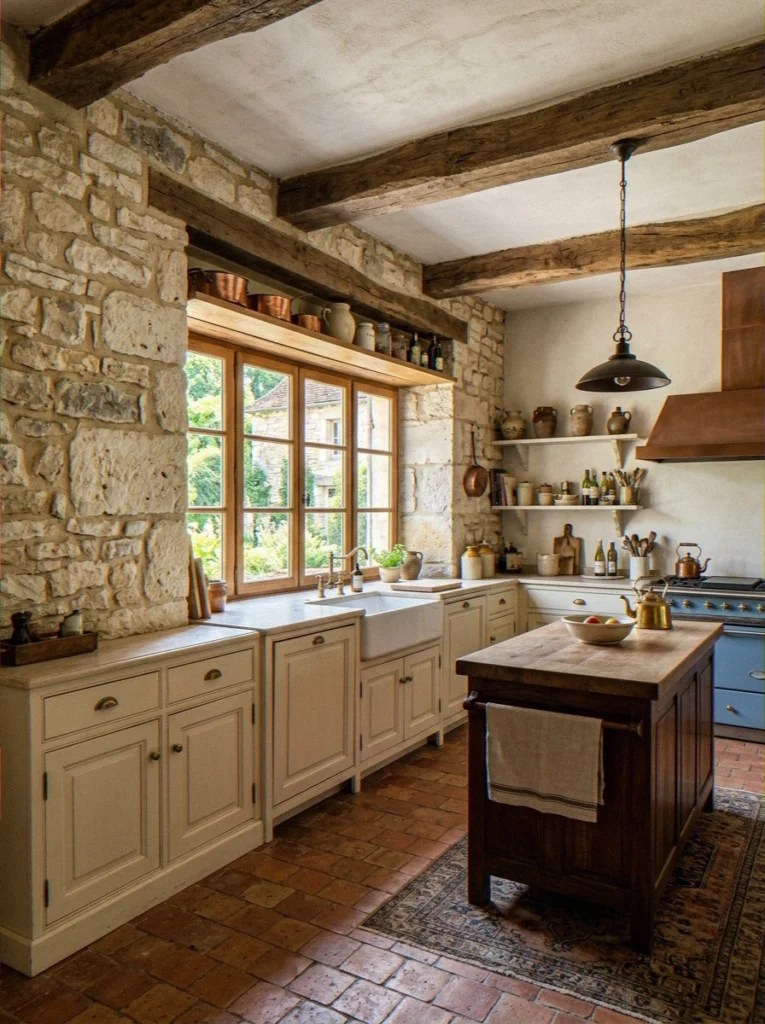
Exposed Stone or Brick
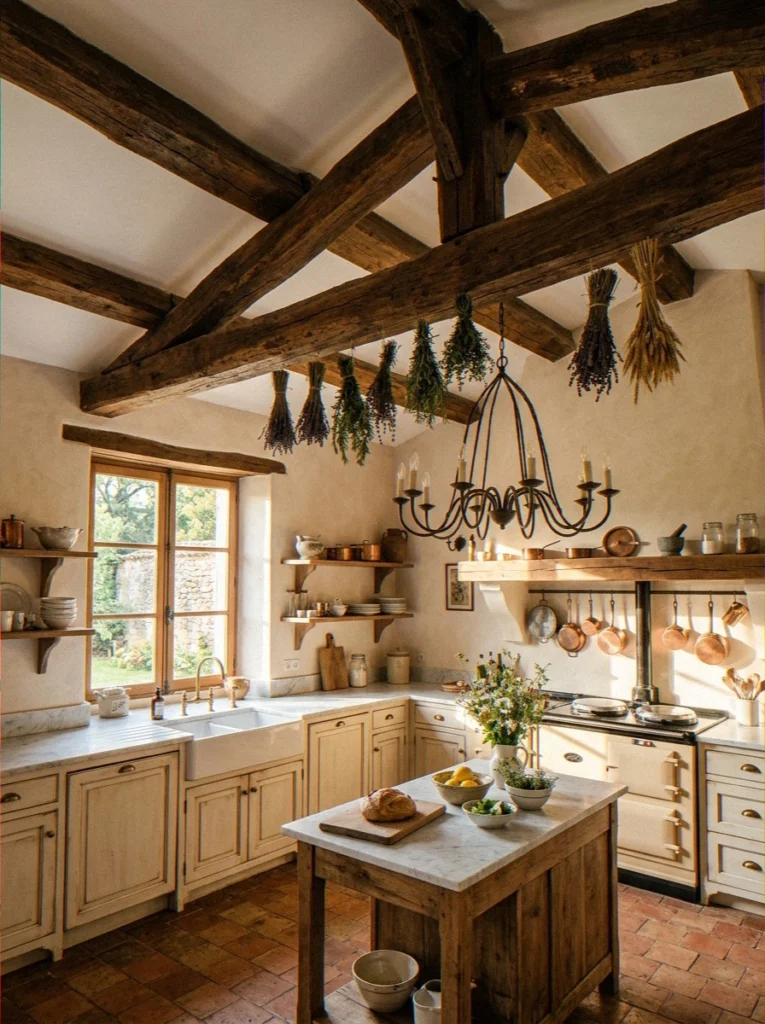
If your walls are hiding original brick or stone behind drywall — I am literally begging you to expose it. An exposed stone or brick wall in a French country kitchen is an absolute design jackpot. It brings texture, history, and permanence that no tile or paint can touch.
No hidden brick? Brick-effect tiles and stone cladding panels have become convincingly good. The Old House Journal has solid guidance on restoration and replication of these original finishes if you want to go the authentic route.
Wooden Beamed Ceilings
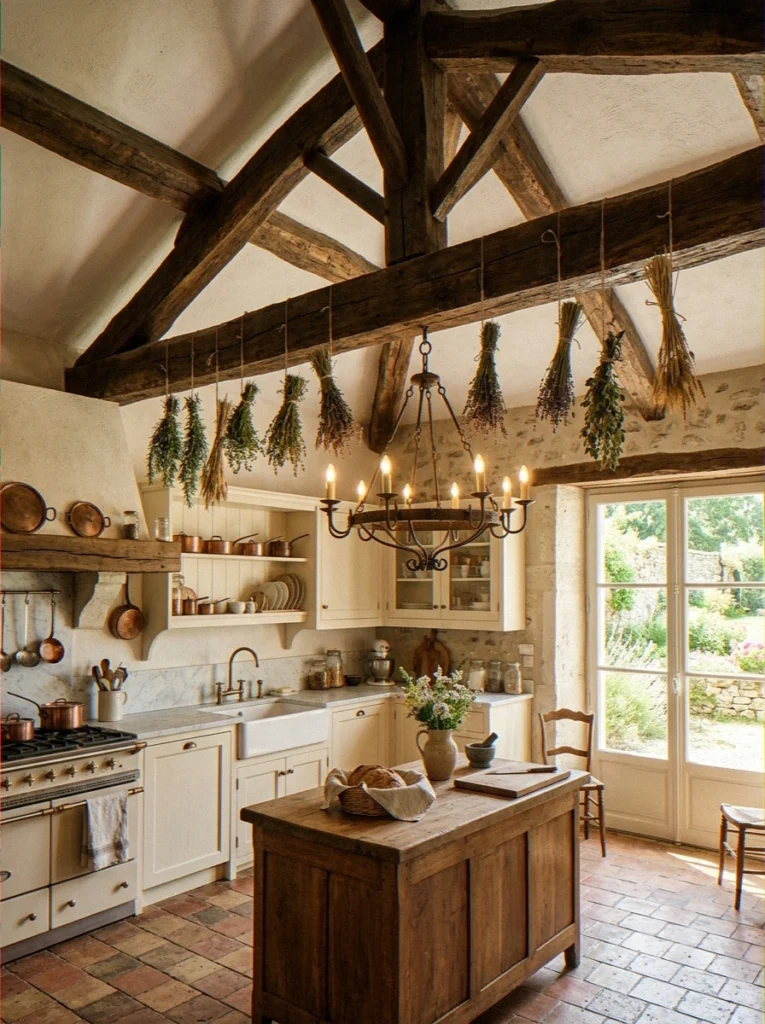
This is the architectural detail that separates a “nice kitchen” from a French country dream kitchen. Exposed ceiling beams — whether original or well-installed faux versions — add warmth and visual dramaoverhead in a way that nothing else quite matches.
Pair them with a statement pendant light and you’ve created a focal point that lifts the whole room. Faux beams have come a long way; Faux Wood Workshop makes some genuinely convincing options if you’re not working with original timber.
Stone Tile Flooring
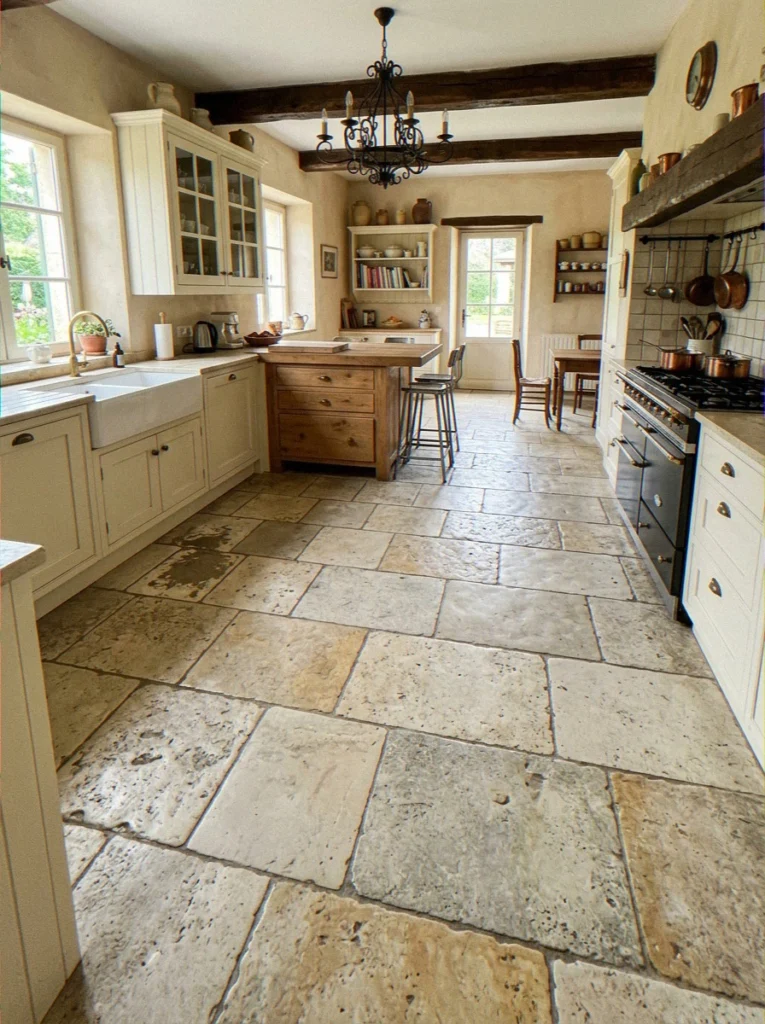
The floor should feel like it’s been there for a hundred years. That’s the standard. This is all correct: herringbone terracotta, large-format aged limestone, and worn stone pavers. Anything that is shiny or too perfectly even is wrong.
If you don’t have a lot of money, you might want to think about porcelain tiles with an aged finish because they have gotten really good.
5. Hardware: The Detail That Changes Everything
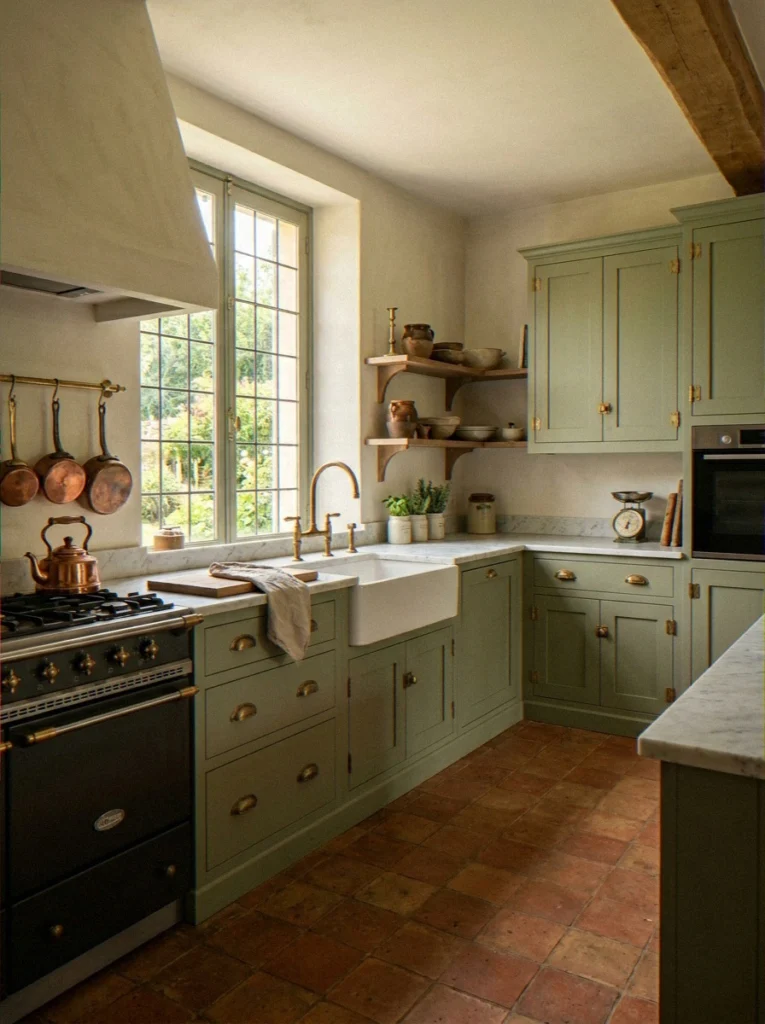
Unlacquered Brass
Hot take incoming: unlacquered brass hardware is the single most transformative upgrade available to a French country kitchen.
It starts bright and develops a warm, irregular patina over time that looks genuinely antique within a year or two of use.
Yes, it requires light maintenance. Yes, it’s 100% worth it. Rejuvenation and Anthropologie both carry excellent options that won’t completely destroy your budget.
Wrought Iron and Oil-Rubbed Bronze
For a darker, heavier, more rustic feel — wrought iron hardware is deeply authentic to the French country tradition. Large ring pulls, hand-forged bar handles, chunky hinges with visible screws.
Pair with darker cabinetry — deep charcoal, hunter green — for a seriously dramatic look. Oil-rubbed bronze lands between brass and iron: warm, dark, and completely forgiving of fingerprints. Practical and beautiful. That combo doesn’t come around often.
Cup Pulls and Bin Pulls
The shape is also important. Cup pulls and bin pulls are the most common types of pulls here. They are big, heavy, and have a slightly old-fashioned look. Stay away from anything that is too sleek or geometric.
The hardware should look like it came from a hardware store in 1920, not an Apple store in 2024. This one didn’t work for me, though.
I thought slim bar pulls would make it look “elevated,” but they just looked wrong. It was back to the bin pulls.
6. The Farmhouse Sink — Just Do It
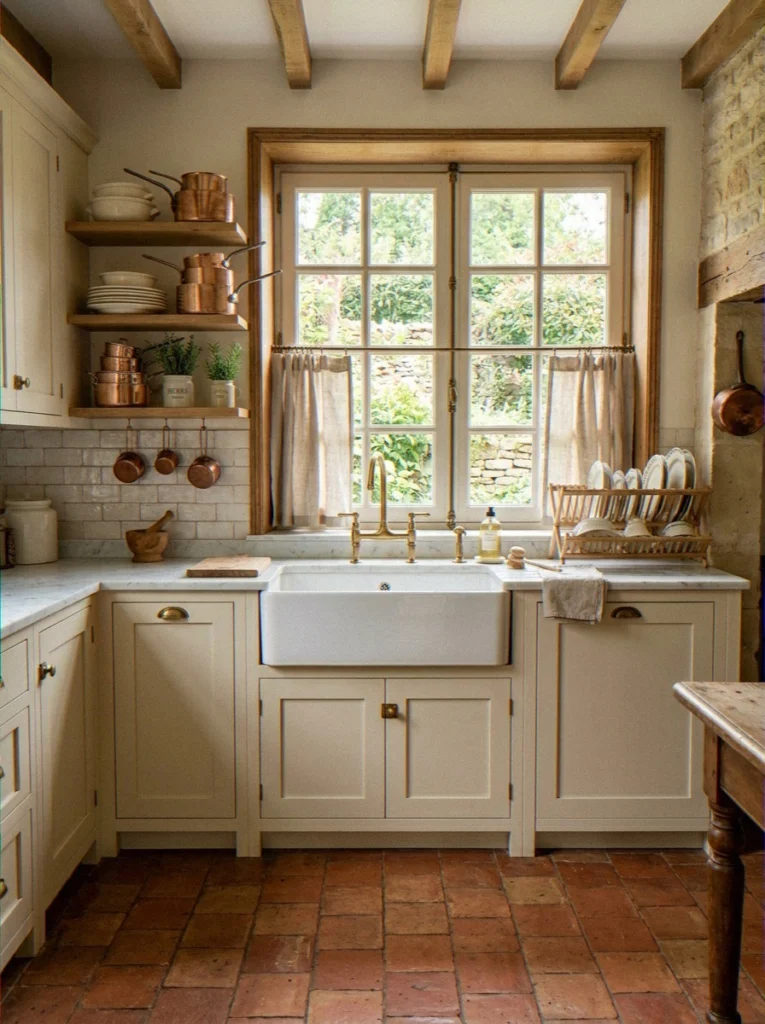
Look, I’m going to be direct: the apron-front farmhouse sink is non-negotiable in a true French country kitchen. This is not an area where I’m going to offer you balanced alternatives and tell you to decide. Get the farmhouse sink. You will never regret it.
White fireclay is the classic choice — durable, beautiful, and develops a gentle aging quality over years that fits the aesthetic perfectly. Alternatives include:
- Soapstone sinks — very dramatic, very French farmhouse, gorgeous patina
- Copper sinks — stunning over time but high maintenance (I tried copper once — it’s gorgeous but bro, the upkeep is real)
- Hammered stainless — more modern but still rustic enough to work in the right context
Pair whatever you choose with a high-arc bridge faucet in unlacquered brass or oil-rubbed bronze. That combination of apron sink and bridge faucet is a genuinely killer design moment that makes the whole kitchen cohere.
7. Lighting That Actually Sets a Mood
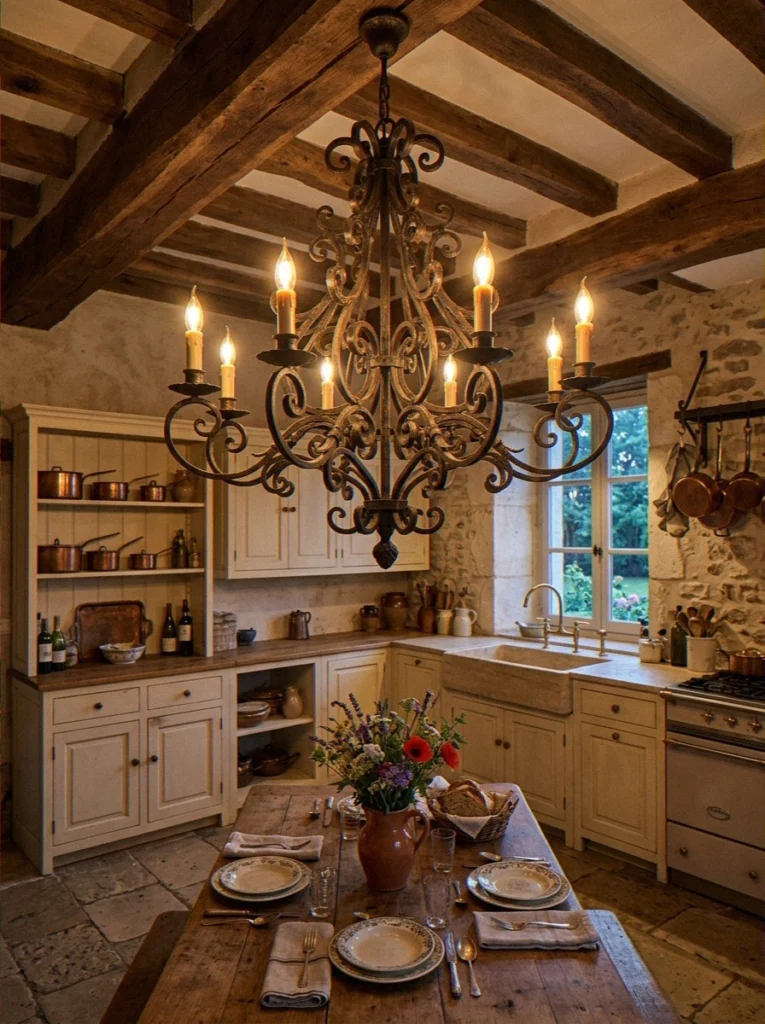
Wrought Iron Chandeliers
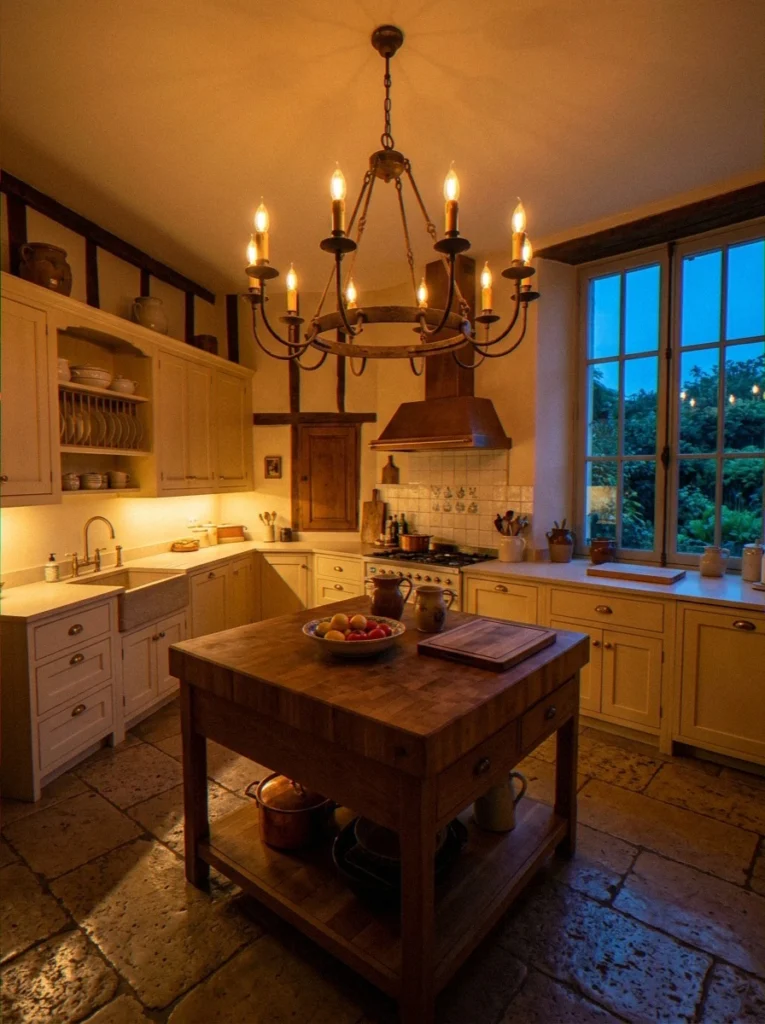
The chandelier is the crown of a French country kitchen and wrought iron is the material that belongs there. Simple candelabra style over an island, or an elaborate scrollwork piece above a dining table — either way, it needs to feel weighty and Old World.
Use candle-style bulbs (Edison or flame-tip) rather than modern globes. The warmth and flicker quality of the light matters as much as the fixture itself.
Rattan and Wicker Pendants
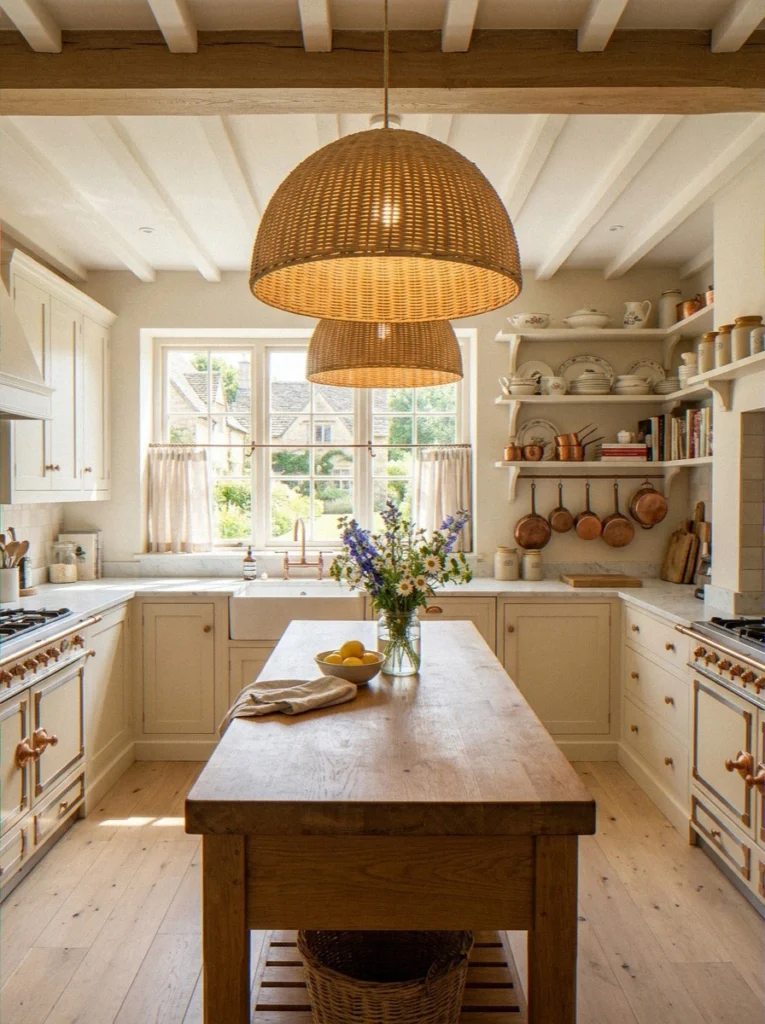
Rattan pendants over an island are really cute and not used enough for something lighter and more coastal-French.
They spread light beautifully, add natural texture to the ceiling, and look great in kitchens with light cabinets and stone floors. Also, they cost a lot less than iron fixtures most of the time. A win-win.
Under-Cabinet Lighting
Honestly, this one gets overlooked constantly and it shouldn’t. Warm under-cabinet lighting — stick to 2700K-3000K color temperature — is what transforms your kitchen from a functional room to an atmospheric one after dark.
That shift matters enormously in a style built around warmth and intimacy. It’s a relatively cheap upgrade with a disproportionately big impact.
8. The Range: Earn Your Focal Point
Statement Ranges in Painted Colors
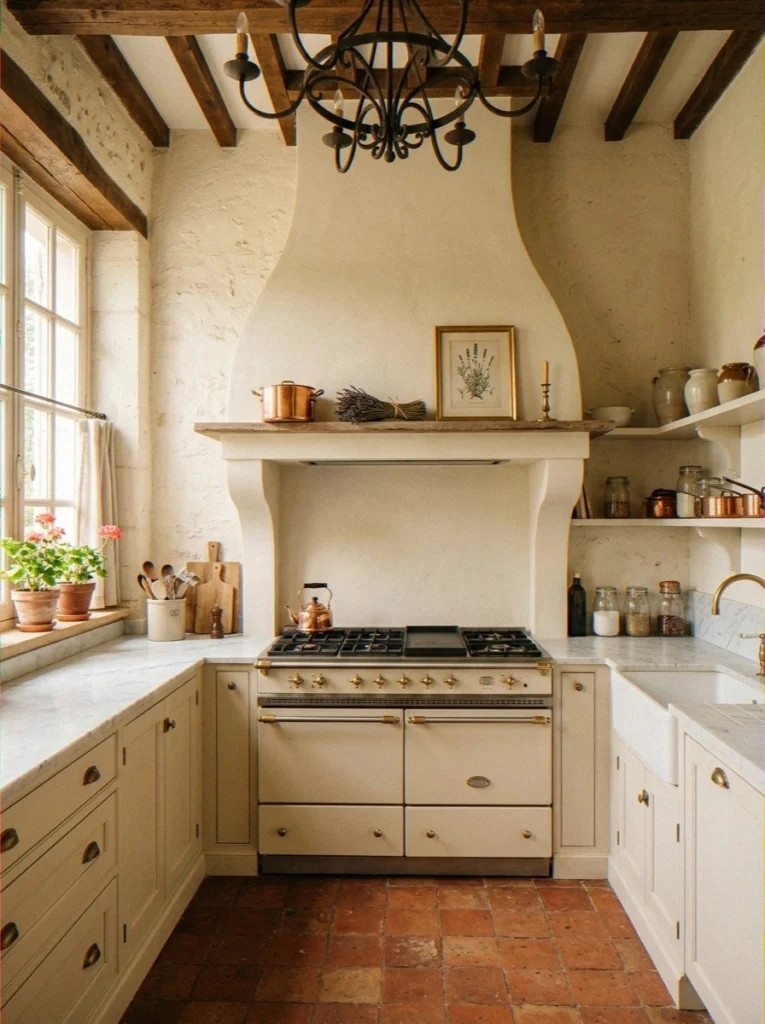
If your budget stretches to it, a professional-style range in a painted color — cream, sage, or French blue — is the single most dramatic French country statement piece available to you. Brands like La Cornue (aspirational), ILVE (slightly more accessible), and Lacanche (somewhere between the two) make ranges that function brilliantly and look like works of art. Everything else in the room gets designed around them.
A Custom Range Hood
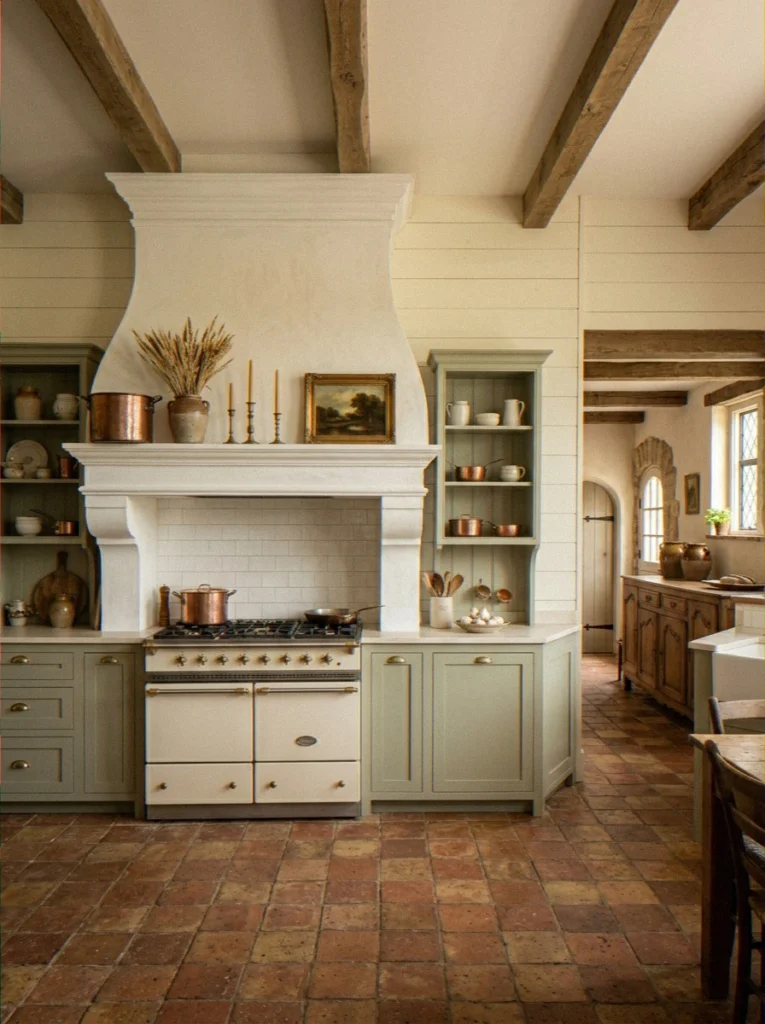
A custom plaster or wooden range hood changes the whole look of a kitchen, even if it is a standard size. A big sculptural hood with a mantel shelf makes a chimney-breast effect that holds the room together.
It gives the room a sense of hearth that is very much in line with the French country style. Put some things on that shelf, like a copper pot, some dried herbs, an old print, and a small brass clock. You will feel like you live in Provence. That one thing does so much. 🏡
9. Open Shelving, Plate Racks, and Pot Hangers
The Classic Plate Rack
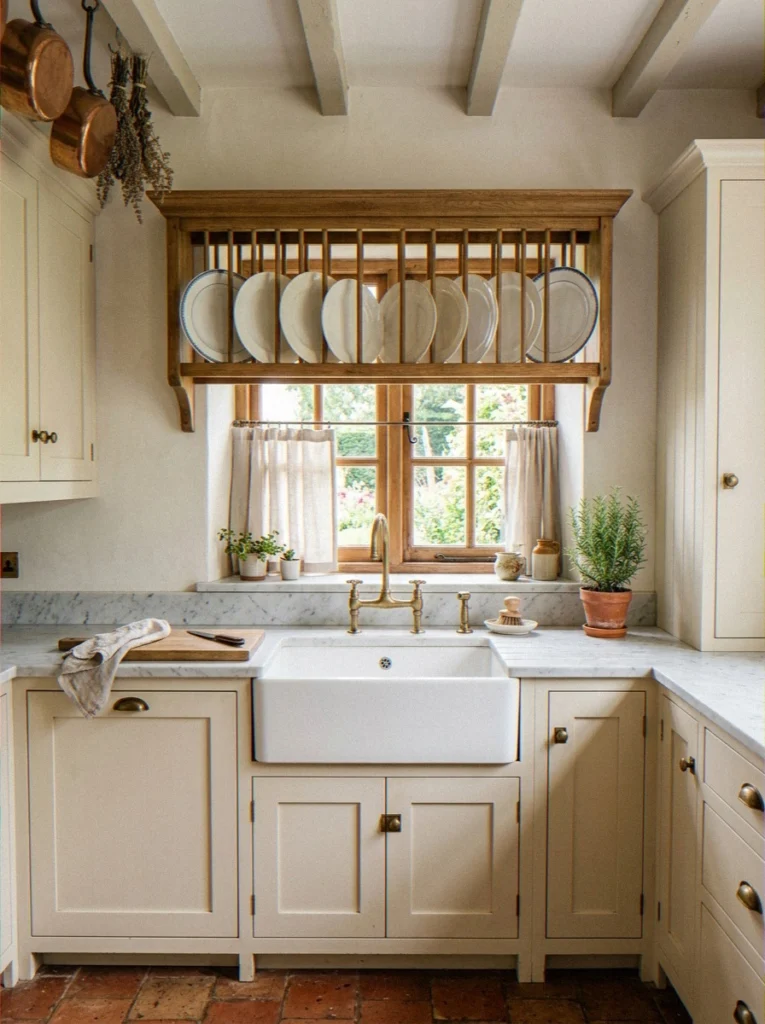
A wooden plate rack displaying your nicest china is one of the most characterful details in this aesthetic. Built-in above the sink or freestanding against a wall — either approach works.
I installed mine above the farmhouse sink three years ago and still get compliments on it constantly. Functional too: plates air-dry on the rack and go straight back to display. No cabinet needed.
Ceiling Pot Racks
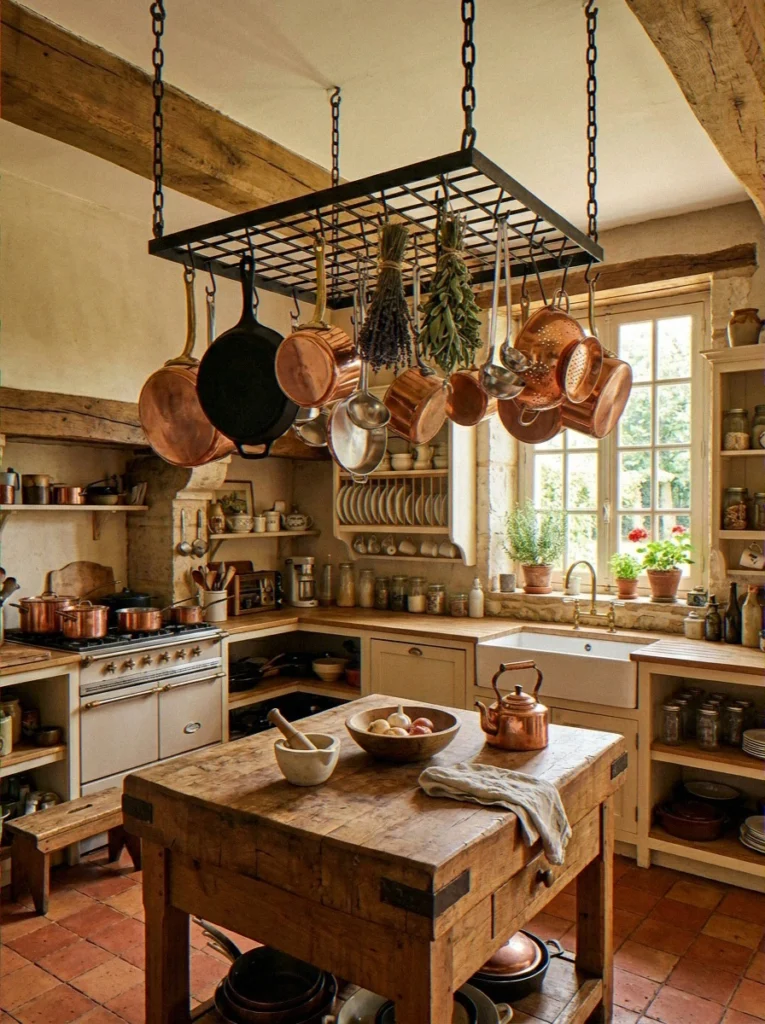
Hanging copper or stainless pots from a ceiling rack does double duty — it frees up cabinet space and looks genuinely beautiful.
A simple wrought iron grid hung with S-hooks costs almost nothing and fills a kitchen with the kind of working-kitchen energy that defines this style. FYI, if you’re going to invest in copper cookware, Mauviel is worth every penny.
10. Furniture and Freestanding Pieces
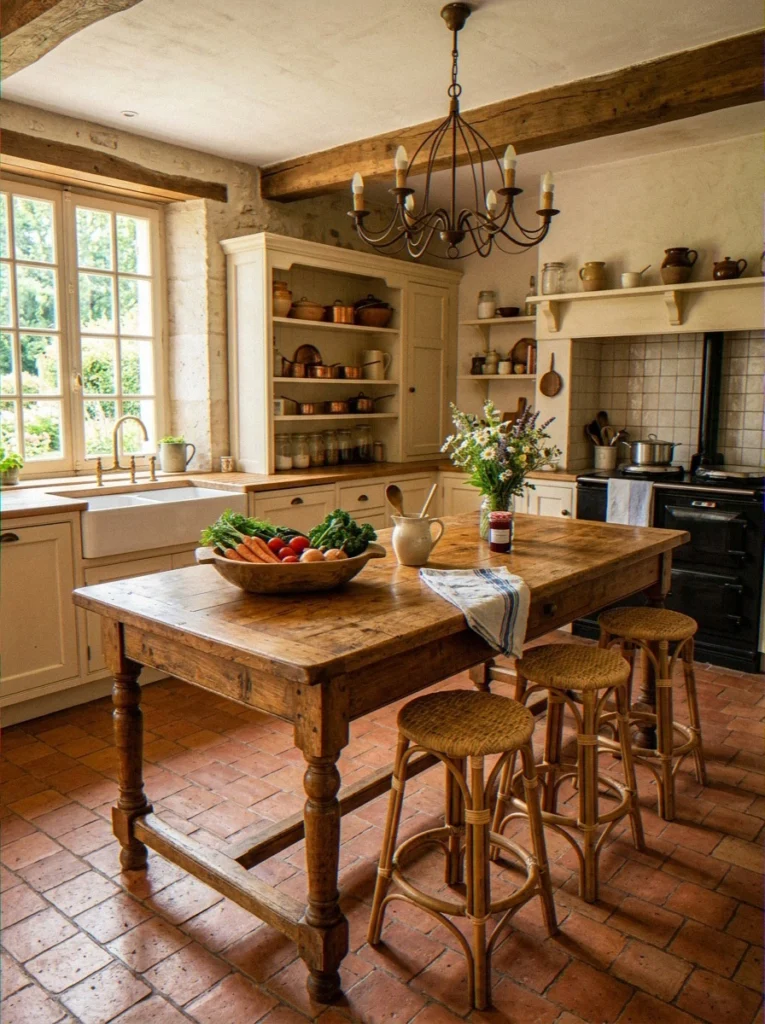
A Farmhouse Table as Island
Instead of a fixed built-in island, consider a large antique or vintage-style farmhouse table as your kitchen island. It’s moveable, it’s beautiful, and it reads as genuinely authentic rather than designed-for-Instagram.
A thick-legged oak or pine table with a weathered finish is exactly right — it looks like it was there before the kitchen was built, which is entirely the energy this aesthetic is going for.
The French Dresser — The Vaisselier
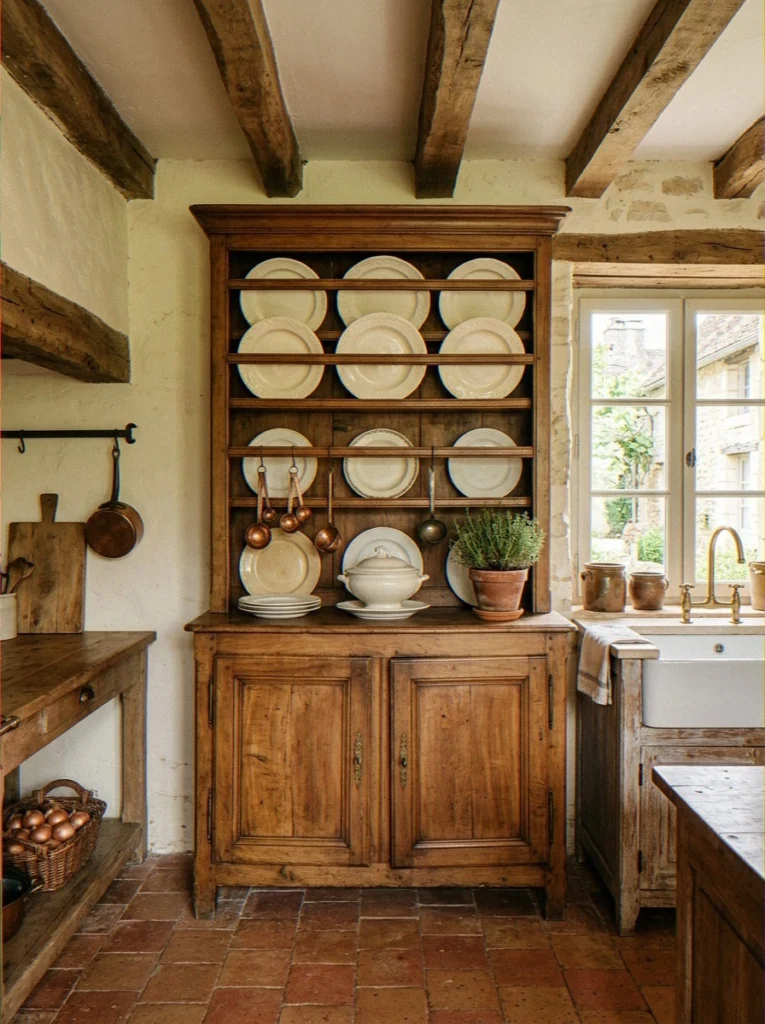
The vaisselier — the traditional French kitchen dresser — is one of the most beautiful pieces of furniture you can bring into this room. Lower cabinets, open shelving mid-section, plate rack above.
The entire French country kitchen philosophy in a single piece of furniture. Hunt for genuine antiques at Chairish or 1stDibs — a real vintage vaisselier is an absolute treasure and will likely outlive you. Honestly, this trend hasn’t felt outdated for three centuries and it’s still not going anywhere.
Bistro-Style Bar Stools
At the island, cane-back or rush-seat bar stools are exactly right. Lightweight, natural texture, unmistakable café-in-Paris energy.
Avoid anything too upholstered or too modern — the bar stool is a small detail but it either reinforces or undercuts the whole direction.
11. Backsplash Ideas That Actually Earn Attention
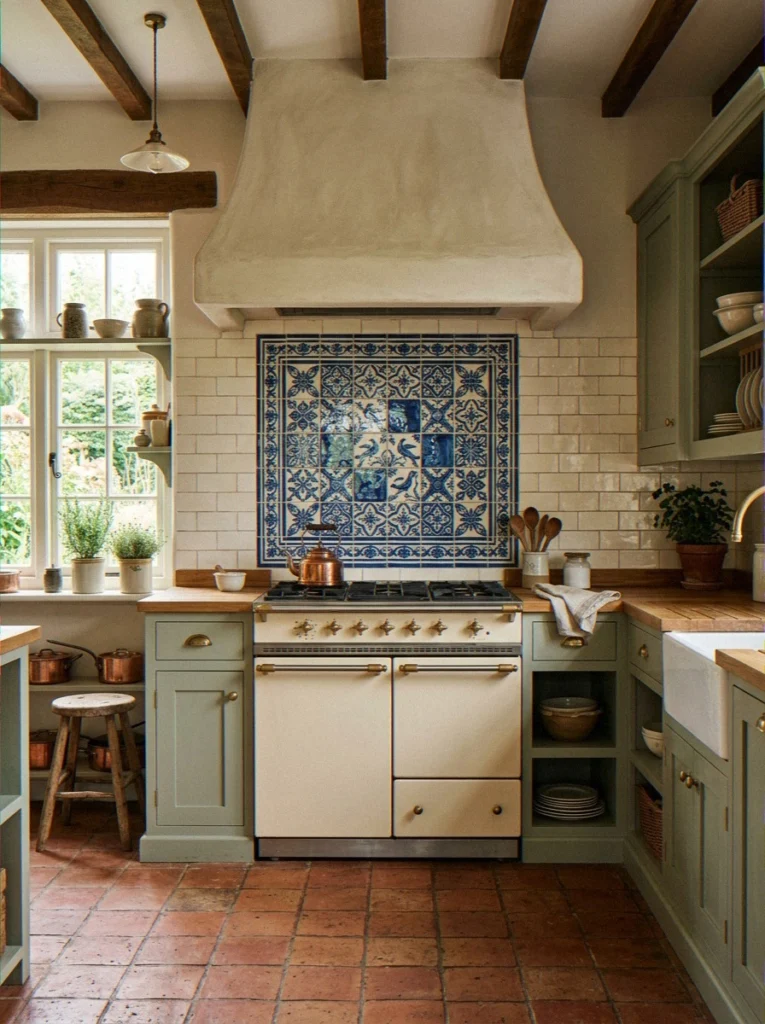
Hand-Painted Ceramic Tiles
Hand-painted ceramic tiles from Portugal or Spain (which are close enough in style) make the most interesting backsplash you can imagine.
The color, glaze, and paint line on each tile are all a little bit different, and that’s the whole point.
These look great as an accent panel behind the range, with plain subway tiles on either side. I’ve seen this combination done well dozens of times, and it’s always a hit.
Classic Subway Tiles (Done Right)
Never underestimate subway tile — but choose handmade ceramic versions with slight surface variation rather than the perfectly uniform, machine-pressed modern kind.
The slight undulation and glaze variation in a handmade tile catches light in a way that feels genuinely artisanal. In a soft white or warm grey, these can be the most quietly beautiful backsplash in the world.
Zellige Tiles
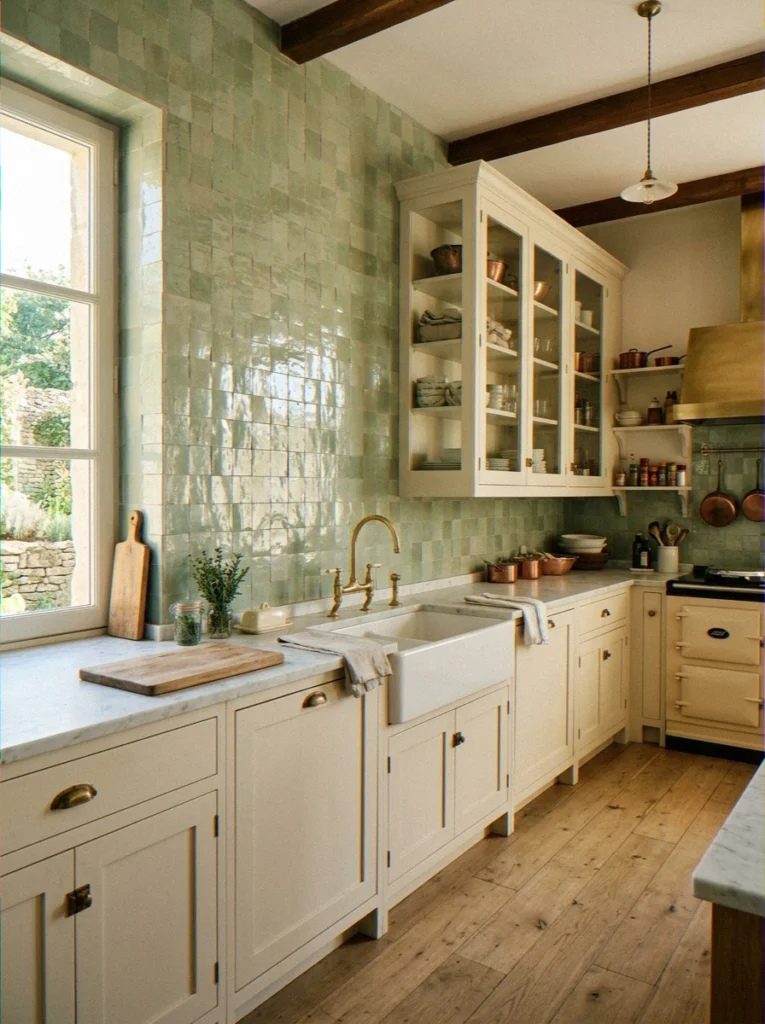
Zellige tiles — handmade Moroccan clay tiles with a jewel-like, irregular glaze — have become hugely popular in French country kitchens and I completely understand why. The way they catch light is unlike anything else.
They come in exactly the right colors for this aesthetic: soft green, warm white, sage, terracotta, dusty blue.
They’re on the expensive side but a single section of them behind the range or along one wall is genuinely breathtaking.
12. Windows, Curtains, and the Role of Natural Light
Café Curtains
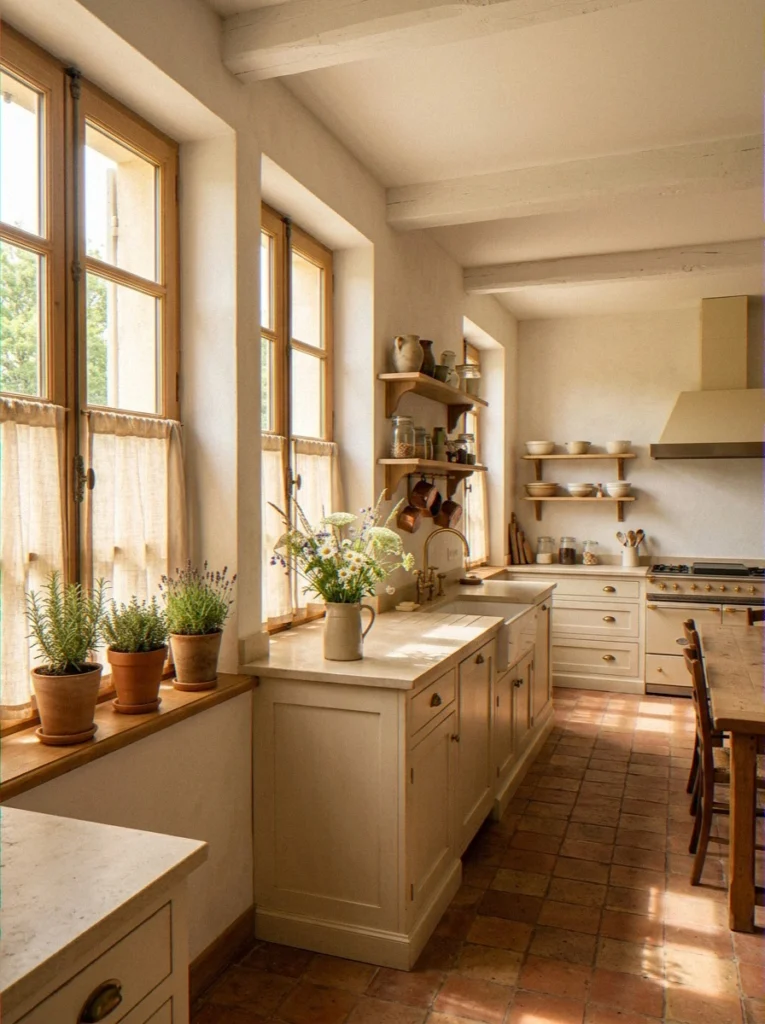
Café curtains — covering only the lower half of a window — are a quintessentially French detail. They provide privacy without sacrificing daylight, and in a simple linen, cotton stripe, or small check pattern, they’re charming in a completely unpretentious way.
Use a simple iron rod with plain rings rather than anything too decorative — the curtain should feel like it’s always been there.
Linen Roman Shades
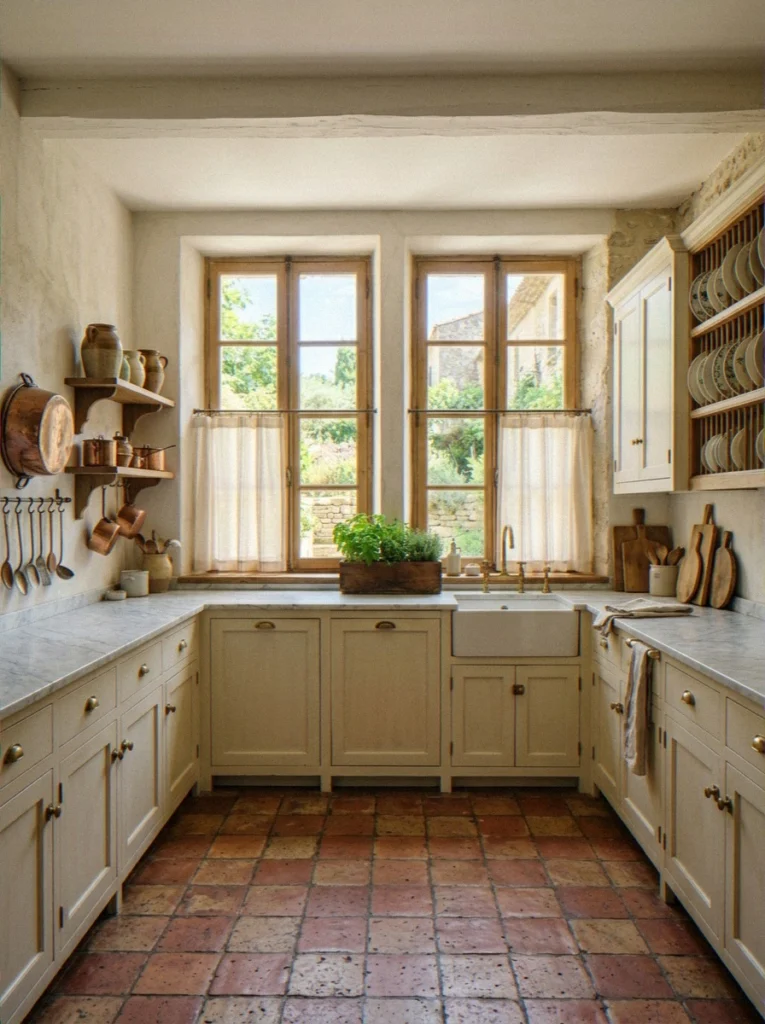
For a cleaner look, unlined linen Roman shades filter light beautifully while holding up well in kitchen conditions.
They’re calm, unpretentious, and look better wrinkled than most things do perfectly pressed. Very French, when you think about it.
Windowsill Herb Gardens
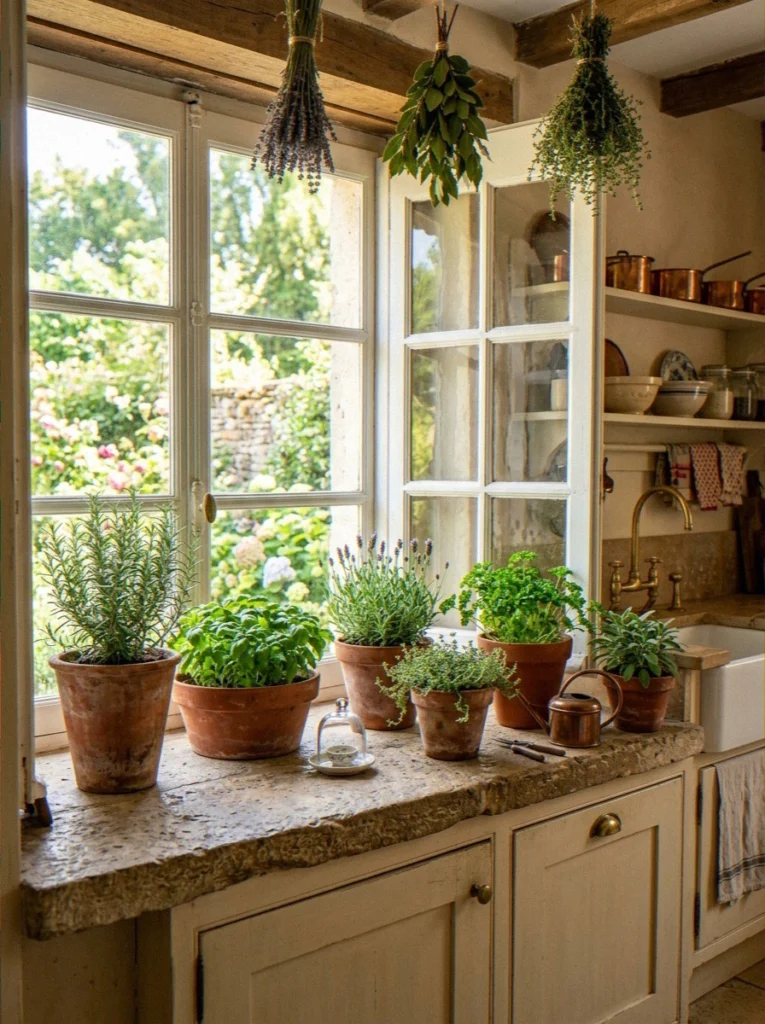
A French country kitchen needs herbs on the windowsill — this is non-negotiable. Terracotta pots of rosemary, thyme, basil, and lavender are both practical and deeply part of the visual story.
Vary the pot sizes, let them get a little overgrown, and resist the urge to make them look too perfect. Wild is better than staged here.
13. Flooring That Tells a Story
Terracotta Pavers
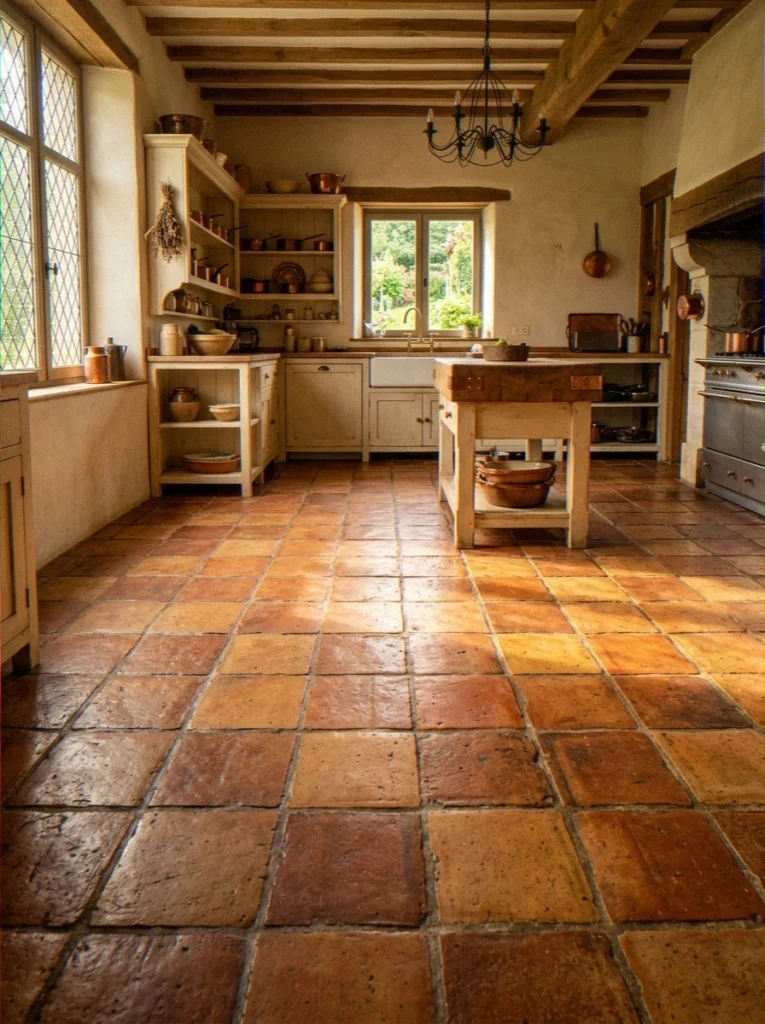
For this look, I love old-world terracotta pavers more than any other kind of flooring. They’re warm to walk on, they get a beautiful natural patina as they age, and they’re deeply and authentically linked to the French and Mediterranean style of this type of flooring.
If you can afford it, radiant heating under terracotta is a great way to change your life. If you seal it correctly, your terracotta stains won’t show, and your floor will get better every year.
Wide-Plank Hardwood
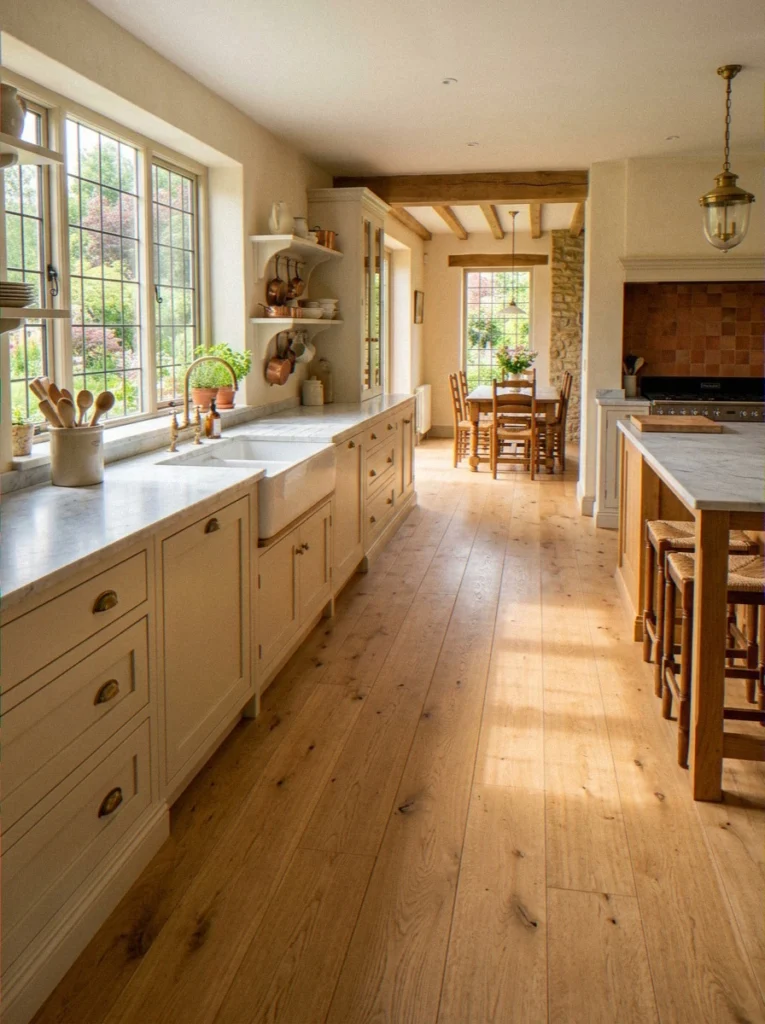
For a warmer, less rustic option, wide-plank hardwood floors in white oak or pine are deeply classic.
Look for visible knots, natural grain variation, and a wire-brushed or hand-scraped surface rather than anything glossy or machine-smooth.
Matte-finish rift-and-quartersawn white oak is, honestly, one of the most beautiful floor materials you can put in a kitchen — full stop.
Encaustic Cement Tiles
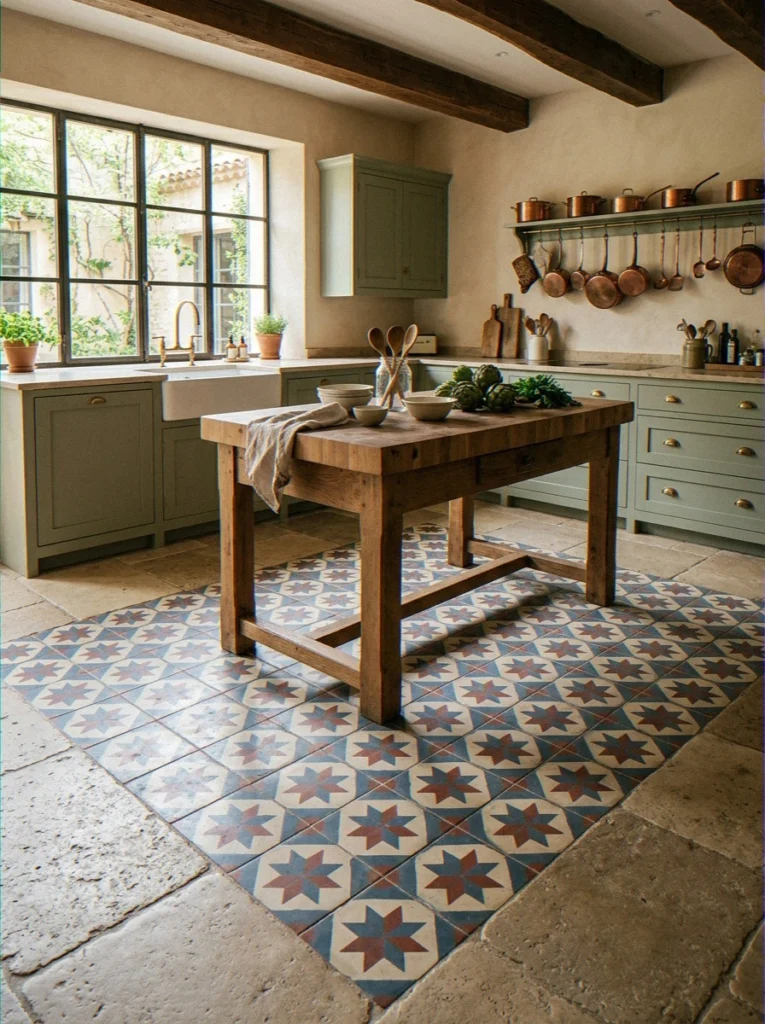
Encaustic cement tiles with geometric or floral patterns bring incredible personality to a kitchen floor.
Labor-intensive to make, which is reflected in the price — but even a small area (the kitchen entry, under the island) creates a major design moment that people notice immediately. They’re not a background detail; they’re a statement.
14. Accessories and Styling: The Soul of the Space
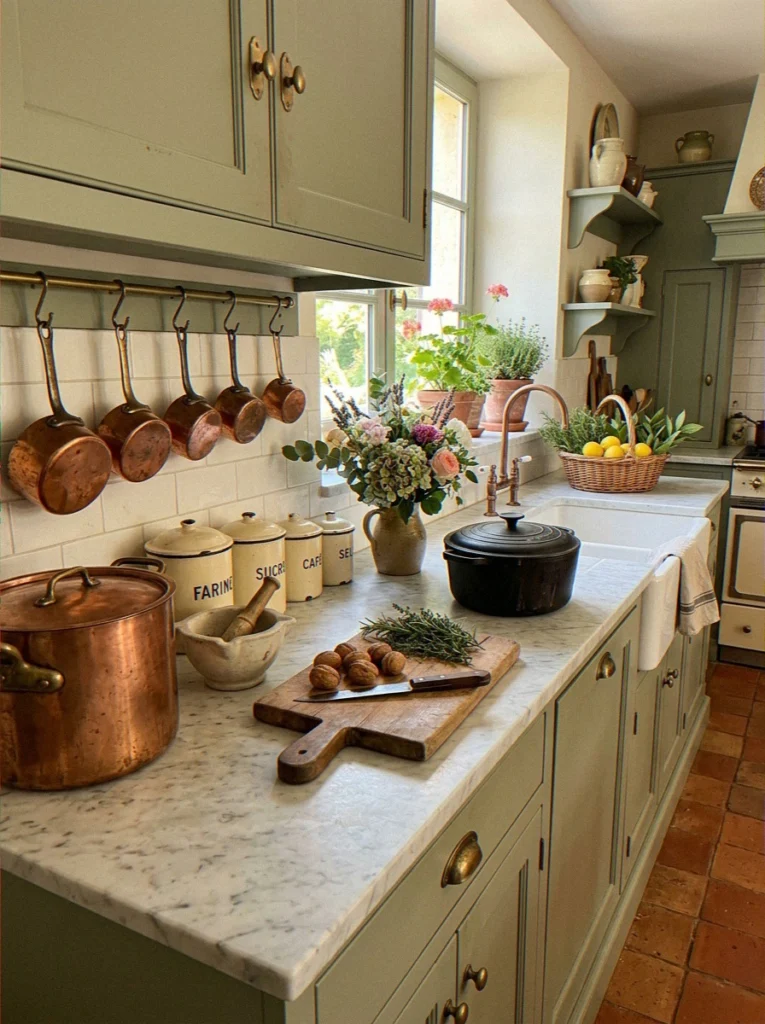
Copper, Enamelware, and Cast Iron
This is where the French country kitchen really comes to life. There were copper pots hanging from the ceiling.
There are cream enamelware canisters on the counter. A Dutch oven made of cast iron that looks like it owns the place on the stove.
These aren’t just pretty things; they’re also useful. That mix is what makes this style feel so real. A row of copper measuring cups hanging from hooks is free decoration. A stack of old cast-iron pans is part of the design. Everything counts.
Vintage and Antique Finds
The French country aesthetic actively needs old things. Vintage olive jars. Antique farmhouse scales. Worn wooden breadboards. Aged pottery. You cannot buy this look new — you have to hunt for it, and that hunting is half the fun.
Local antique markets, estate sales, and platforms like eBay and Etsy are goldmines. Set aside a Sunday, make it a mission, and don’t rush it. The best pieces in my kitchen all came from unexpected places.
Dried Herbs, Botanicals, and Fresh Flowers
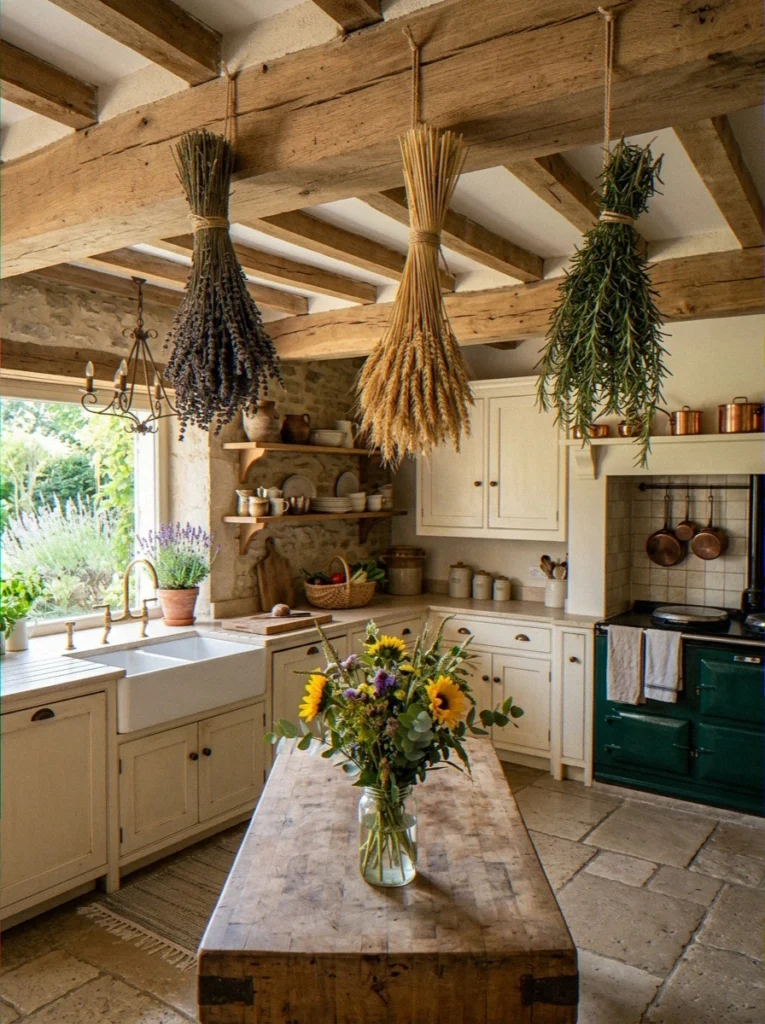
Bundles of dried lavender or rosemary hung from ceiling beams or hooks are nearly free and add extraordinary authenticity.
Combine with fresh flowers — a jar of sunflowers, wildflowers, or a simple bunch of lavender on the counter — and you’ve got a kitchen that feels genuinely alive.
The French approach to flowers is abundant but unstudied: grab them from a market, stick them in whatever vessel is nearby, don’t overthink it.
Wicker Baskets and Linen Textiles
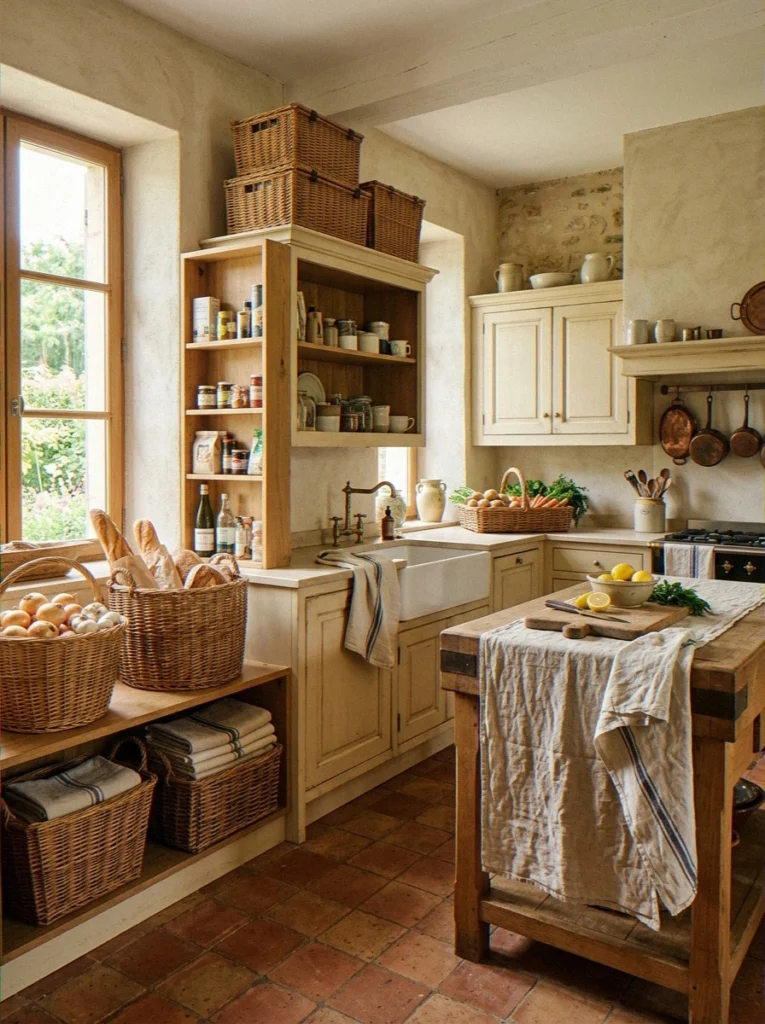
Wicker baskets are workhorses here — store produce in them, display bread, stack them on top of cabinets, line open shelves.
They add natural texture at every level of the room. Linen is the textile of choice: dish towels, table runners, curtains. It wrinkles beautifully and looks better the more you use it — which is a wildly rare quality in home goods.
15. The Kitchen Island: Make It the Heart
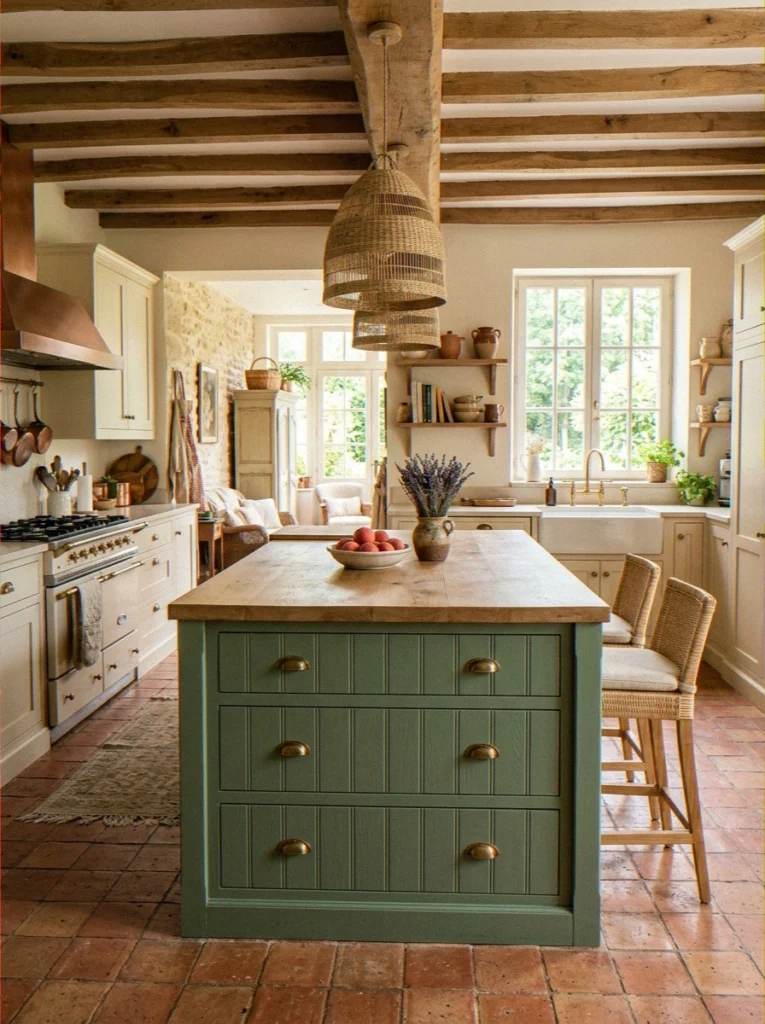
A Contrasting Island Color
One of the best things you can do in a French country kitchen is paint the island a different color than the cabinets around it. Sage green island with cream-colored edges? Very pretty. A deep blue island against a warm white sky? Stunning.
The contrast makes the space more interesting to look at, breaks it up, and gives the island its own identity as the room’s meeting place.
Bead-Board Paneling on the Island Sides
Bead-board paneling on island sides adds a cottage-quality texture that flat panels simply can’t match. Paint it to match the island color for a seamless look, or pick it out in white for a contrasting detail that references the cabinetry above.
Either way, it adds architectural character that transforms a plain box into something that looks built and considered.
Built-In Bench Seating
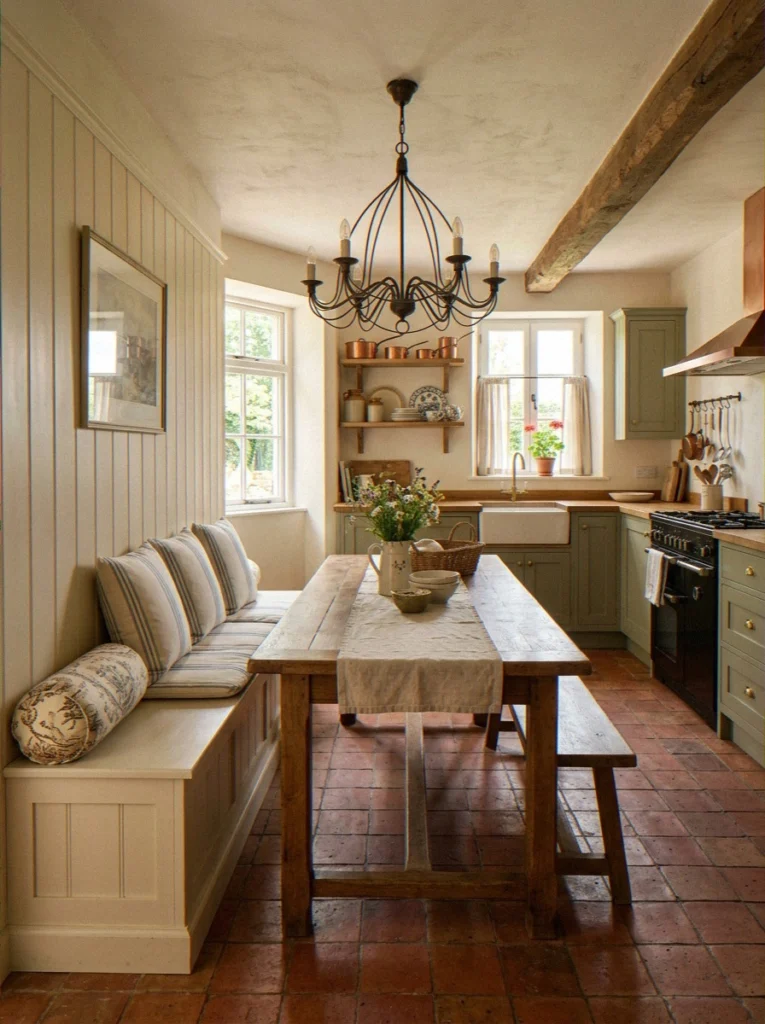
If your layout allows, built-in bench seating along one side of the island creates a genuinely incredible casual dining nook.
Add cushions in a ticking stripe or Provençal print fabric and you’ve got the exact spot where everyone ends up gathering when people come over. In my experience, this is where a kitchen goes from functional to truly social.
16. Pantry Design: The French Country Larder
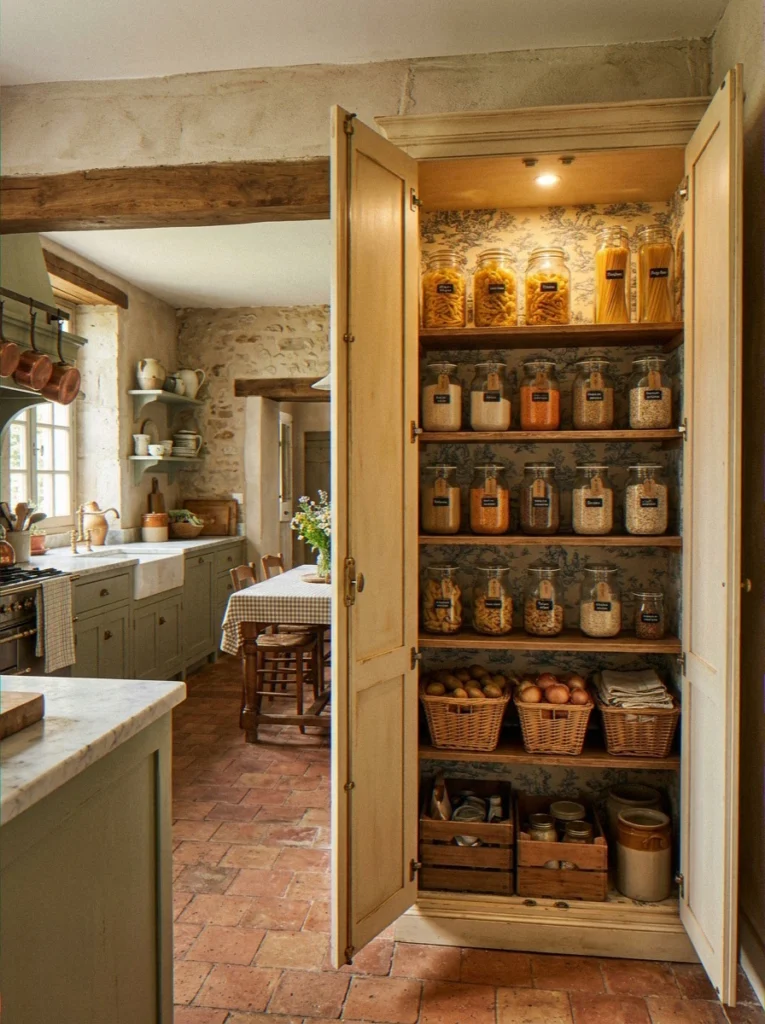
Traditional French homes had dedicated larder rooms — cool, purposeful food storage spaces that were serious about their function.
In a modern kitchen, a tall pantry cabinet fitted with pull-out shelves, hooks, and built-in organization recreates this beautifully. Line the inside with a simple toile or stripe wallpaper for a delightful surprise when the door opens — it’s a small touch that shows real intention.
Inside the pantry: wicker baskets with hand-written labels, glass jars of decanted pasta and grains, wooden boxes for small items.
Decanting pantry staples into glass jars sounds fussy but it genuinely looks brilliant and makes everything easier to find. This is one of those small habits that changes how you feel about being in your kitchen every single day.
17. Wall Treatments That Add Depth
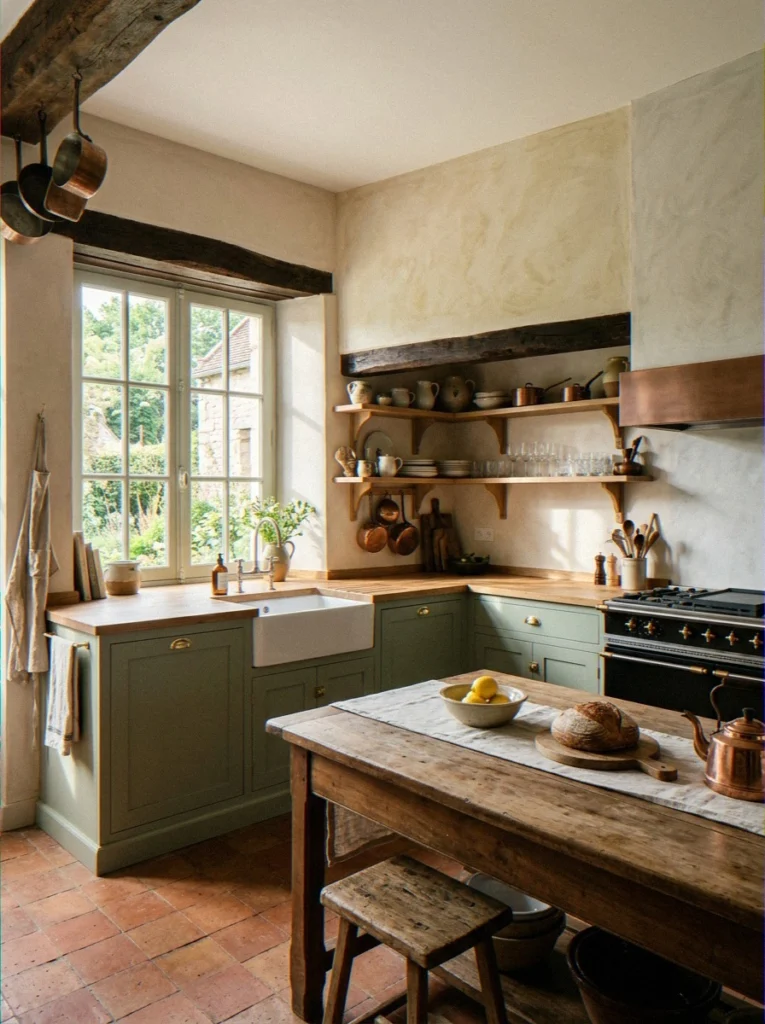
Lime-Wash and Venetian Plaster
Venetian plaster or a lime-wash paint finish adds extraordinary depth to kitchen walls that flat paint simply cannot touch. It catches light differently throughout the day, ages beautifully, and has an authentically European quality that reads as entirely correct in this aesthetic.
Portola Paints makes excellent lime-wash formulas that aren’t as difficult to apply as you might expect — and the result is genuinely spectacular.
Toile de Jouy (Used With Restraint)
One of the most famous patterns in this style is Toile de Jouy, which has a blue or red print on cream.
Use it sparingly in the kitchen, like in a pantry, as an accent panel, or as framed art. A little toile can go a long way. Even by French country standards, a whole kitchen covered in it is probably too much.
Shiplap and Tongue-and-Groove Paneling
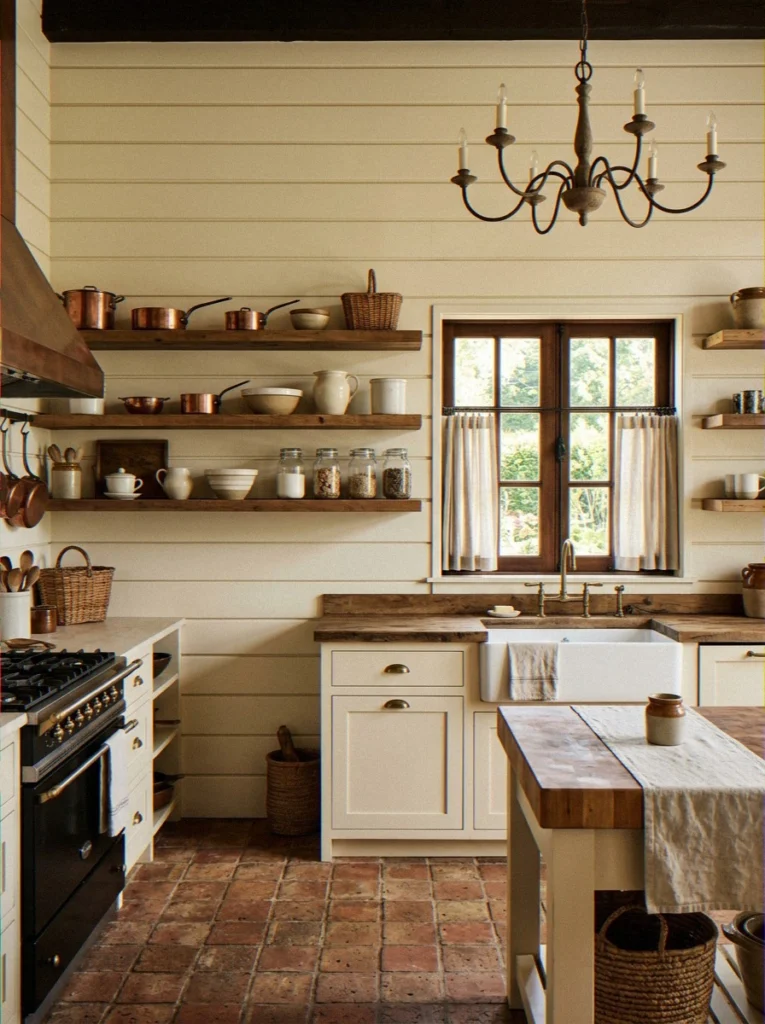
Painted shiplap or tongue-and-groove on a kitchen wall adds architectural texture without overwhelming the space.
Paint it matching to the cabinetry for a seamless envelope effect, or white against colored cabinetry for clean contrast. Either way, it adds dimension that a flat painted wall simply can’t provide.
Small Space French Country Kitchen Ideas — Vintage and Rustic Takes
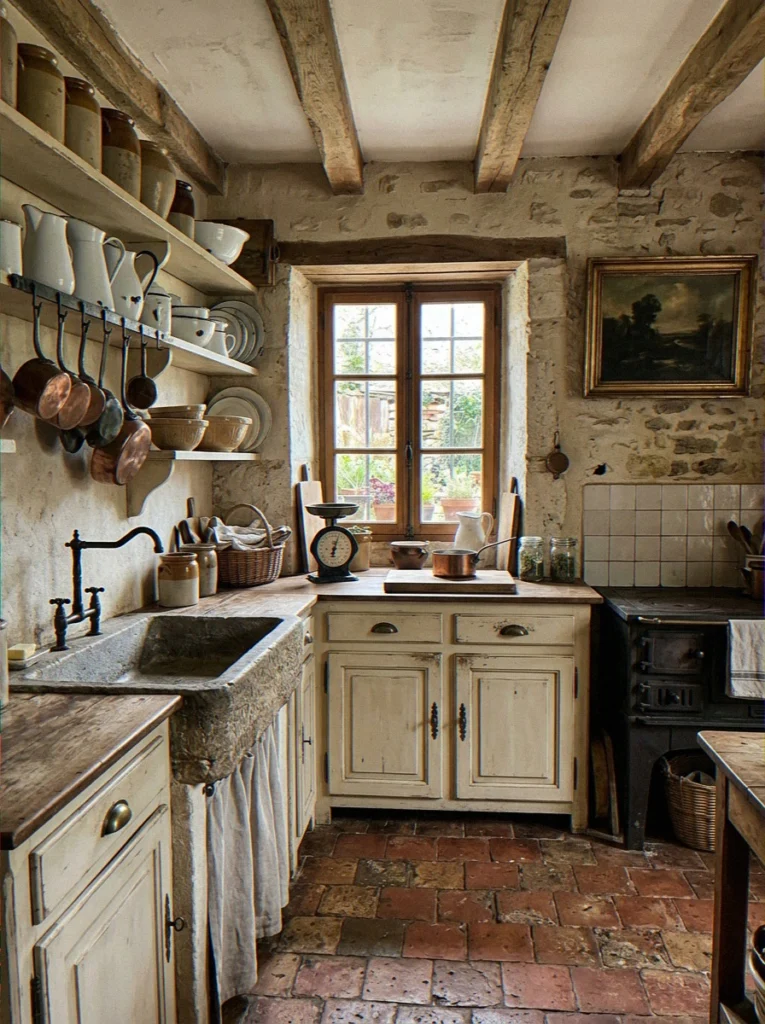
Vintage French Country Kitchen
The vintage direction is arguably the purest expression of this style. Genuine vintage pieces — a vaisselier, a farmhouse table, old pottery, a salvaged stone sink — create a kitchen that couldn’t be replicated with a design budget alone.
Hunt for real things. Accept the imperfection. Lean into the history. This approach rewards patience enormously.
| Vintage Element | Where to Find It | Budget Impact | Design Payoff |
|---|---|---|---|
| Vaisselier dresser | Chairish, 1stDibs | $$$ | Extremely high |
| Farmhouse table | Estate sales, eBay | $–$$ | Very high |
| Old pottery/jars | Flea markets, Etsy | $ | High |
| Antique lighting | Salvage yards | $–$$ | Very high |
Rustic French Country Kitchen
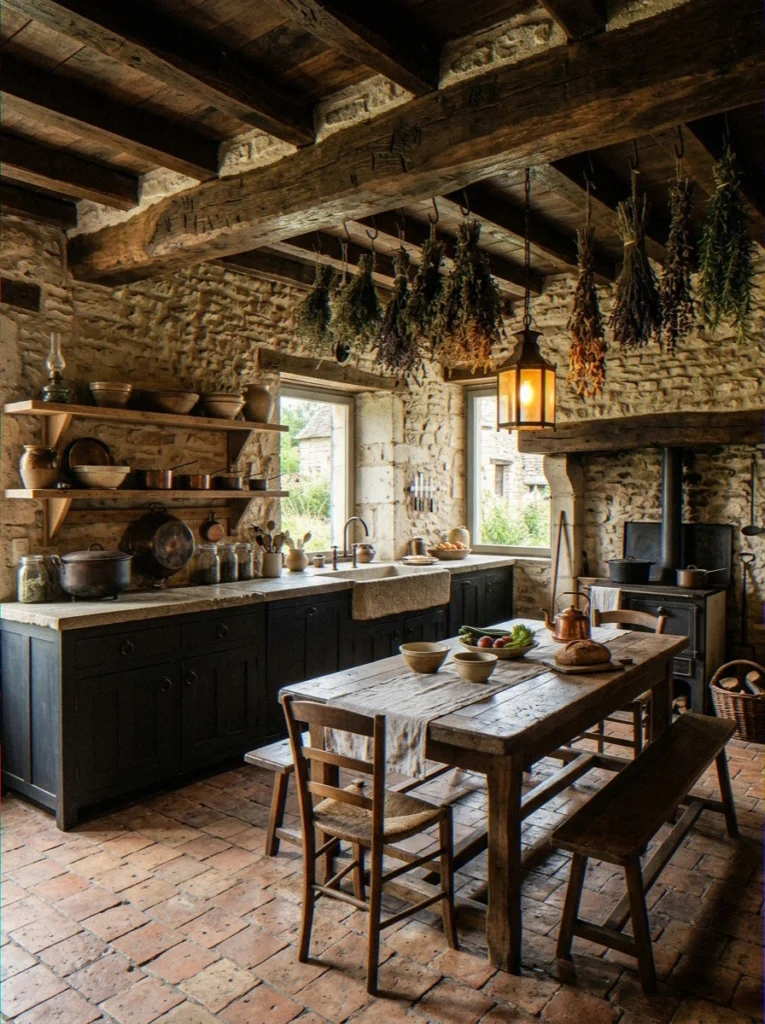
The rustic direction leans harder into raw materials and less refined finishes. Exposed stone walls, rough-hewn wooden beams, terracotta floors, and simple iron hardware — everything feels like it was built by hand from local materials, because in the original version of this style, it was.
The beauty of rustic French country is that it genuinely doesn’t require expensive finishes — it requires honest ones.
French Country Kitchen Design Ideas — Pinterest-Worthy Details
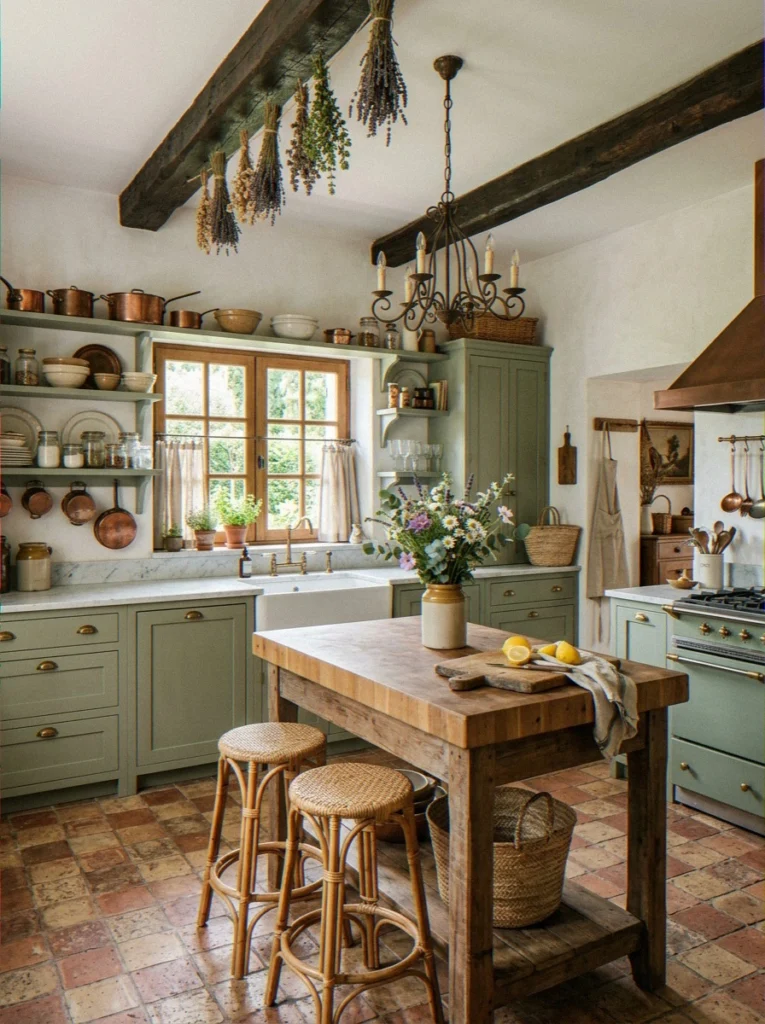
What makes French country kitchens so endlessly pinned? It’s the layering. No single element makes the aesthetic — it’s the copper pots AND the stone floor AND the wooden beams AND the sage cabinetry AND the linen curtains. All of it working together creates something that feels irreducibly warm and real.
The elements individually are beautiful; combined, they’re a lifestyle. That combination is what makes this style so consistently irresistible on Pinterest and beyond — it photographs like a dream because it’s designed around warmth, texture, and genuine life.
Small French Country Kitchen Ideas
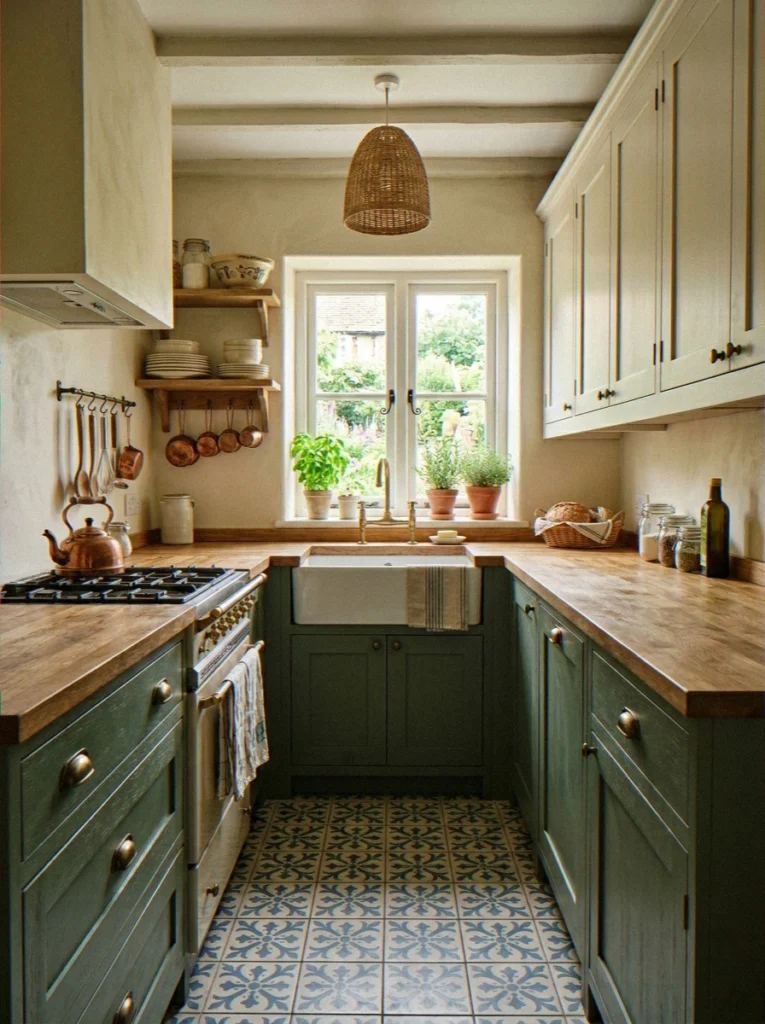
Small kitchens can absolutely carry this aesthetic — you just have to be strategic. Take storage vertical with tall cabinets, use one or two signature elements as anchors, and keep the palette tight and warm.
A farmhouse sink in a compact kitchen is still a farmhouse sink. A wrought iron pendant over a small island still does its job. Glass-front cabinets in a narrow kitchen make the space feel larger and more interesting simultaneously.
Small doesn’t mean sacrificing character — it means editing carefully. Two-tone cabinetry works especially well in small spaces: darker lower cabinets, lighter uppers grounds the room without shrinking it.
18. Bringing the Outdoors In
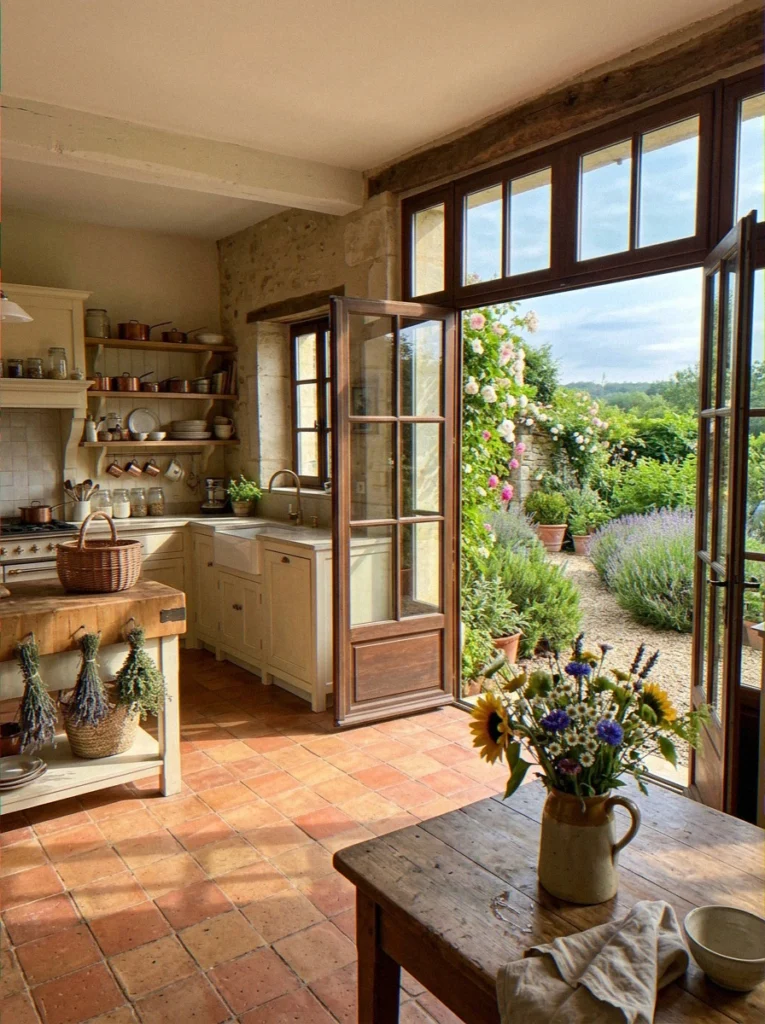
A kitchen garden view, framed intentionally through a simply dressed window, is one of the most powerful atmospheric elements available — and it costs absolutely nothing if the garden is already there.
Keep window treatments low and simple so the greenery reads as part of the room. If you don’t have a garden view, a windowsill full of herbs in terracotta pots does a convincing impression.
There is no way to get around having fresh flowers on the kitchen table. The French way: go to the market, get a bunch, put them in whatever container is nearby, and let them do their thing.
No fussing or arranging. In this case, a jar of sunflowers or a handful of lavender sprigs is prettier than any formal arrangement.
19. Mixing Old and New Without Losing the Thread
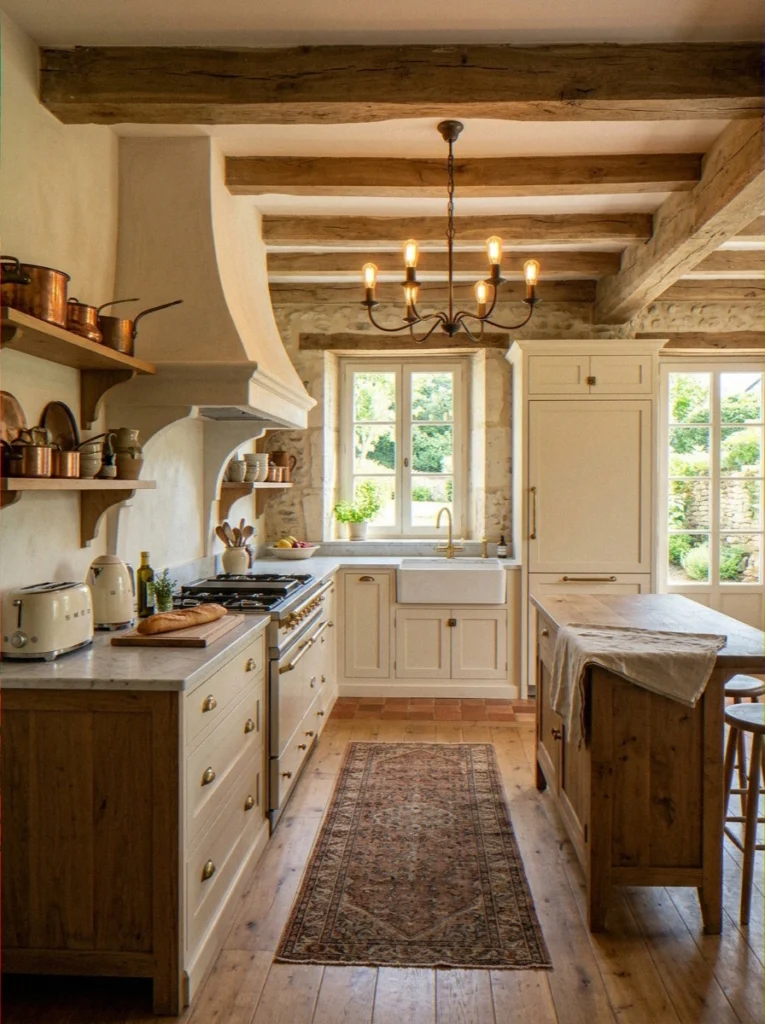
Panel-front refrigerators and dishwashers that disappear into cabinetry are how you integrate modern appliances without breaking the aesthetic.
For smaller appliances, look for designs in cream, matte black, or copper tones — SMEG makes retro-styled pieces that genuinely fit the visual language of this style without feeling like a gimmick.
One of the best things you can do with your money is to rewire old light fixtures so they can be used in modern times.
You can turn a wrought iron chandelier you bought at an estate sale for thirty dollars into the most beautiful light fixture in your home by cleaning it up and rewiring it. The quality of old ironwork is often much better than that of new ironwork that costs the same amount.
20. The Lived-In Final Layer
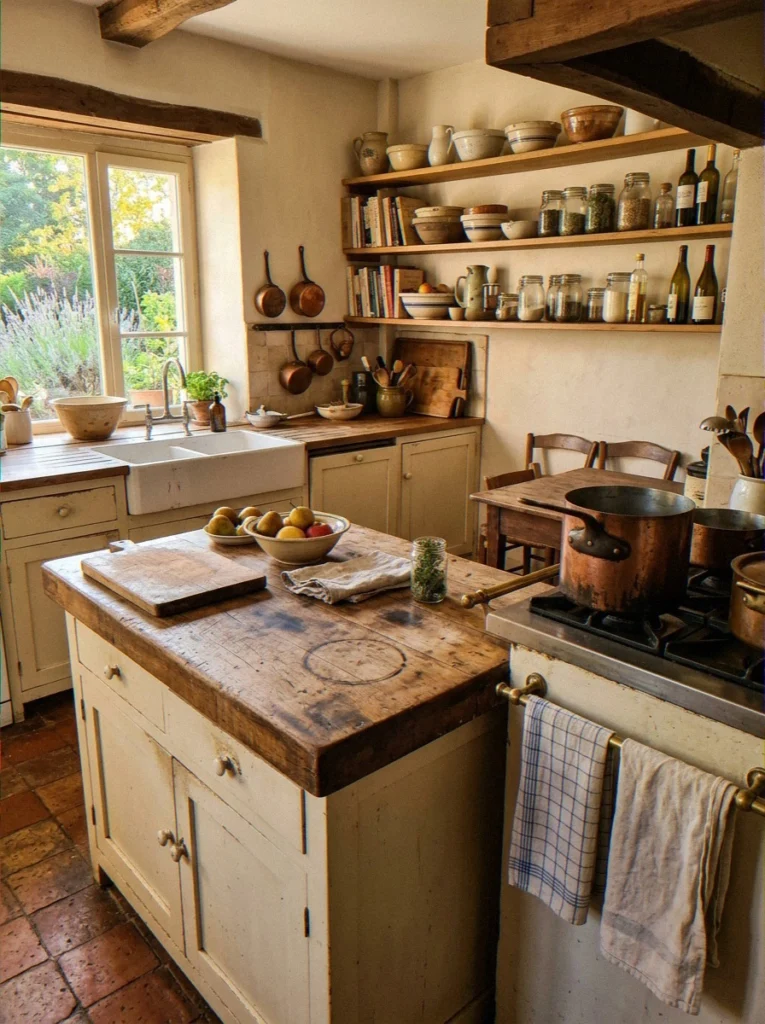
This is the part no designer can do for you. The French country kitchen becomes itself through use — through the oil stain on the butcher block from a hundred dinners, the faded linen dish towels, the copper pot that’s gone green-black at the base from the heat of the stove. It builds over time, through actually living and cooking and gathering in the space.
That’s what makes it so different from a designed-to-a-photo-shoot aesthetic. It’s not trying to look perfect. It’s trying to look loved. And a loved kitchen — one that shows evidence of real life being lived in it — is always the most beautiful kind.
French Country Kitchen Design: Quick-Reference Essentials
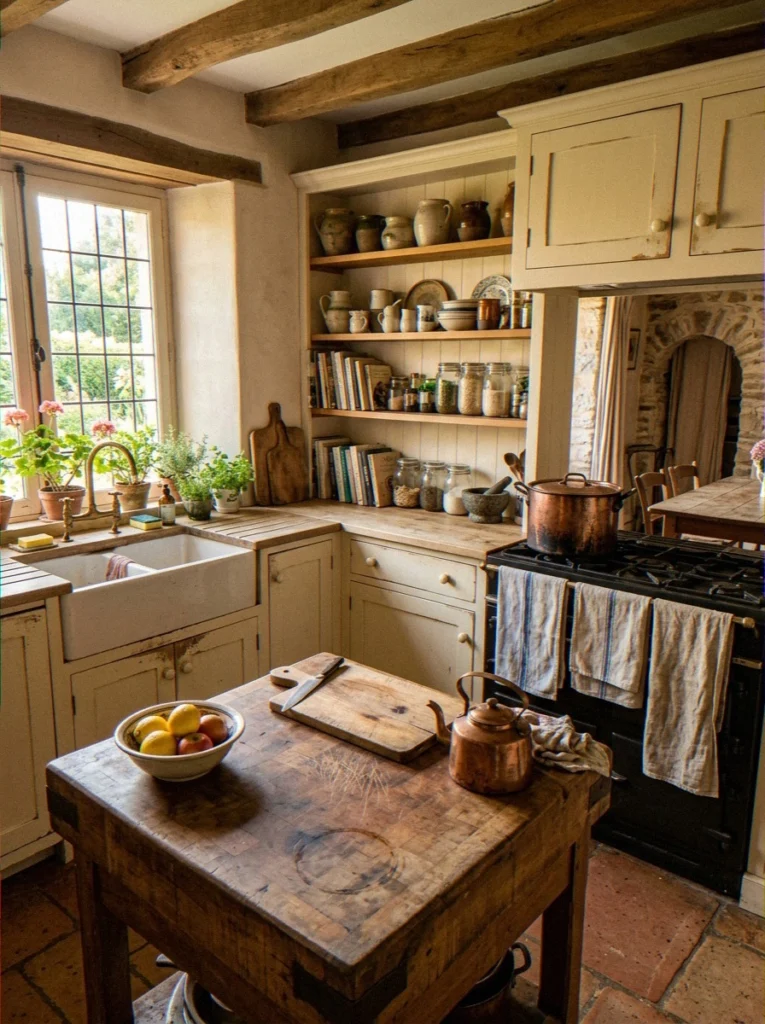
Must-Have Elements:
- Apron-front farmhouse sink in white fireclay
- Warm cabinetry color — cream, sage, or soft blue
- Unlacquered brass or wrought iron hardware
- Open shelving with displayed cookware and dishware
- Natural stone or butcher block countertops
- Terracotta, limestone, or wide-plank hardwood flooring
- Wrought iron or rattan lighting fixtures
- Fresh herbs, dried botanicals, and fresh flowers
- Copper, enamelware, and cast-iron accessories
- At least one genuine vintage or antique piece
People Also Ask
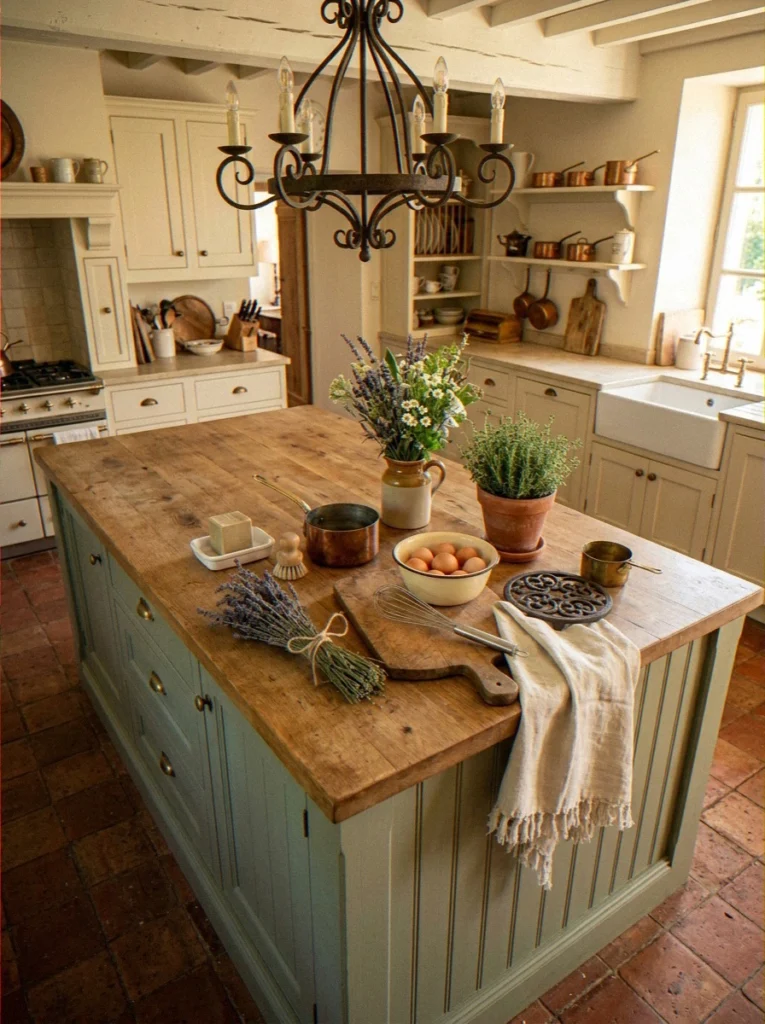
How to Make Your Kitchen French Country?
Start with the basics: a warm paint color, natural materials, and at least one unique feature, like a farmhouse sink or open wooden shelving.
You don’t have to do everything at once. Change your hardware to unlacquered brass; that alone changes the whole look of a room.
Put some old things in the room, like a wooden bowl, some old pottery, and a copper pot. Put herbs on the windowsill and hang a simple iron pendant. The style builds up over time through real choices and use, and that’s how it’s meant to be.
If you try to do everything in one weekend, it will work against you. The look needs to feel like it’s been built up over time, not just put together.
Are French Country Kitchens in Style?
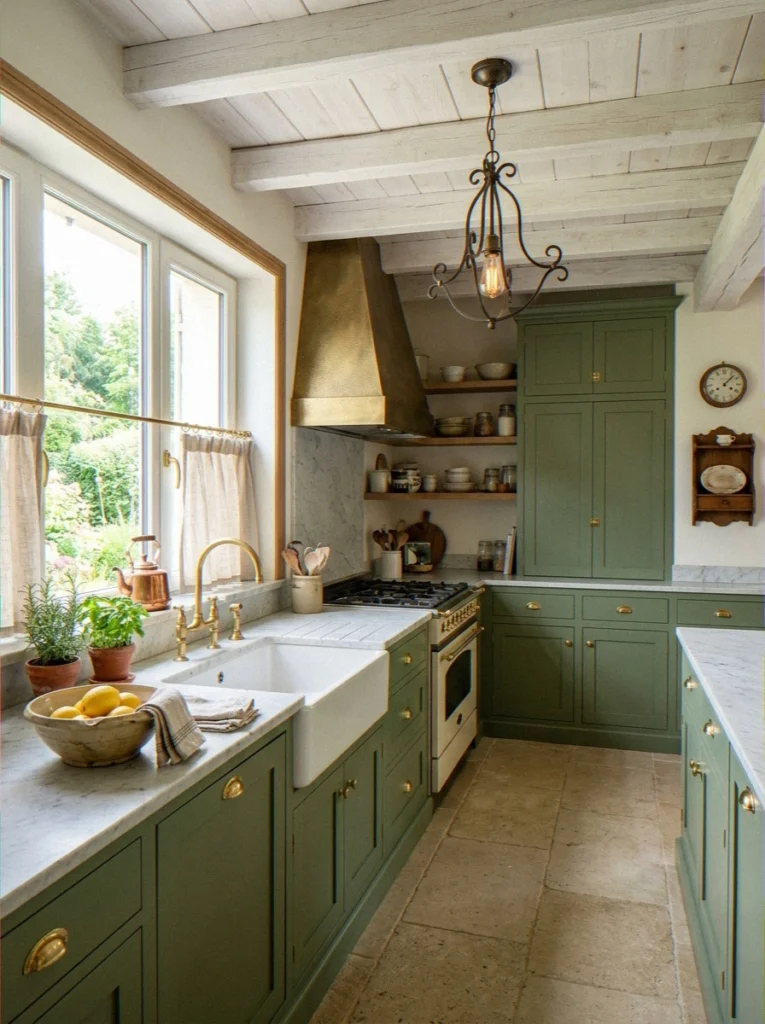
Yes — and more relevantly, they’ve never really gone out of style because they’re not trend-dependent in the way that, say, all-white minimalism or industrial loft kitchens are.
French country is anchored in timeless materials, honest craftsmanship, and a philosophy of warmth and livability that doesn’t expire.
The specific details shift — zellige tiles are very current, unlacquered brass feels fresh again after years of chrome — but the fundamental aesthetic has been continuously desirable for decades. It photographs beautifully, it ages beautifully, and it makes daily life feel genuinely good. That combination is bulletproof.
Discover More Decor Ideas
20 Gorgeous Serena And Lily Bedroom Ideas to Try Now
18 Gorgeous Black And Green Bedroom Ideas for a Bold Makeover
19 Stylish Black And Green Bedroom Ideas for Any Space
What Do Kitchens Look Like in France?
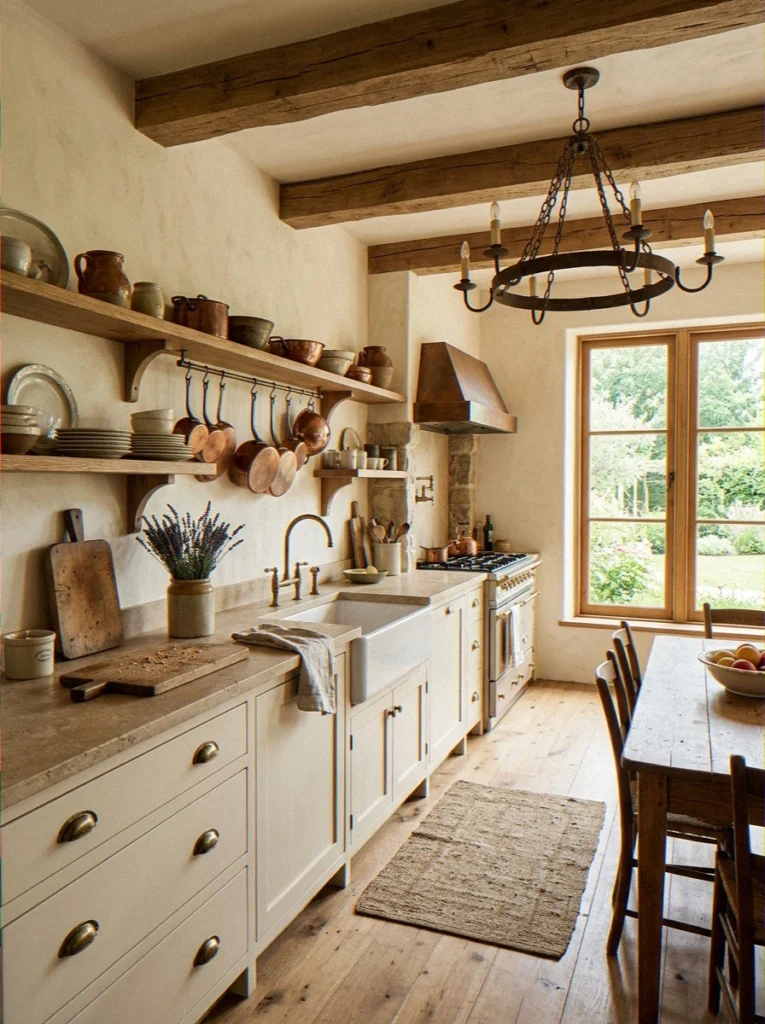
Not the Pinterest version of a French kitchen, but real French home kitchens are functional first and beautiful by habit.
They are usually smaller than American kitchens, with fewer upper cabinets and more open storage. Floors made of stone or tile are common.
A serious range is more important than a big fridge (the French shop every day, so they don’t need a lot of fridge space).
Instead of being hidden, cookware is shown off. The table is the most important part. It’s big, sturdy, and always has chairs for one more person than you think it will.
There isn’t a lot of fuss, which is very appealing: things are well-made, well-used, and well-loved.
What Are the 4 Types of Kitchens?
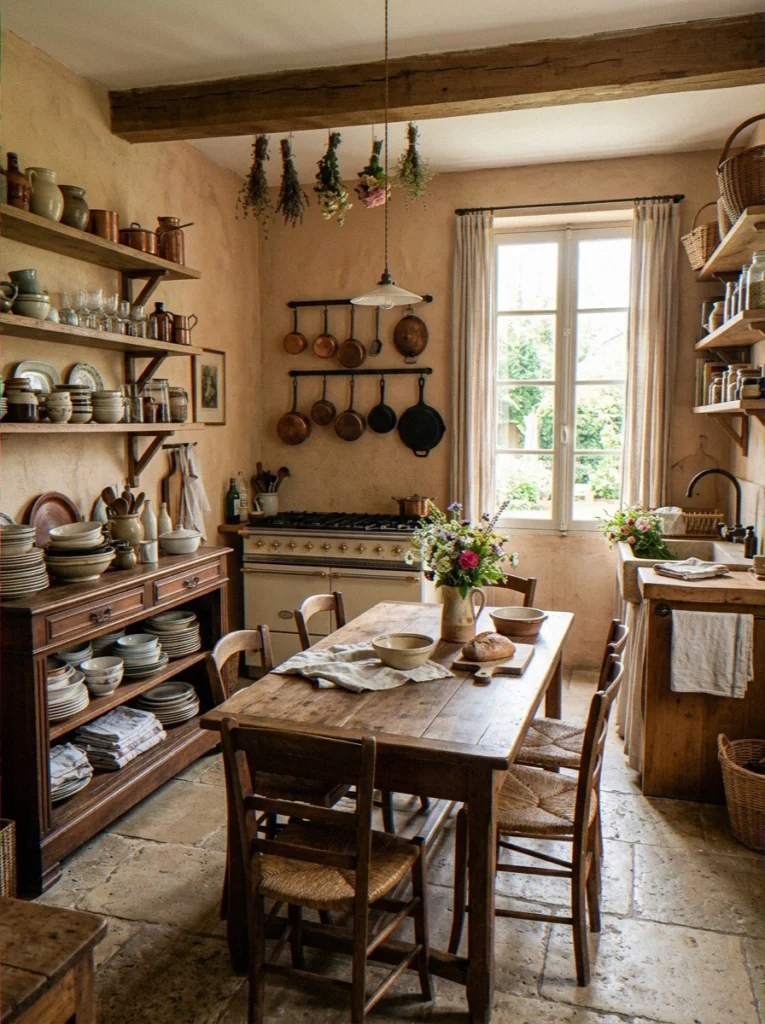
In terms of layout, the four classic kitchen configurations are:
- Galley kitchen — two parallel runs of cabinetry facing each other; efficient and compact
- L-shaped kitchen — cabinetry along two adjacent walls; flexible and common
- U-shaped kitchen — cabinetry on three sides; maximum storage and counter space
- Island kitchen — any of the above with an added central island; the French country ideal
French country style works brilliantly in all four layouts — the aesthetic is about materials, color, and character rather than a specific footprint.
A galley French country kitchen with stone floors, open shelving, and a copper pot rack can be every bit as beautiful as a large U-shaped kitchen with a statement island.
Wrapping It Up — Now Your Turn
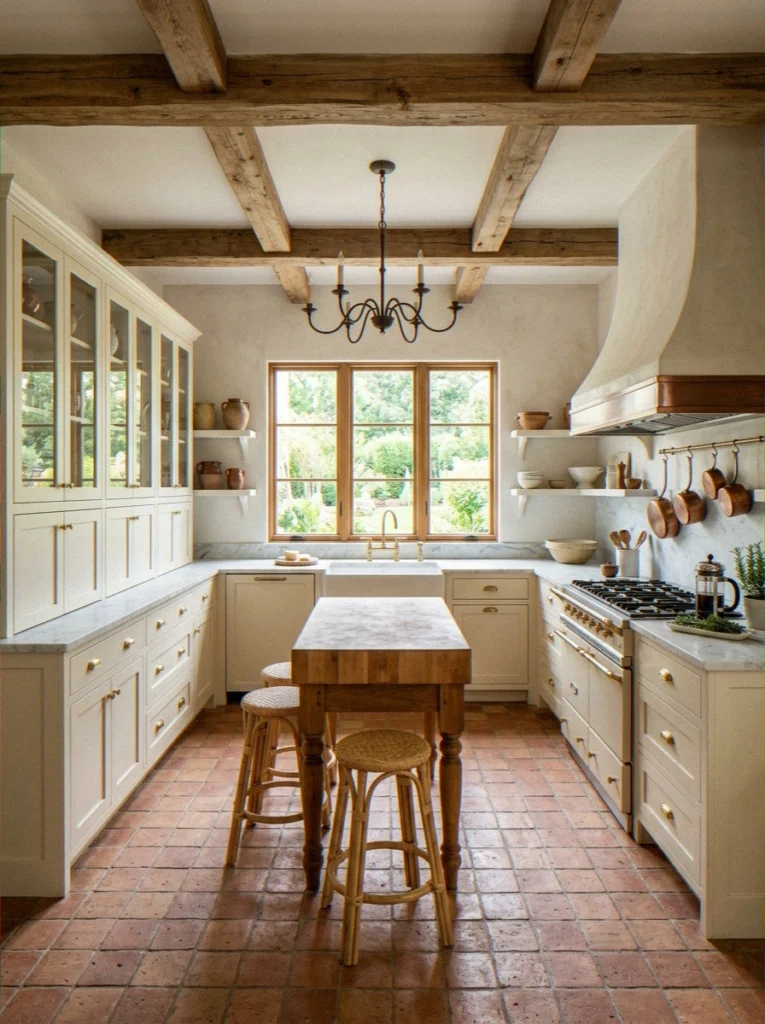
There you have it: 46 cozy and chic French country kitchen design ideas spanning everything from honed marble countertops and unlacquered brass hardware to dried lavender bundles and vintage vaisseliers.
The beautiful thing about this aesthetic is that it has no strict rules — only a spirit. Warmth. Texture. Natural materials.
A deep appreciation for things that are both beautiful and useful. A sense that the kitchen has been genuinely lived in.
You don’t have to do everything at once. Choose the color of the paint first. Switch out the hardware.
Choose one old thing that speaks to you. Put some plants on the windowsill. The French country kitchen builds itself slowly, through real choices and real living. That’s what makes it so fun to make.
This isn’t a look you install. It’s a feeling you cultivate. And bro — trust me on this — once you’ve got it, you’ll wonder how you ever cooked in any other kind of kitchen.
Which of these ideas are you starting with? Drop it in the comments — I’d genuinely love to know where you’re taking your kitchen next! 🏡
For further inspiration on restoring and designing with authentic materials, check out The Old House Journal, browse vintage finds at Chairish, and explore handcrafted cookware at Mauviel.
