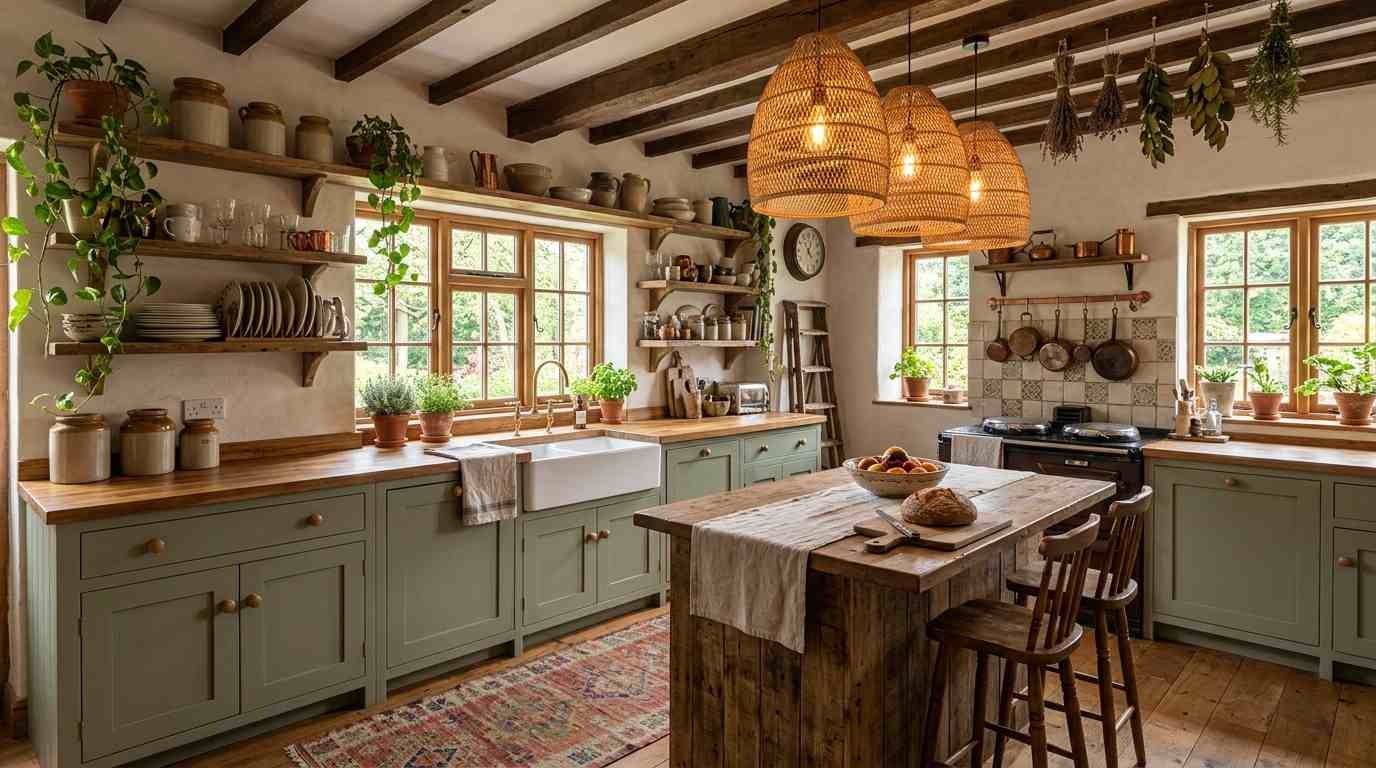
There’s something about a bohemian farmhouse kitchen that just stops you mid-scroll.
You know the feeling — you’re deep in a Pinterest rabbit hole at 11pm and suddenly one image makes you want to tear out your entire kitchen and start over. Yeah, that.
I’ve been obsessed with this style for years, and I’ve spent an embarrassing amount of time pulling inspiration from real homes, renovation blogs, and interior designers who actually live and breathe this stuff.
So here are 24 ideas that genuinely work — not just look good in a photo — for creating a kitchen that feels warm, slightly wild, and completely your own.
What Even Is a Bohemian Farmhouse Kitchen?
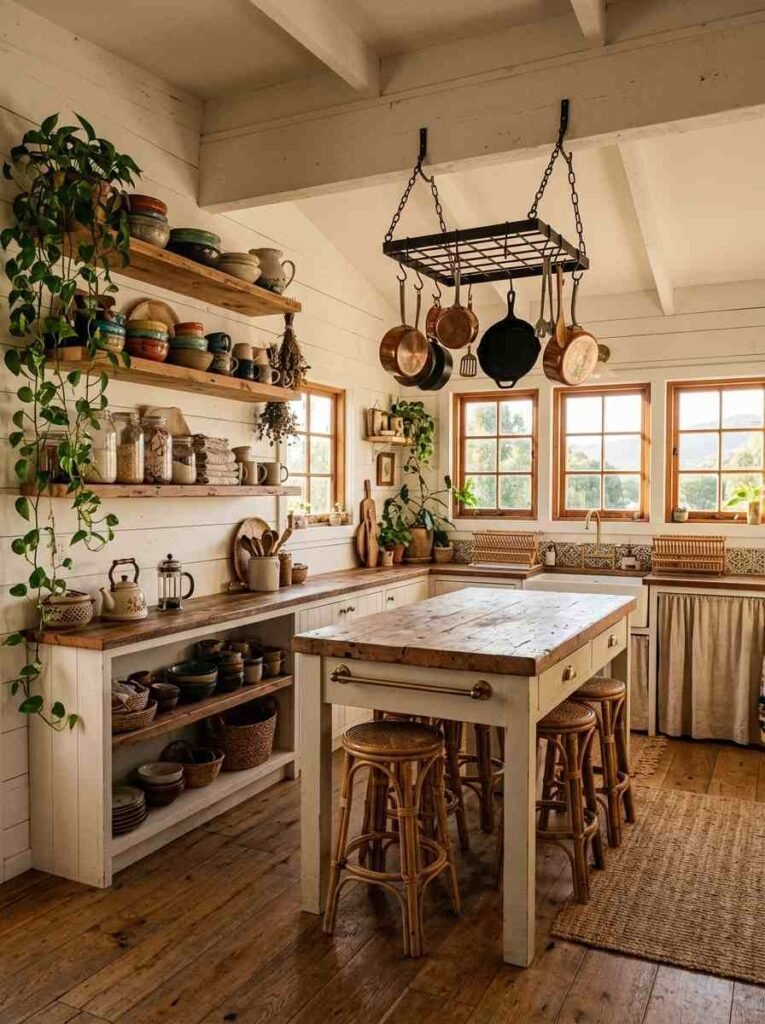
Good question. The boho farmhouse aesthetic sits right at the intersection of two styles that shouldn’t really work together but absolutely do. Farmhouse brings the structure — shiplap, open shelving, apron sinks, worn wood.
Bohemian brings the chaos — layered textiles, plants, collected objects, nothing perfectly matched.
The result? A kitchen that looks like it evolved over decades rather than being assembled from a single catalog page. That’s the goal.
1. Start With an Apron Sink (You’ll Never Go Back)
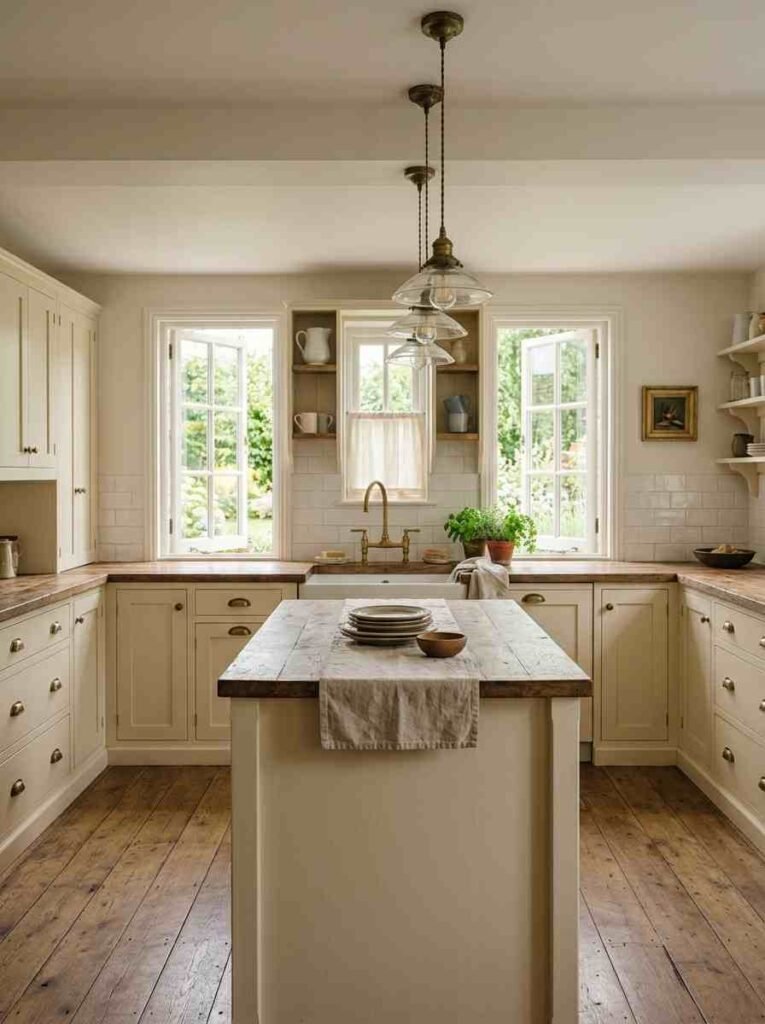
If there’s one non-negotiable in a boho farmhouse kitchen, it’s the apron front sink. Also called a farmhouse sink, it anchors the entire space.
I personally went with a fireclay option in a matte off-white, and it changed how the whole kitchen felt — suddenly everything else had something to organize itself around.
Pair it with unlacquered brass fixtures that will patina over time. That aging process? That’s not a flaw. That’s the whole point.
2. Open Shelving With Curated Clutter
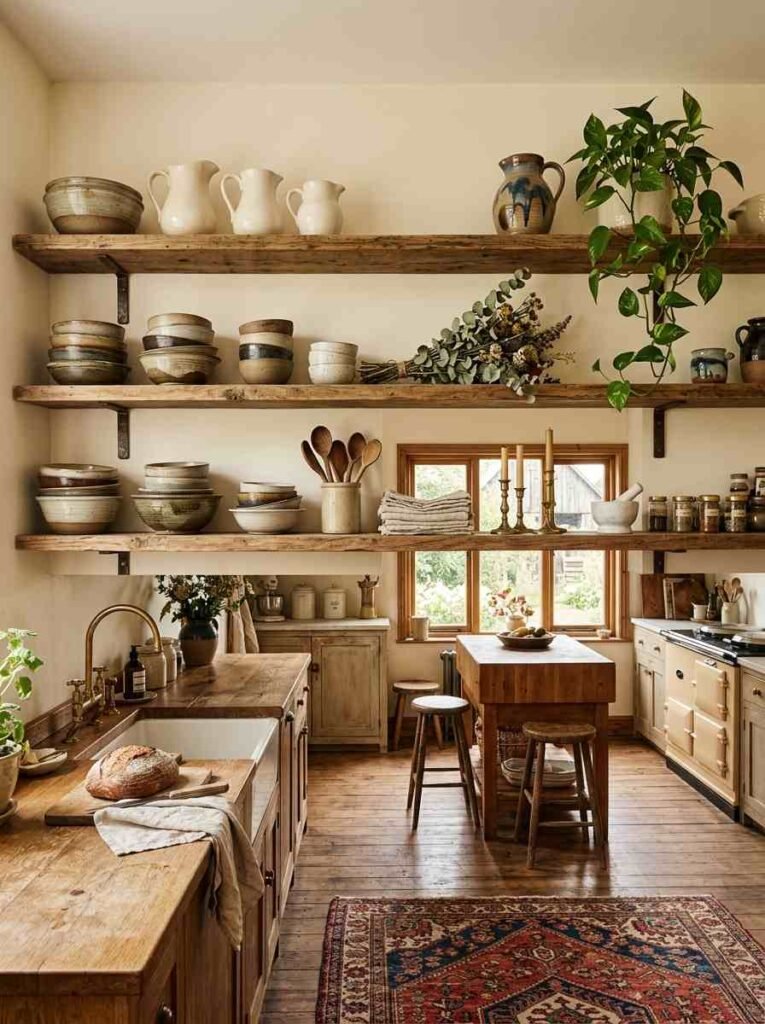
Open shelving is either the best decision you’ll make or a constant source of low-grade anxiety, depending on your personality. In a bohemian farmhouse kitchen, it works because the aesthetic allows for imperfect arrangement.
Stack mismatched ceramics. Mix vintage ironstone with handmade pottery. Let a trailing pothos drape over the edge of a shelf.
The open shelving guide from Apartment Therapy has some solid tips on making it feel curated rather than chaotic — worth a read if you’re on the fence.
3. Warm Wood Tones Everywhere You Can Manage
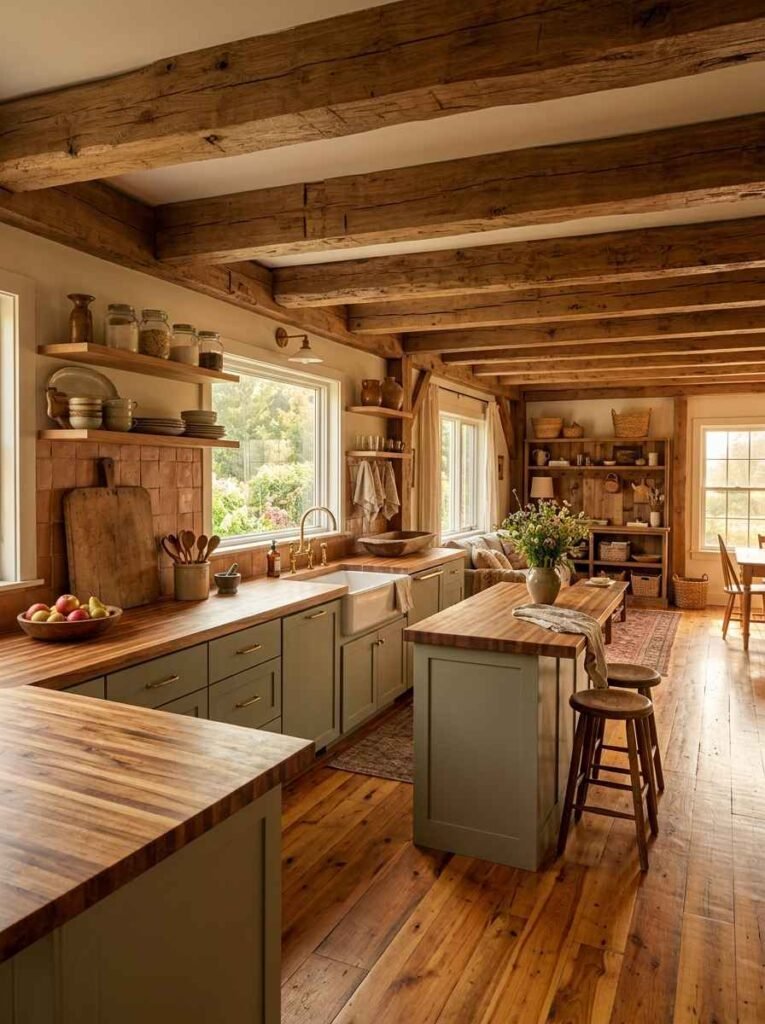
Cold gray and white kitchens had their moment. But nothing reads “warm, rustic, and chic” quite like wood.
Think butcher block countertops, wood-beamed ceilings, or even just a few solid wood cutting boards propped against your backsplash like art.
Reclaimed wood is the gold standard here. The knots, the grain variation, the slight imperfections — that’s what you’re paying for.
4. A Statement Backsplash That Doesn’t Apologize
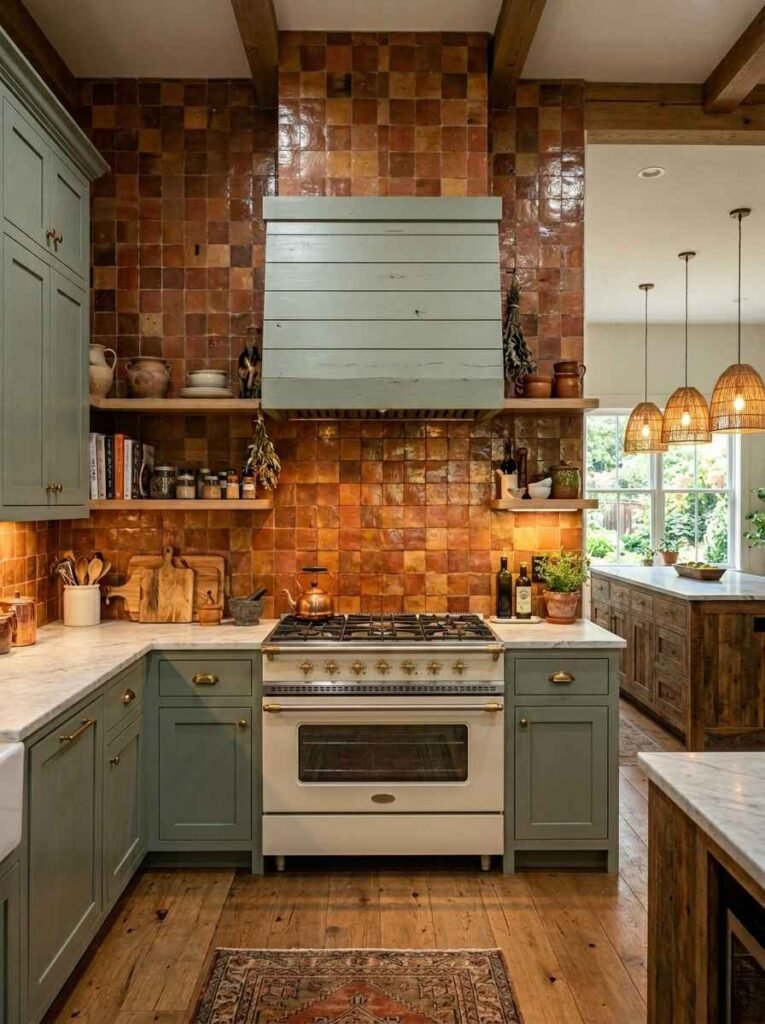
Most farmhouse kitchens default to subway tile. And look, subway tile is fine. But if you want that boho edge, go further.
Think Zellige tiles in terracotta, handmade tiles with slight color variation, or even a mix of vintage tiles that don’t perfectly match.
The imperfection is the point. A backsplash like this from Fireclay Tile can genuinely transform a basic kitchen layout into something that feels intentional and lived-in.
5. Vintage Rugs Under Your Feet
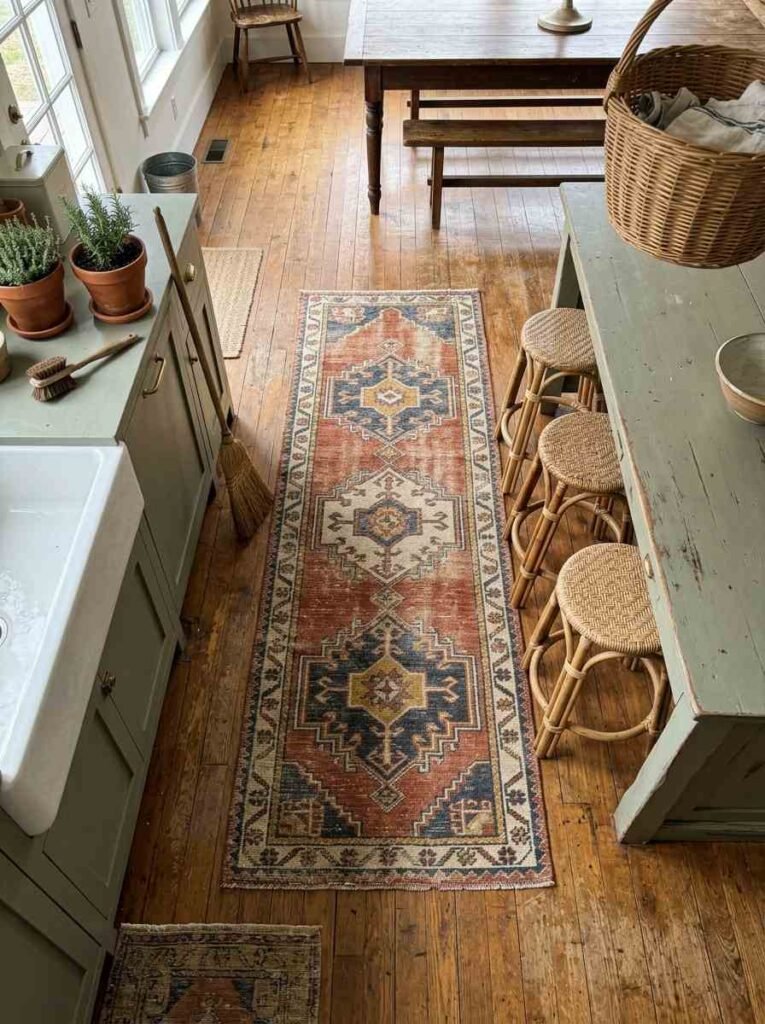
This is the one people always forget, and honestly it’s the easiest win. A vintage or vintage-inspired rug on a kitchen floor immediately softens the whole space.
Turkish kilim patterns work especially well. So do faded Persian-style runners. The key is going for something that looks like it has a story — not something fresh off an IKEA shelf.
6. Rattan and Wicker Accents
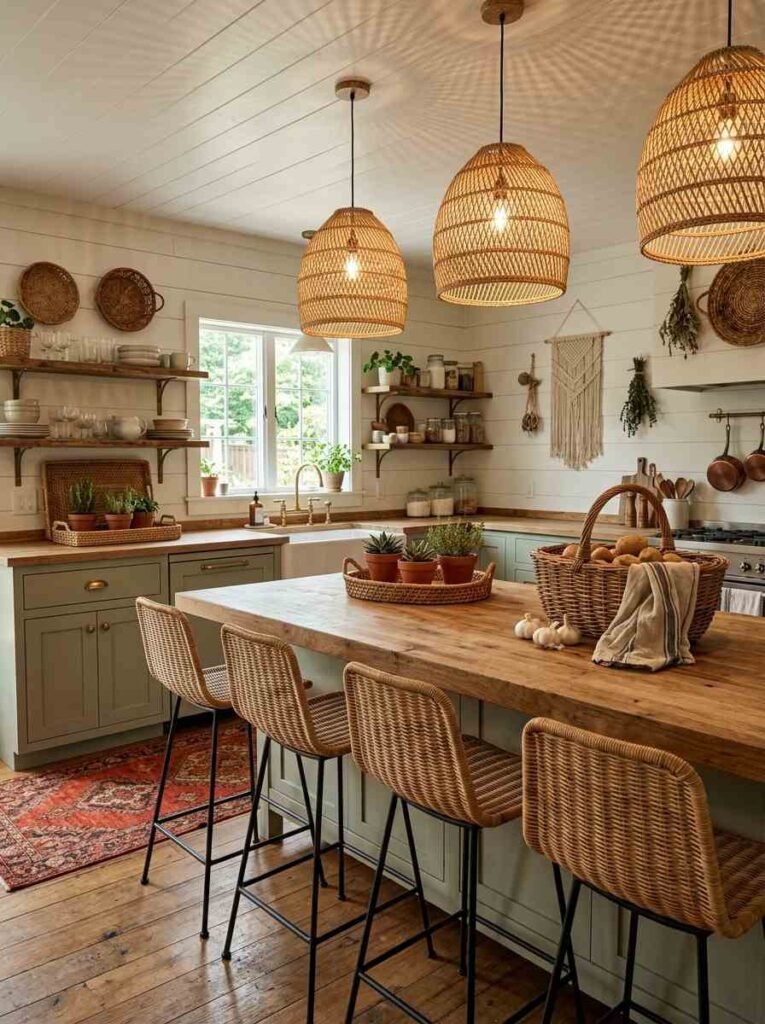
Wicker pendant lights. Rattan bar stools. A woven basket for storing onions and garlic on the counter.
These natural textures are the connective tissue of the boho aesthetic, and they layer beautifully with farmhouse materials like linen and raw wood.
FYI — rattan pendants over a kitchen island are probably the most-pinned boho farmhouse detail on Pinterest right now, and for good reason.
They’re warm, sculptural, and cheap compared to a custom light fixture.
7. Plants. More Plants. Then a Few More.
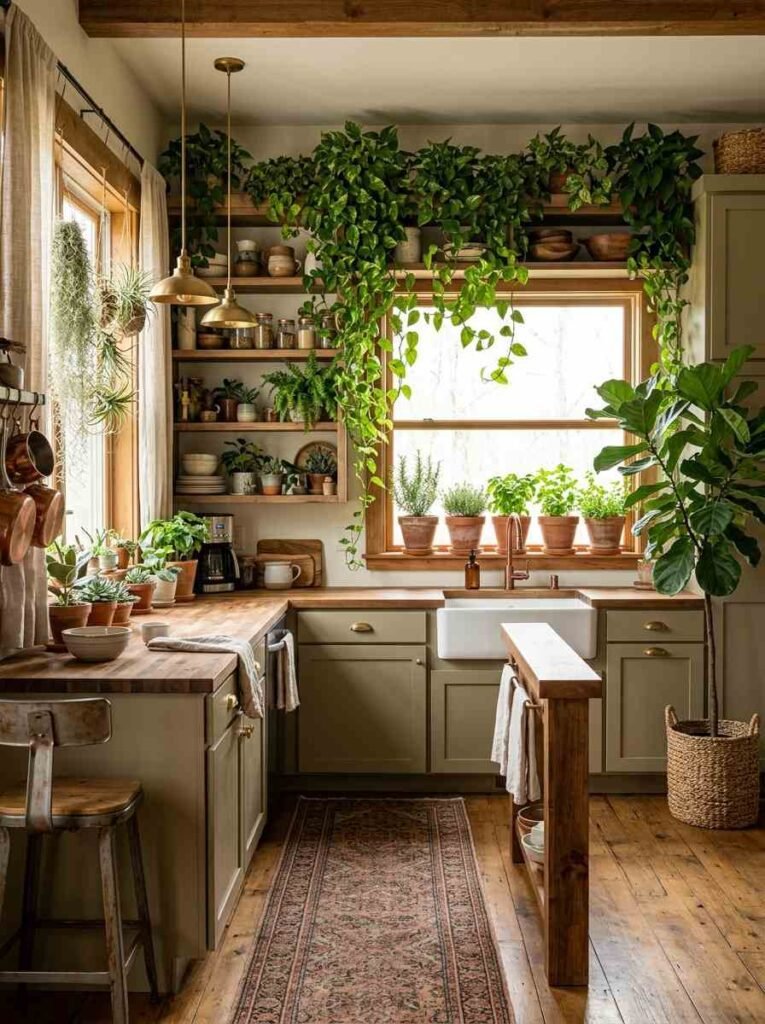
Wow — the difference a few plants make in a kitchen is genuinely insane. A trailing pothos above the cabinets.
Fresh herbs in terracotta pots on the windowsill. A fiddle leaf fig in the corner if you’re feeling ambitious (and if you can keep one alive, which I cannot).
Plants bring the outside in, which is core to the boho philosophy. They also make every photo taken in your kitchen look approximately 40% better.
8. Painted Cabinets in Earthy, Unexpected Colors
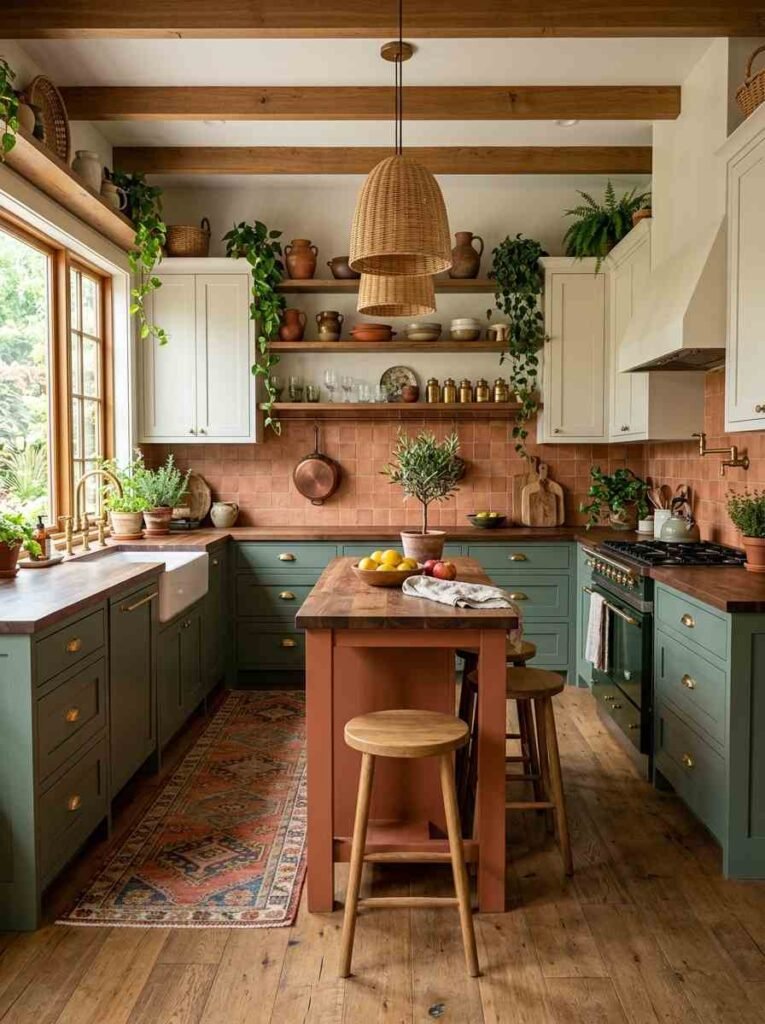
Forget white cabinets. Or if you love white, keep it — but consider an earthy alternative for at least one section. Sage green, terracotta, dusty blue, warm taupe — these colors read farmhouse without being predictable.
A two-tone approach works really well: lighter uppers, darker lowers. Or paint just the island a different color. You get the visual interest without committing entirely.
9. Mismatched Hardware That Actually Matches
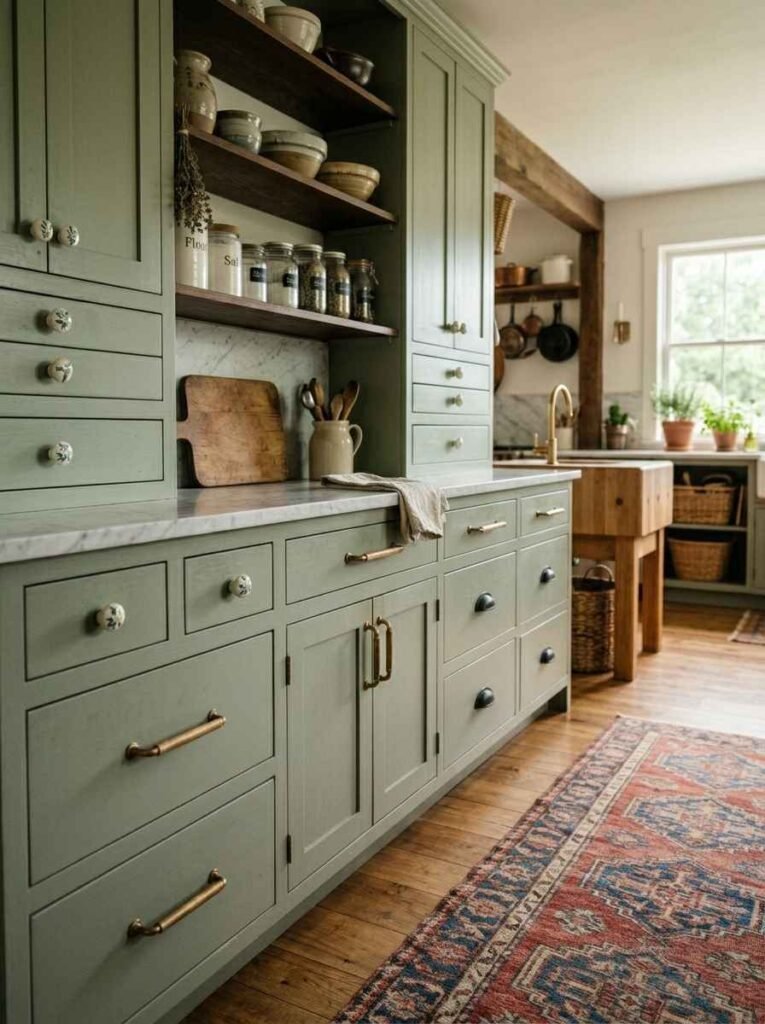
Here’s the thing about hardware in a boho kitchen — you don’t need everything to be the same finish.
Mixing aged brass, matte black, and vintage ceramic knobs actually works, as long as you keep some internal logic.
Maybe all the knobs are ceramic and all the pulls are brass. Maybe everything is brass but in slightly different shapes.
Consistency in material, variation in form. That’s the rule.
10. A Farmhouse Table That Doubles as a Kitchen Island
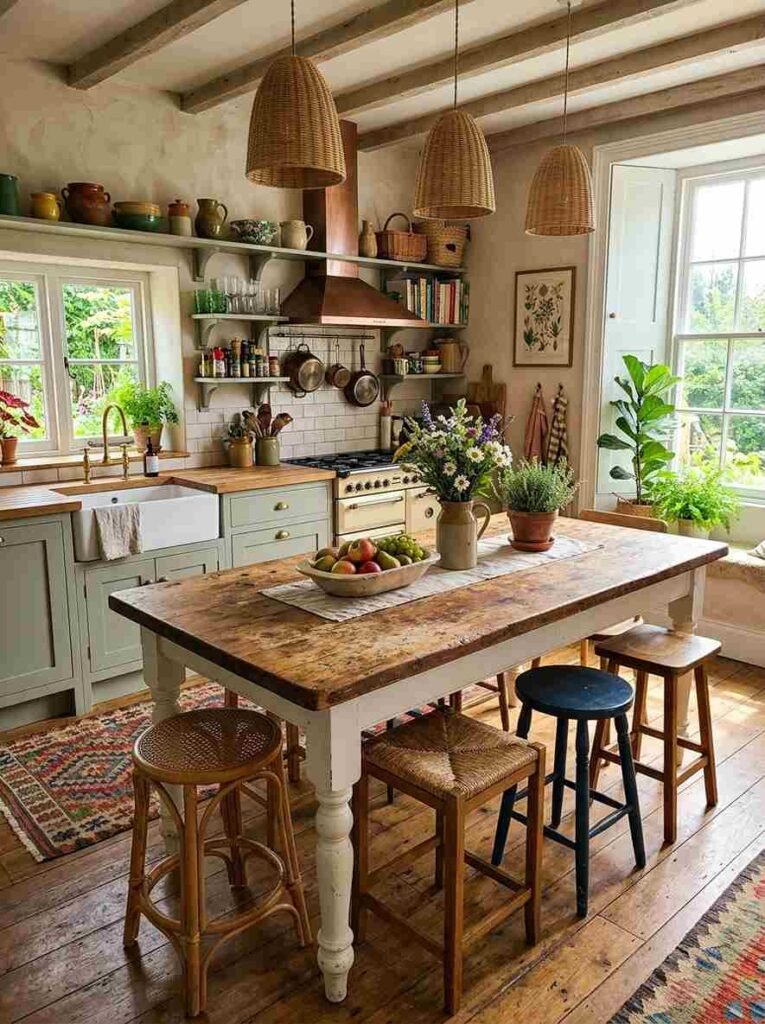
If your layout allows it, a big, sturdy farmhouse table functioning as a kitchen island is one of the most charming things you can do. It immediately makes the kitchen feel more like a gathering place than a work zone.
Scrub-top tables with turned legs, rustic trestle tables, old butcher blocks on casters — all of these work. Add a few mismatched stools and you’ve got something genuinely special.
11. Shiplap or Beadboard: Pick Your Fighter
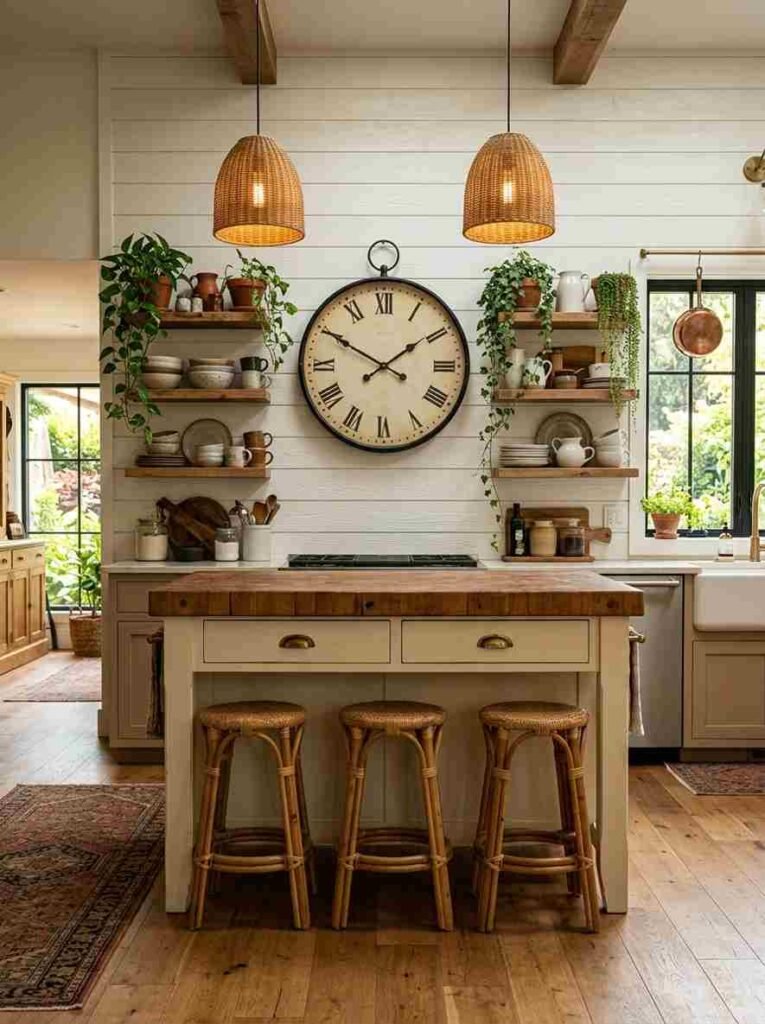
Both shiplap and beadboard are farmhouse staples. Shiplap reads more modern farmhouse — think clean horizontal lines. Beadboard reads more cottage or vintage. Either works in a boho kitchen, depending on the overall direction you’re going.
Apply it to one wall, the back of open shelves, or the kitchen island sides. You don’t need to go wall-to-wall for impact.
Boho Farmhouse Kitchen Style Quick Reference
| Element | Farmhouse Lean | Boho Lean | Sweet Spot |
|---|---|---|---|
| Shelving | Clean, white, spaced | Layered, eclectic | Open wood with ceramics |
| Color palette | White, cream, gray | Terracotta, jewel tones | Sage, taupe, rust |
| Lighting | Simple pendants | Lanterns, rattan | Woven pendants + sconces |
| Countertop | Marble, quartz | Mosaic, reclaimed wood | Butcher block |
12. Woven Pendant Lights Over the Island
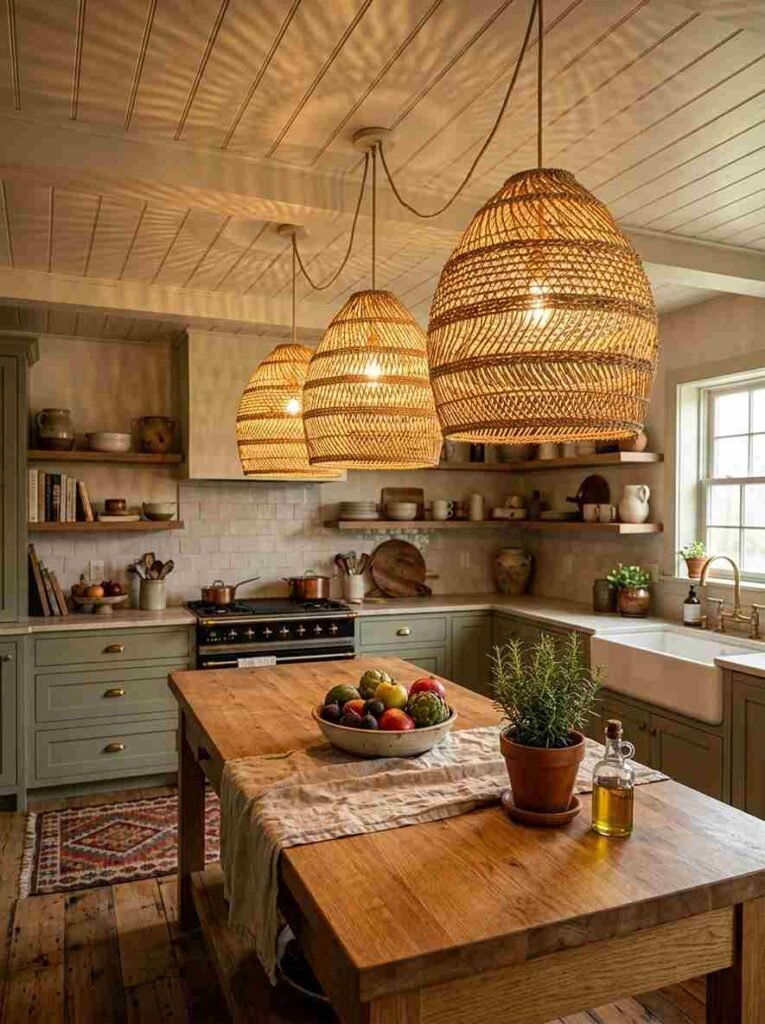
Already mentioned rattan, but it deserves its own section because the right pendant light does so much heavy lifting.
Look for pendants with visible weave texture — the kind where the light filters through the material and throws interesting shadows on the ceiling.
Hang them lower than you think. Kitchen pendants that hover just 28-32 inches above the counter surface feel intimate rather than distant.
13. A Pot Rack for Function and Form
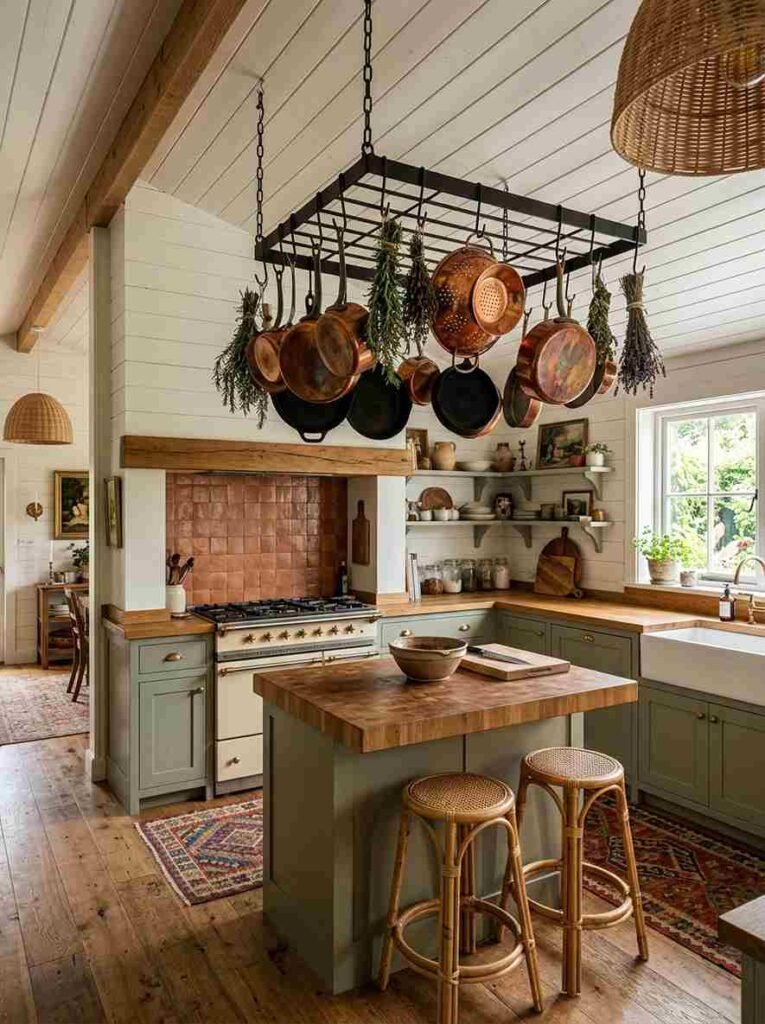
A hanging pot rack is one of the most functional and visually compelling choices in a boho farmhouse kitchen. All your cast iron and copper cookware becomes the decor.
Wrought iron ceiling-mounted racks are the classic choice.
Pair them with a mix of copper pots, cast iron skillets, and the occasional ceramic piece and you’ve got something that looks designed rather than improvised.
14. Exposed Brick or Stone (Even Faux Works)
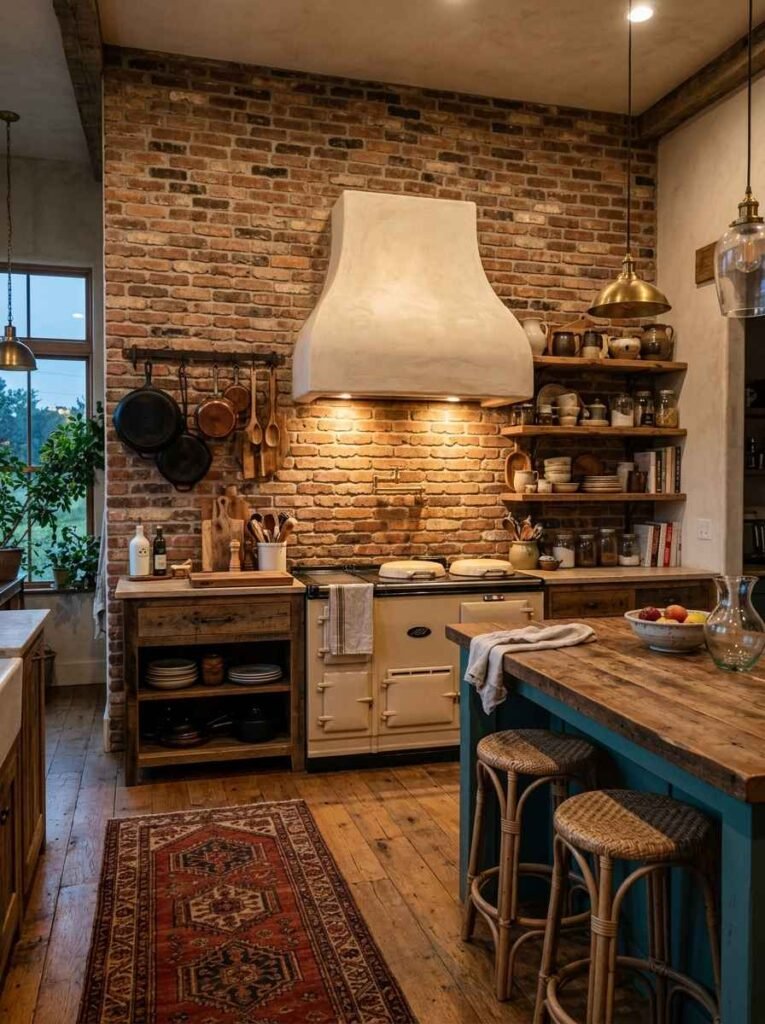
If you have exposed brick behind your range or along one wall, protect it with your life. If you don’t, consider a faux brick panel or a real stone accent wall.
The texture adds so much warmth and visual depth that paint simply can’t replicate.
A brick or stone surround around a range hood is particularly stunning and a very Pinterest-worthy focal point.
15. Linen, Cotton, and Natural Textile Accents
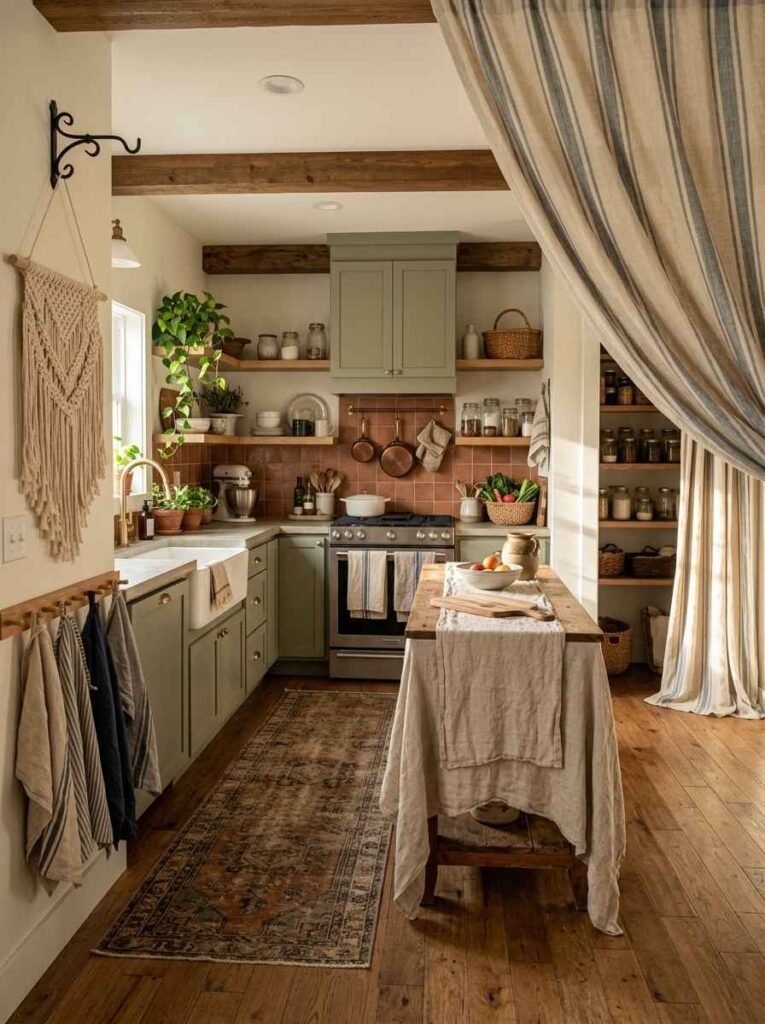
Dish towels in faded stripes. A linen curtain over a pantry doorway. Cotton macramé on a wall hook. These soft elements take the edge off harder materials like wood and stone.
Layer textiles the way you’d layer clothing — each piece adds something, nothing overwhelms.
The linen home textile collection at Cultiver is one of my personal favorites for kitchen linens if you want something that actually ages beautifully.
16. A Farmhouse Apothecary Cabinet or Hutch
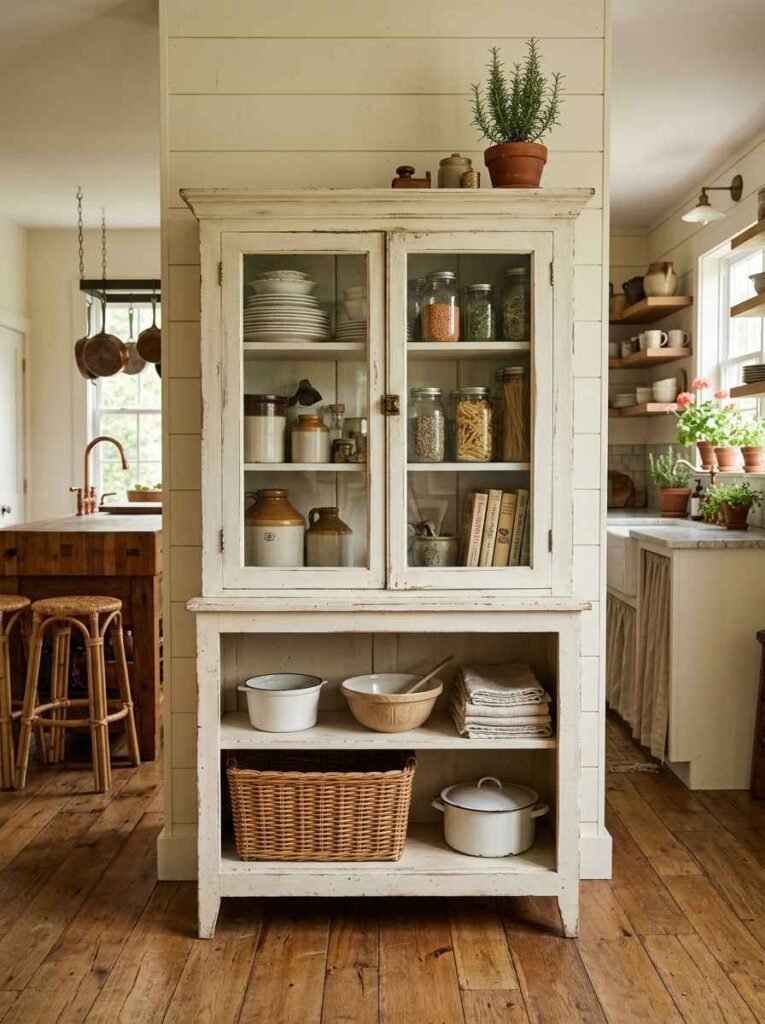
An old apothecary cabinet, a painted hutch, or a repurposed general store cabinet adds tremendous character.
Use it to store and display at the same time — jars of dried goods, stacked plates, a few books.
This piece becomes a conversation starter. Honestly, hunting for it at an antique market is half the fun. 🙂
17. Terracotta Pots and Vessels as Decor
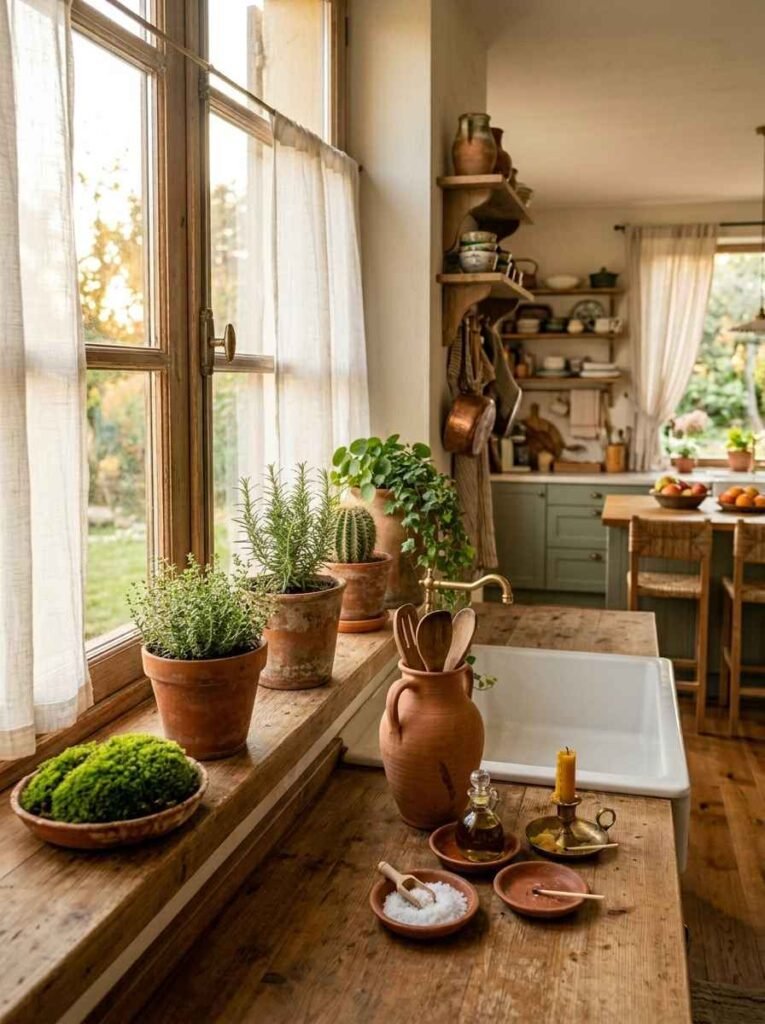
Terracotta doesn’t have to live outside. A grouping of terracotta pots on a windowsill, a large terracotta jar used as an umbrella
stand near a back door, or even terracotta tiles used as trivets — all of these add that handmade, earthy quality the boho kitchen craves.
The color also works beautifully with sage green, olive, and warm cream palettes.
18. Vintage Signs and Printed Art
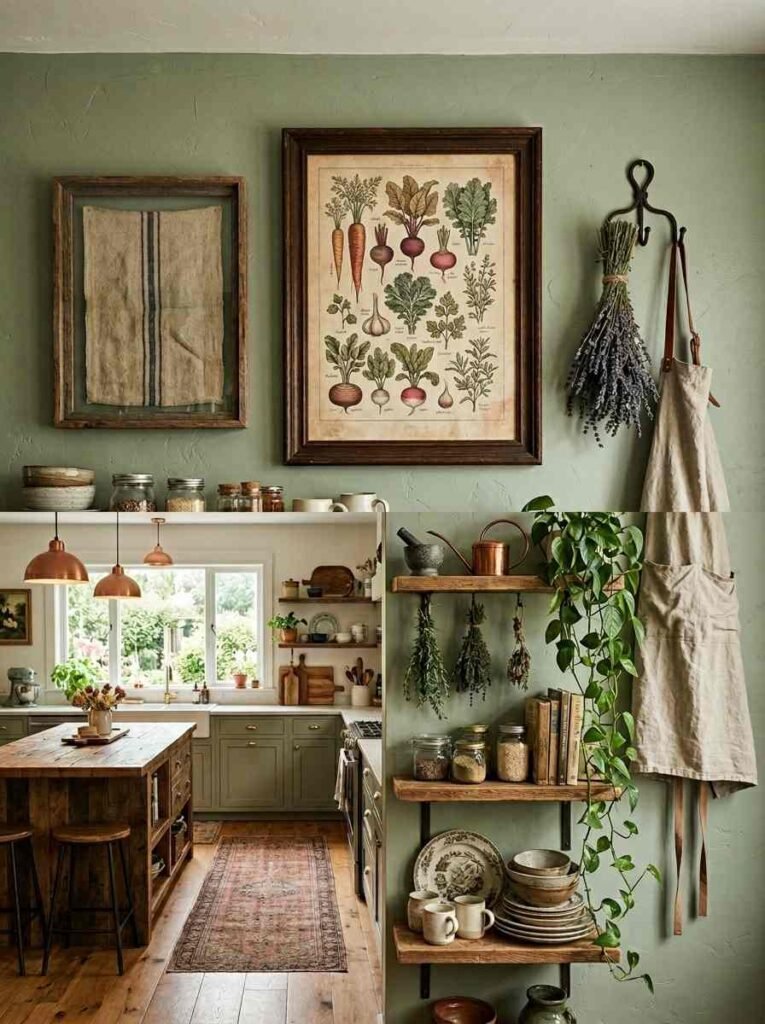
A hand-lettered vintage sign, an old grain sack print, or even a framed botanical illustration brings personality to walls that might otherwise feel bare.
IMO the key is to avoid anything that looks mass-produced from a big box store.
Hunt for originals at flea markets. Or look for independent artists on Etsy who replicate vintage styles authentically.
19. Farmhouse Pendant Lights With an Antique Bulb
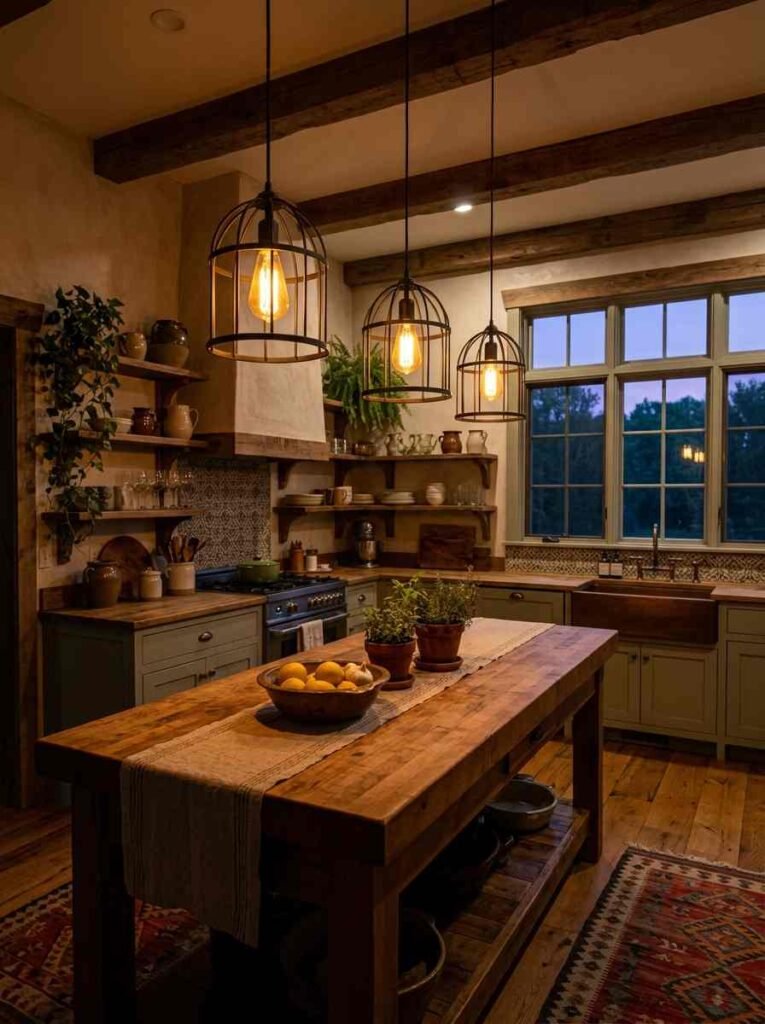
Even something as simple as swapping a modern light fixture for an antique-inspired cage pendant with an Edison bulb changes a kitchen’s mood.
The warm glow of an exposed filament bulb makes everything look more golden and inviting.
Group three of them over a kitchen island at varying heights. Simple. Effective. Timeless.
20. A Statement Range Hood
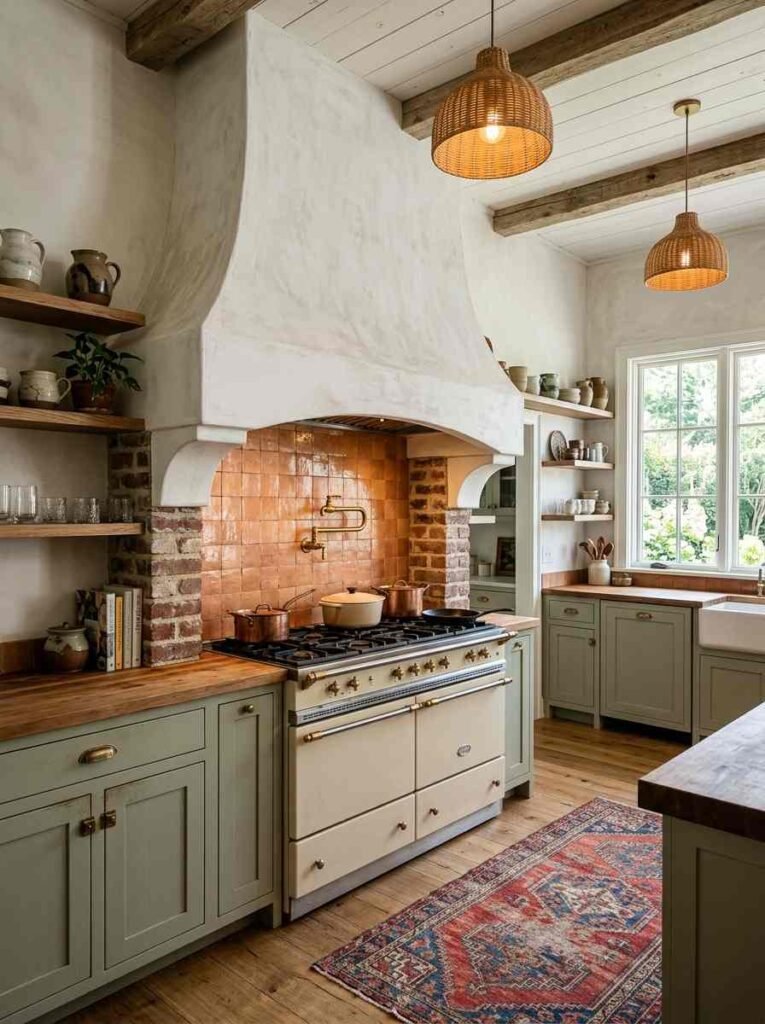
The range hood is often ignored, which is a mistake. In a boho farmhouse kitchen, it’s a design opportunity.
Shiplap hoods, copper hoods, plaster hoods with a curved profile — any of these instantly become a focal point.
If you’re renovating, this is where I’d put real budget. The hood anchors the cooking area the way a headboard anchors a bedroom.
21. Stone or Concrete Countertops With Character
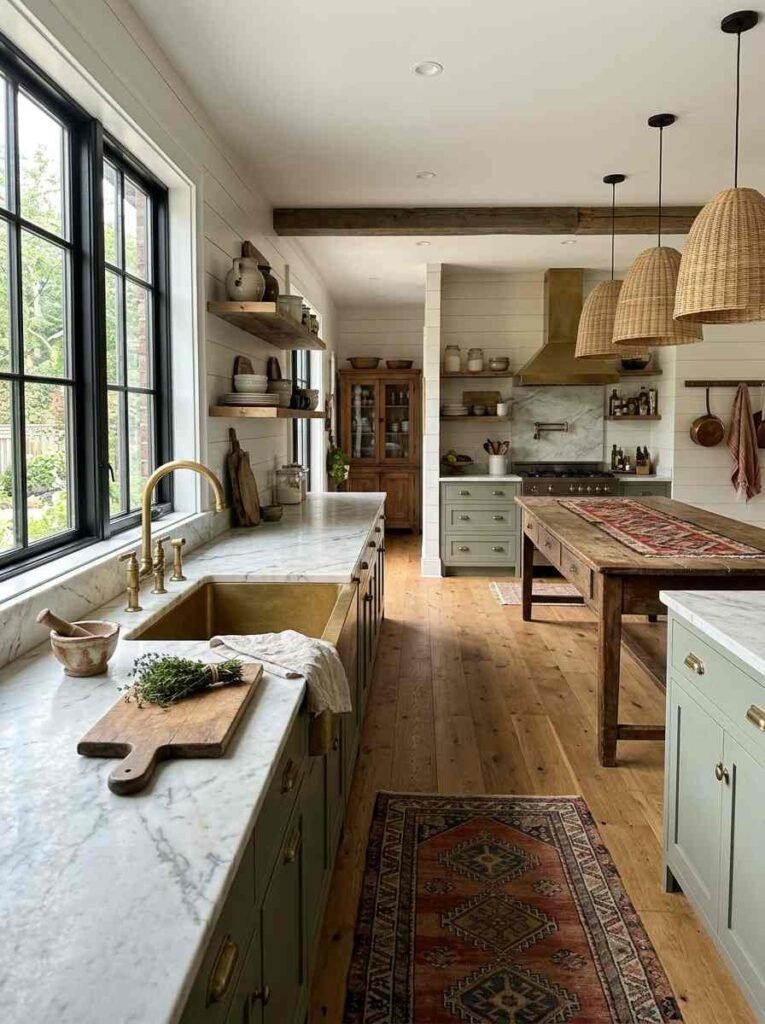
Honed marble, concrete, or soapstone — these materials age in a way that synthetic surfaces don’t. They get scratched. They stain slightly.
They develop a patina. And in a boho farmhouse kitchen, that patina is what makes them beautiful.
Pair a honed Calacatta marble countertop with unlacquered brass fixtures and you’ve got one of those combinations that photographers actually cry over. Slight exaggeration. But only slight.
22. An Antique or Reproduction Farmhouse Clock
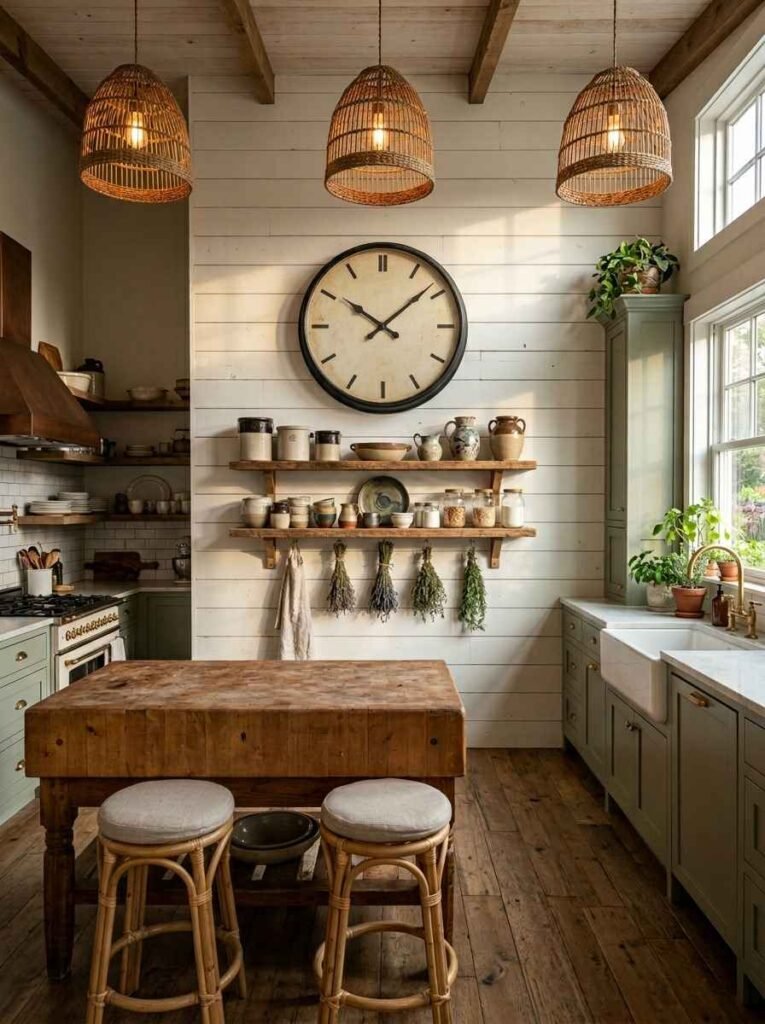
A large farmhouse clock on the wall sounds like a small thing. It isn’t. It gives scale, warmth, and a kind of domesticity that modern kitchens often miss.
Look for a vintage French station clock, a railroad-style clock, or a simple black-rimmed schoolhouse clock.
Place it somewhere unexpected — above the range hood, centered on a shiplap wall, or above a window.
23. Collected Ceramics and Pottery on Display
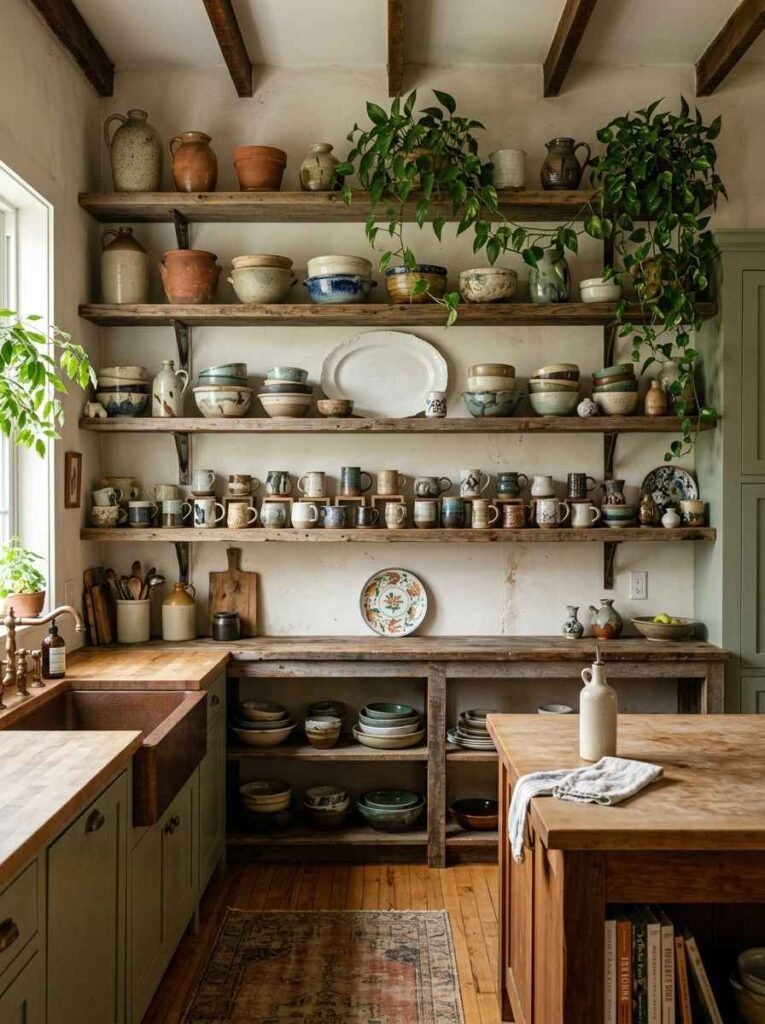
This is where the “bohemian” part really shows up. A shelf full of collected ceramics — some handmade, some vintage, some from a trip somewhere memorable — tells a story that a matched set never could.
Go to pottery fairs. Shop local ceramic artists. Bring home a piece from every trip. Over time, you build something genuinely irreplaceable.
24. Let the Kitchen Evolve, Not Arrive
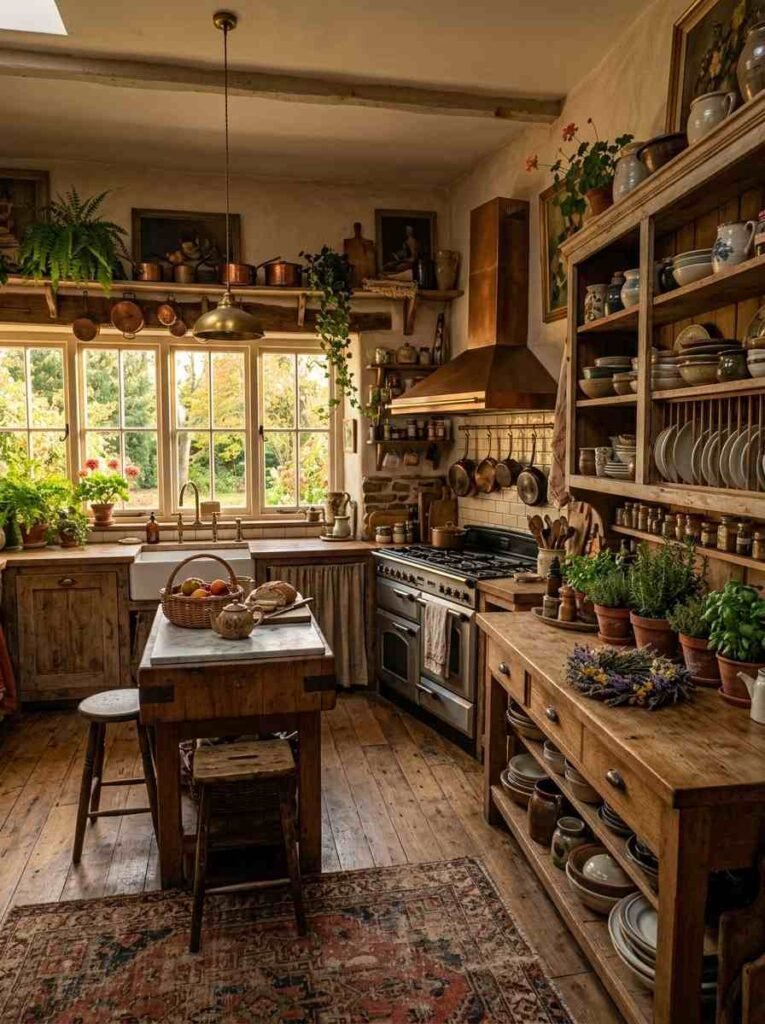
This is the most important idea of all 24. A truly great boho farmhouse kitchen doesn’t happen all at once. It develops.
You add a piece here, paint something there, find a vintage rug at a market and realize it ties everything together.
The kitchens that stop people mid-scroll aren’t usually the ones that came from a single renovation budget. They’re the ones that got better over time.
Frequently Asked Questions
Q: Can I create a bohemian farmhouse kitchen on a tight budget?
Absolutely. The boho part of this aesthetic actually rewards thrift — vintage shops, flea markets, Facebook Marketplace, and family hand-me-downs all contribute to the layered, collected look.
Focus budget on one high-impact element (like an apron sink or a statement backsplash) and build the rest gradually with affordable finds.
Q: What colors work best in a bohemian farmhouse kitchen?
Warm neutrals are your foundation — cream, warm white, oat, linen. Then layer in earthy accents like sage green, terracotta, dusty blue, or ochre.
Avoid anything too cool or too saturated. The palette should feel like it belongs to the land, not a paint chip display.
Q: Does open shelving actually work in a real kitchen, or is it just for photos?
It works, but it requires commitment. You have to be okay with keeping things reasonably tidy, because everything is on display.
The trade-off is a kitchen that feels open, personal, and genuinely lived-in rather than sealed behind cabinet doors.
A Quick Thought on the Full Picture
Something that doesn’t get said enough in kitchen design content: the smell of a kitchen matters as much as how it looks.
Fresh herbs on the windowsill, a beeswax candle near the sink, dried lavender from the garden — these details complete the sensory experience of a boho farmhouse kitchen in a way that no amount of shiplap can on its own.
Design for how it feels to be in the room, not just how it photographs.
Final Thought
The bohemian farmhouse kitchen works because it gives you permission to mix things that “don’t match” and call it intentional. And it is intentional — just not controlled. There’s a difference.
Which of these 24 ideas are you actually going to try first? Drop it in the comments — I’d love to know what direction you’re going with your space.
