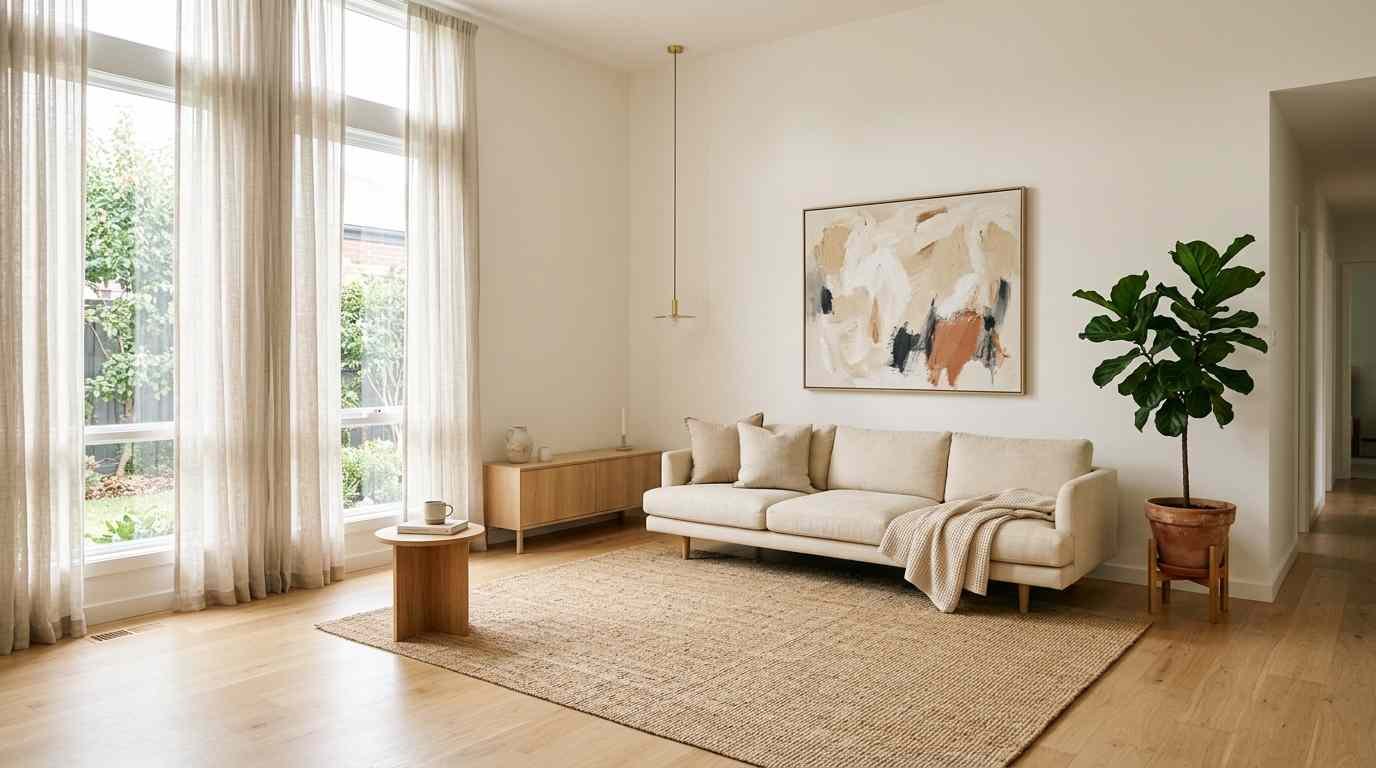
My living room used to look like a storage unit with a couch. Boxes tucked into corners, three different throw blanket patterns fighting each other, a gallery wall that was more “anxious collector” than intentional design.
I kept pinning minimalist interiors on Pinterest thinking, sure, that’s beautiful, but my place could never look like that.
Then I actually tried a few of these ideas. Cleared out the clutter, picked a palette, got intentional about what stayed.
The room felt twice as big and, weirdly, way more relaxing. I think a lot of people assume minimalism means cold and sterile, but it doesn’t have to be.
Here are 31 ideas that lean into that sweet spot between clean and cozy, the kind of room you actually want to sit in at the end of a long day.
Start with the walls
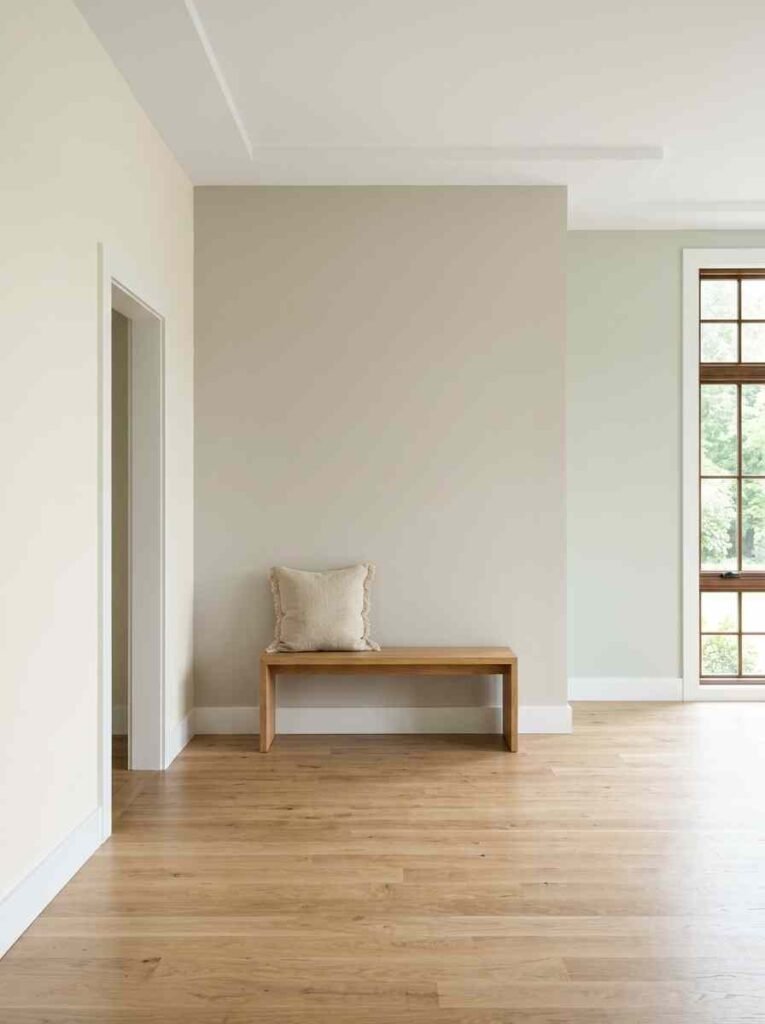
Go neutral, but pick your neutral carefully
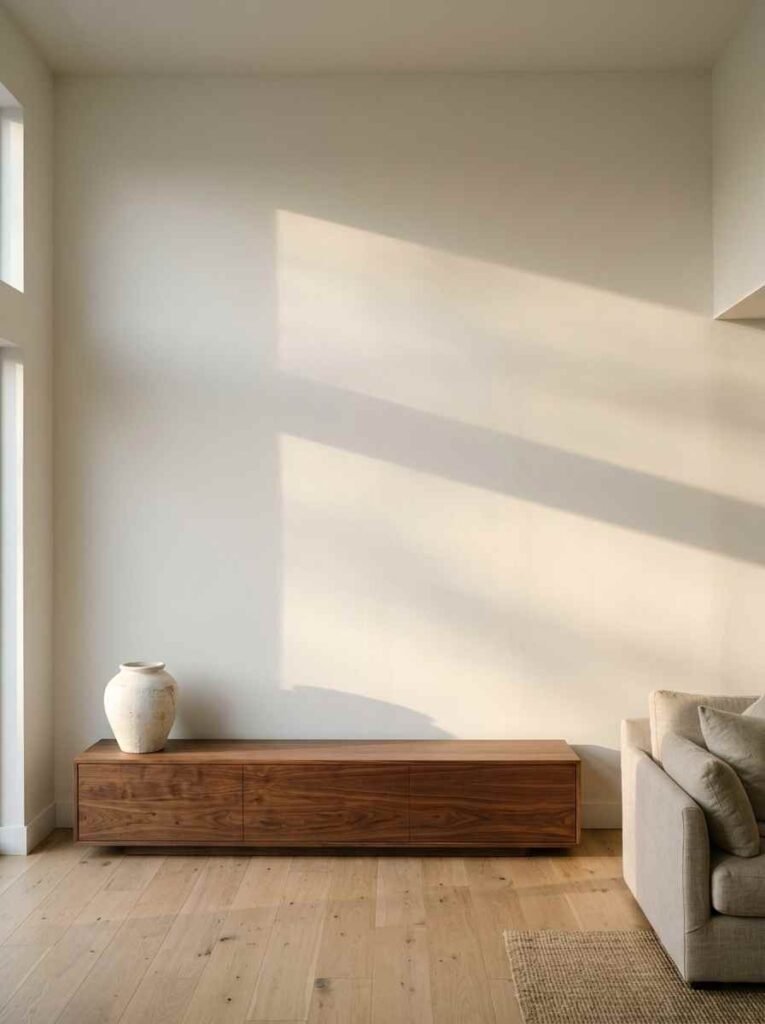
Beige, warm white, greige, sage, off-white: these all read “minimal” but they feel completely different from each other.
I painted my walls Benjamin Moore’s “White Dove” and it reads cream in daylight, warm white at night. Much softer than a stark, cool white.
If you’re going for that airy Scandinavian look, try a warm white with yellow undertones. For something moodier, a soft greige (grey-beige blend) works without going full dark academia.
Sites like Apartment Therapy have good real-home examples of how undertones play out in actual rooms, not just swatches.
Leave some wall space empty on purpose
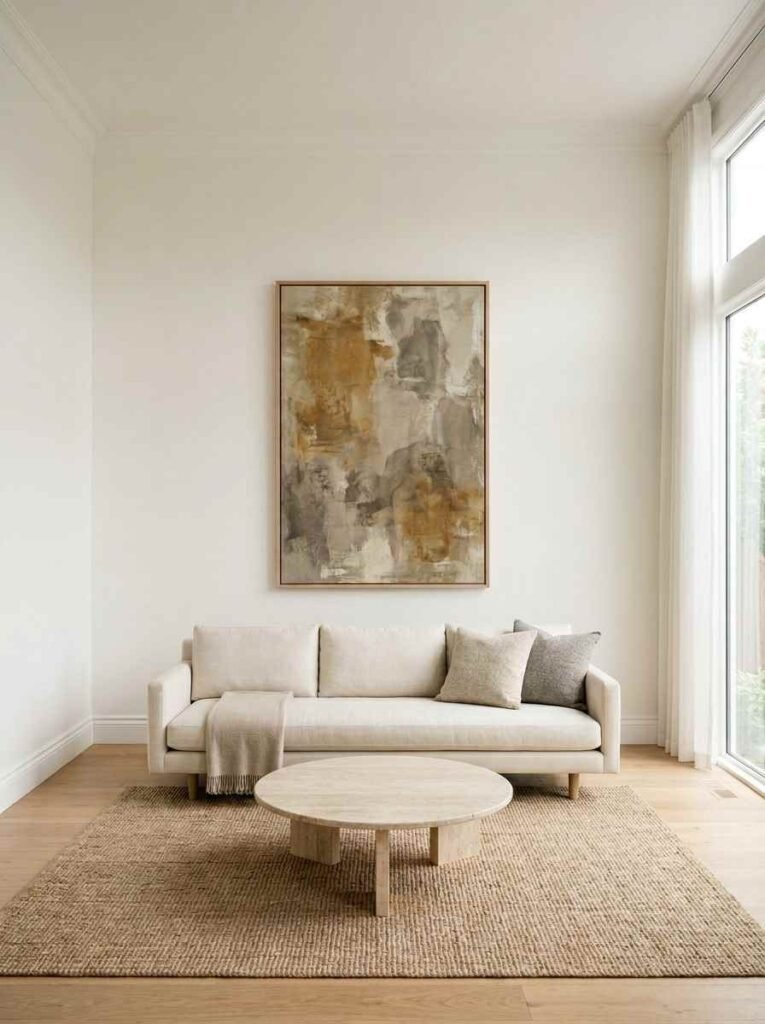
This one feels wrong at first. You painted the wall, why would you leave it bare?
But negative space on a wall does the same thing it does in graphic design: it makes everything around it breathe.
Pick 1 wall to keep completely bare. Your room will feel more considered and less “I ran out of wall space.”
One large piece of art instead of a gallery wall
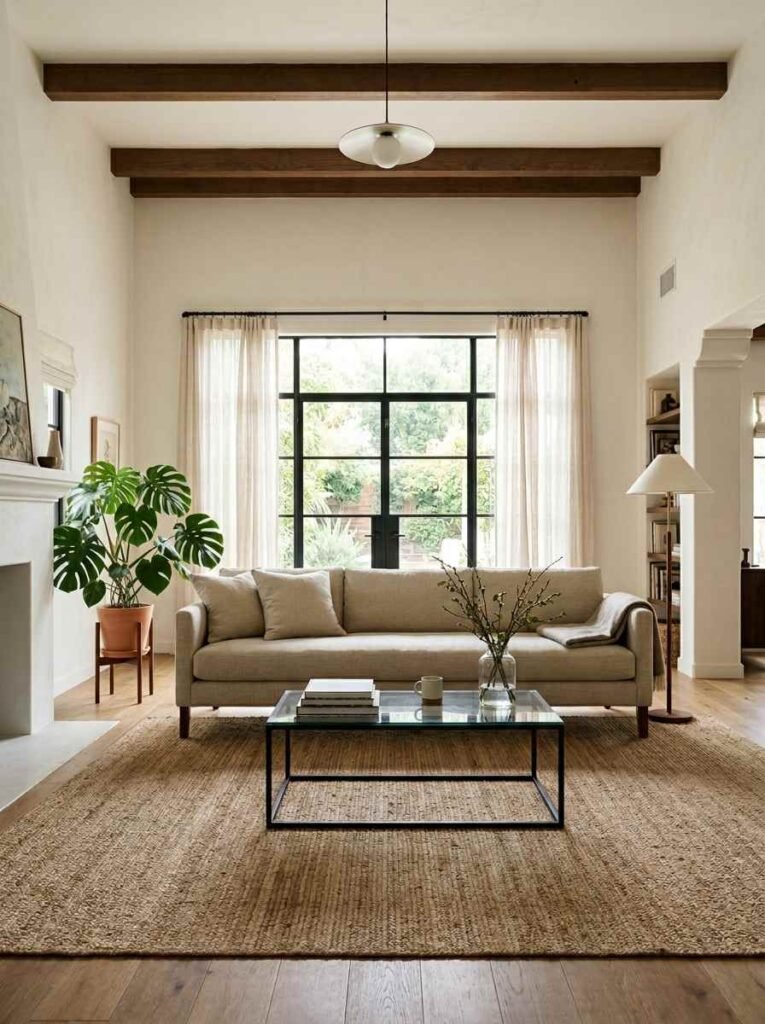
A single 24×36 print does more for a minimalist room than 12 small frames arranged in a grid.
If you’re a gallery wall person, I get it (and I miss mine sometimes, if I’m honest), but one strong piece reads cleaner and draws the eye without overwhelming.
Furniture that earns its place
Choose low-profile sofas
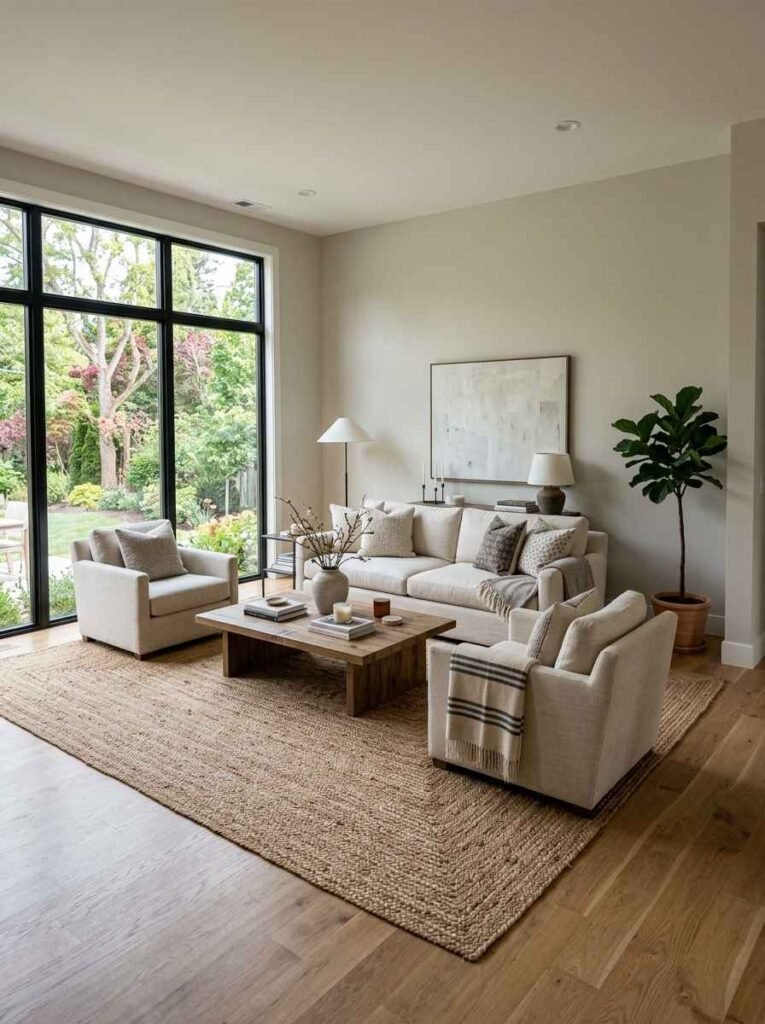
High-back sofas eat visual space. A low, long sofa with clean lines sits in the room without dominating it.
The classic Ikea Kivik is a good budget-friendly version. If you want something that looks genuinely architectural, look at sofas in the Article or Castlery range.
The “one sofa, two chairs” rule
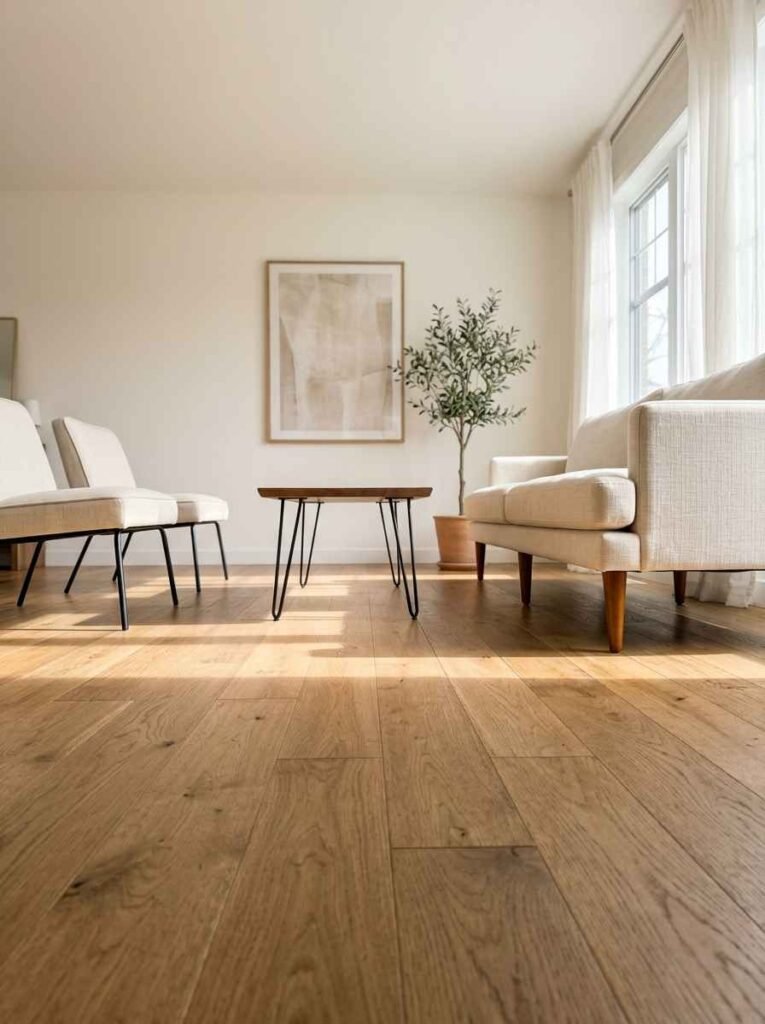
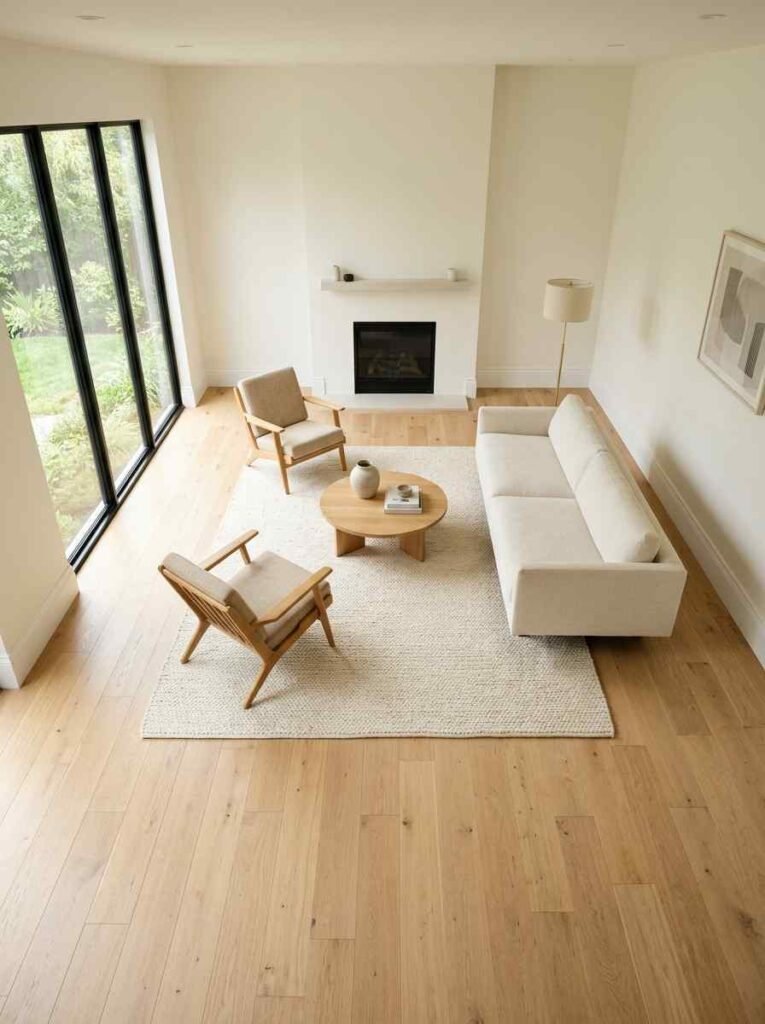
A sectional crammed into a small room makes the space look smaller. Try a sofa plus 2 accent chairs instead. You get the same seating, but the eye can actually travel around the room.
Pick furniture with legs
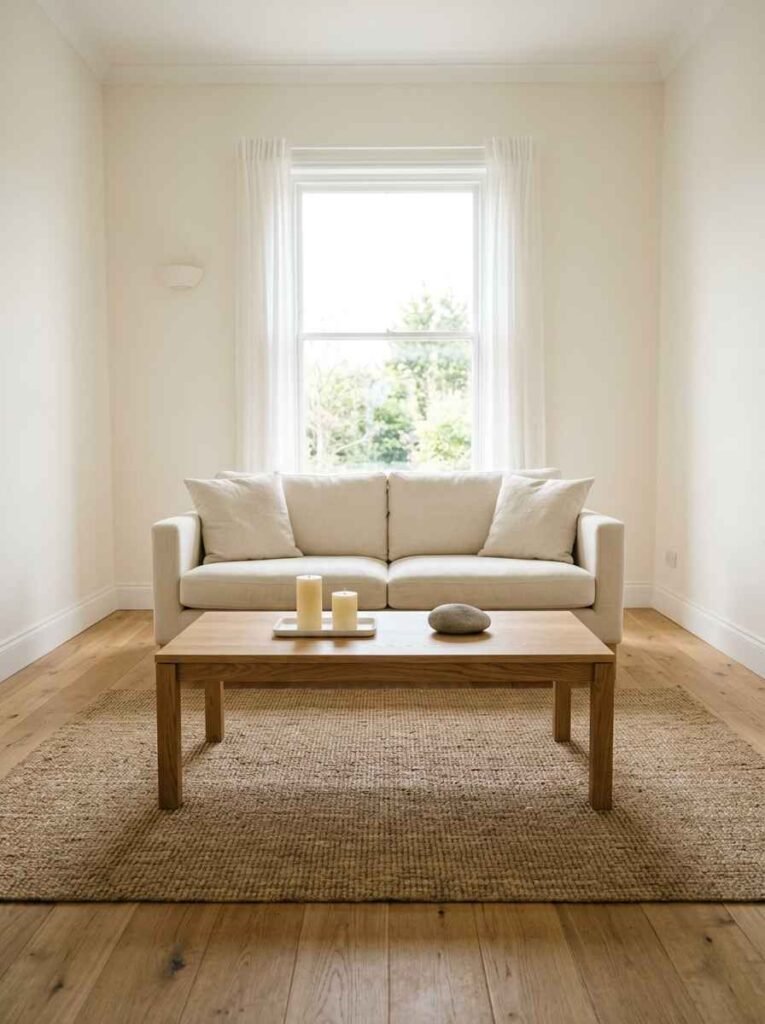
Sofas and chairs that sit directly on the floor block the sightline at floor level. Furniture with legs (even 4-inch ones) lets light pass under, which makes the room feel taller and less heavy. This is such a simple swap and it genuinely changes how big a room feels.
Limit your coffee table to one
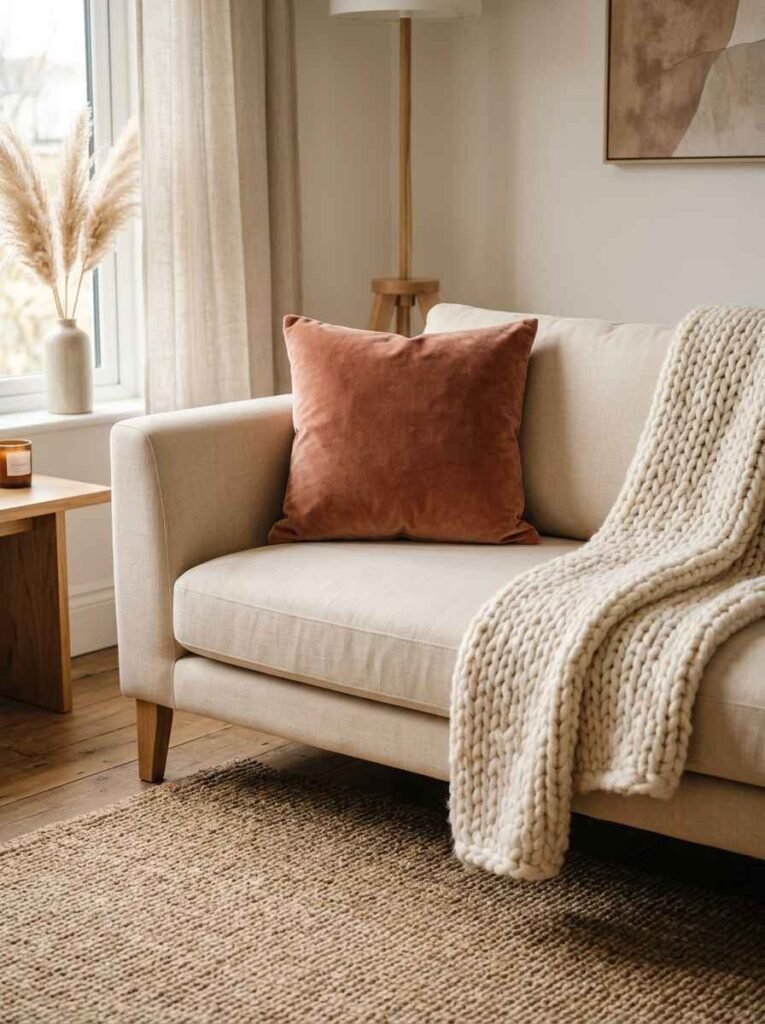
I used to have a coffee table AND a side table AND a nesting set of 3 little tables. Wow, that was a lot.
One good coffee table, properly sized to your sofa (about 2/3 the length of the sofa is the general rule), is all you need.
Texture is how minimalism stays cozy
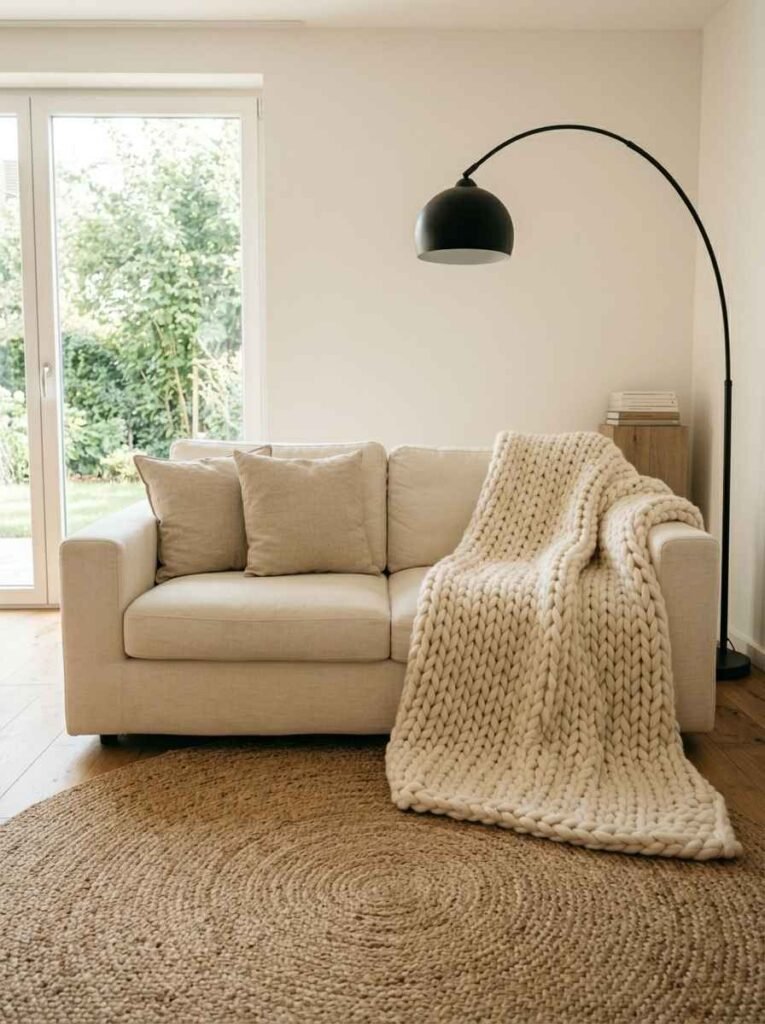
This is probably the most important section, so pay attention here. Minimalist rooms fail when they’re all hard surfaces and no warmth. Texture is the fix.
Layer two or three different fabric weights
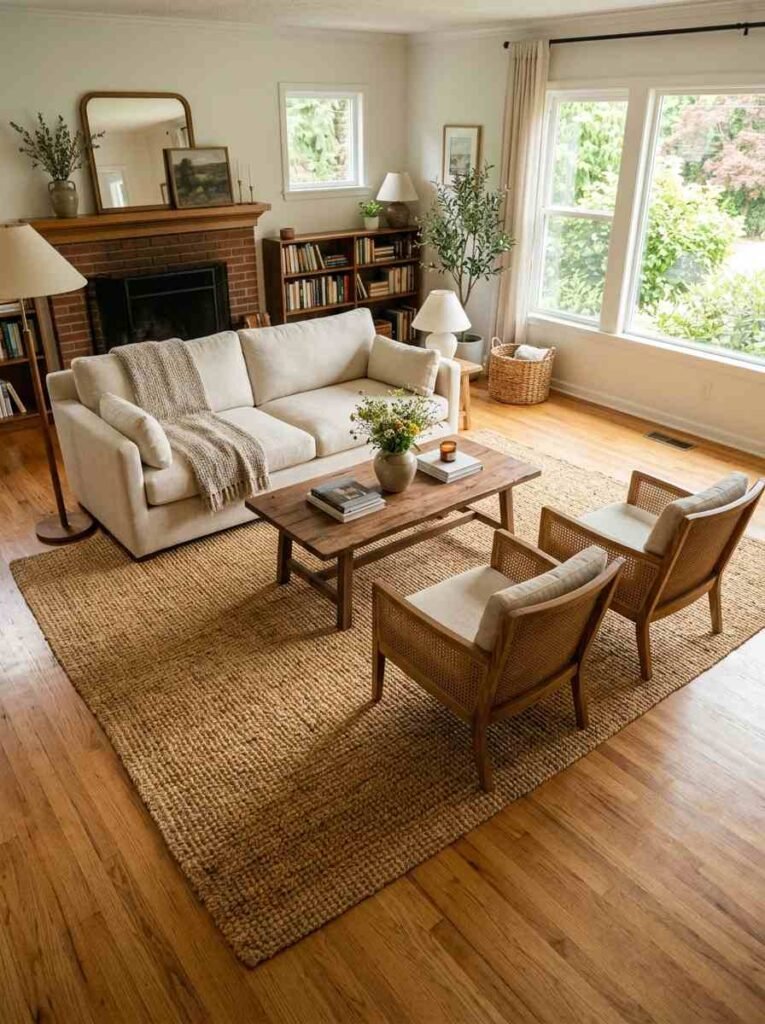
Think: a linen sofa, a chunky knit throw, a smooth velvet cushion. The contrast between weights is what makes a room feel layered without looking cluttered.
You’re adding sensory variety without adding visual noise.
The chunky knit throw
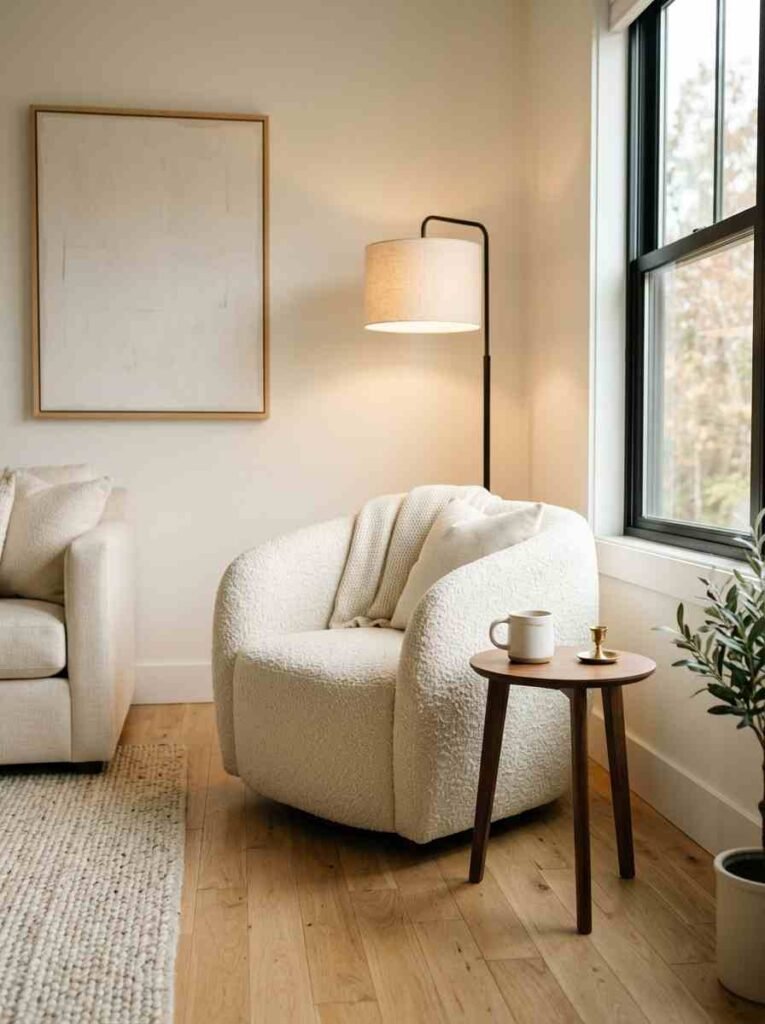
Yes, everyone has one. There’s a reason. A thick, cream-colored knit throw draped over the arm of a neutral sofa does more work than most decor pieces.
It photographs beautifully for Pinterest, which is probably why you’re here, and it’s actually functional.
Jute and natural fiber rugs
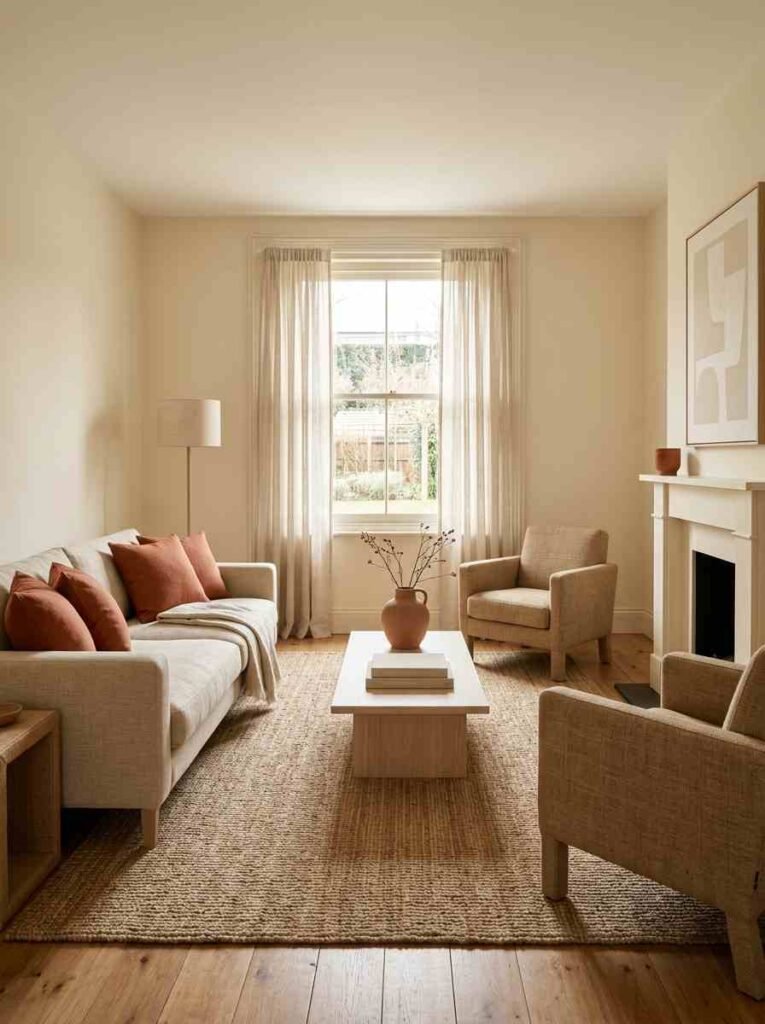
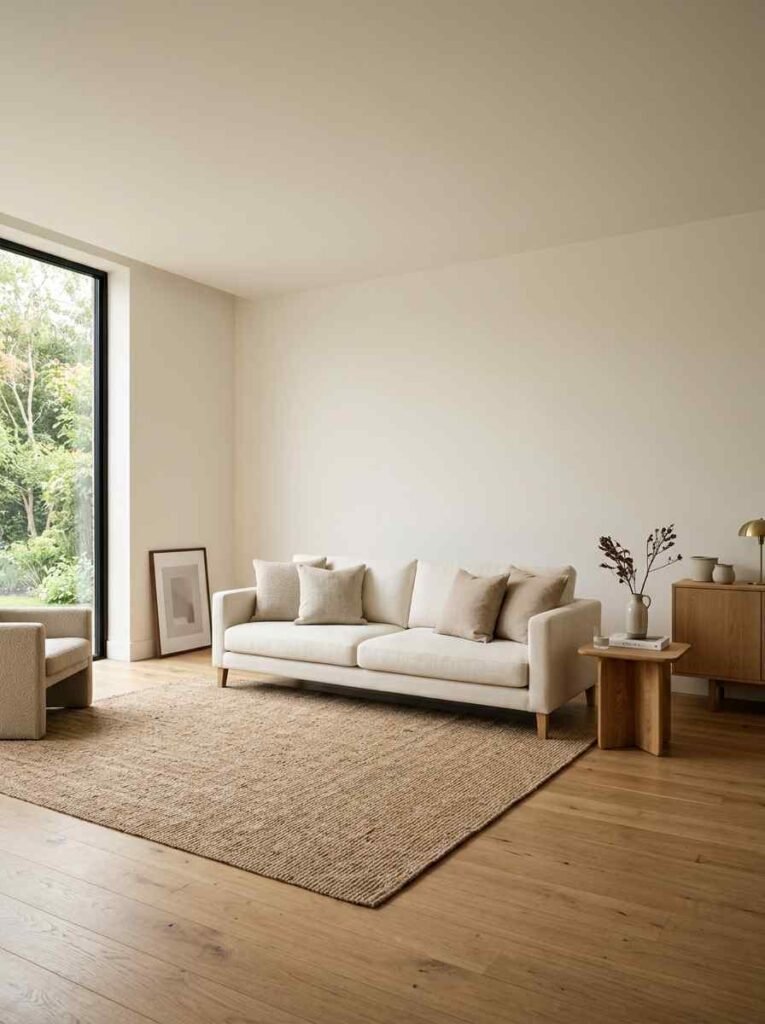
A jute rug under a low-profile sofa grounds the seating area and adds warmth without any pattern to manage. They’re affordable at IKEA (the LOHALS is maybe $60 for a 6×9), they age well, and they go with almost every palette.
Boucle is having a moment for a reason
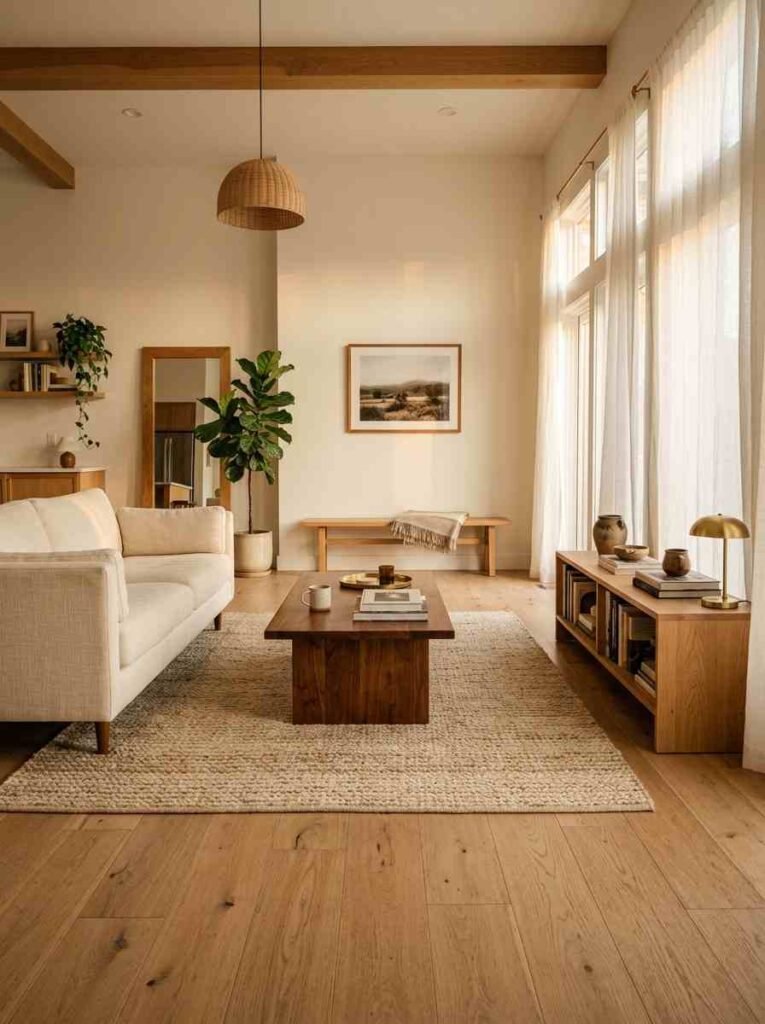
Boucle fabric (that loopy, textured weave you see on chairs and ottomans everywhere right now) adds softness without adding pattern.
An off-white boucle accent chair is probably the single most-pinned piece of furniture in minimalist interiors right now. I think it’s peaked at this point, but it still works.
The color conversation
Stick to 3 colors max
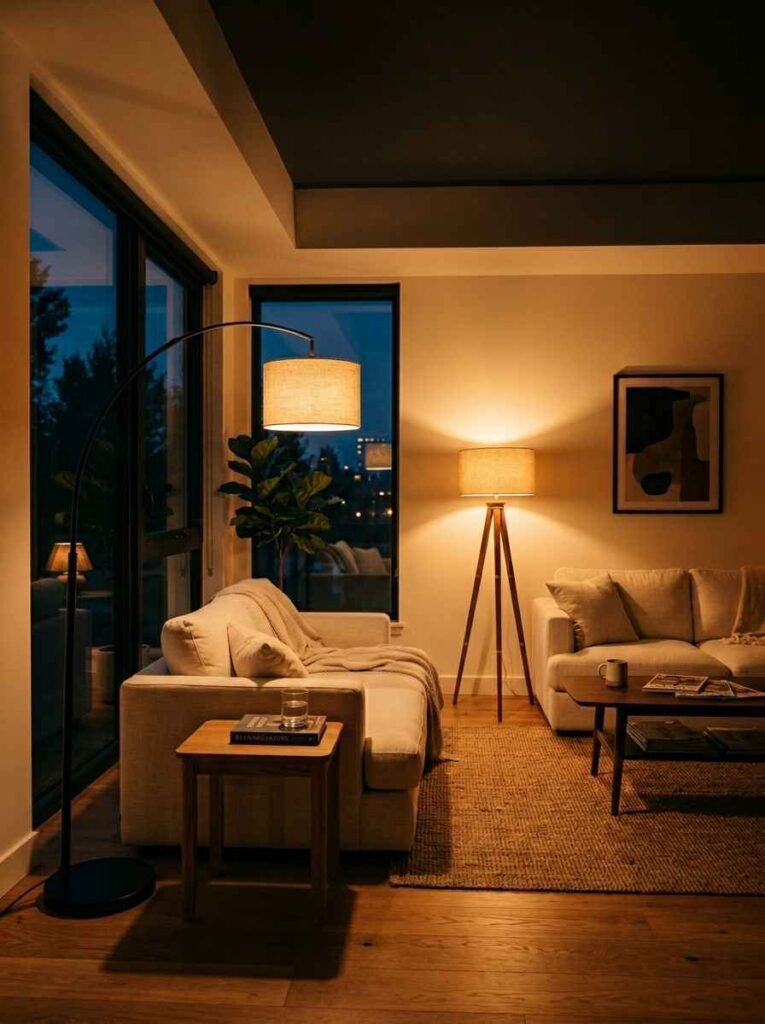
Pick a base (your walls, big furniture), a secondary (your rug, smaller furniture), and an accent (cushions, art, one or two objects).
That’s it. When you add a 4th or 5th color, the room starts to argue with itself.
Here’s a quick reference for common minimalist palettes:
| Palette name | Base | Secondary | Accent |
|---|---|---|---|
| Warm Scandi | Warm white | Natural linen | Terracotta |
| Cool minimal | Pale grey | Charcoal | Matte black |
| Organic | Cream | Sage green | Raw wood |
| Japandi | Off-white | Warm walnut | Slate or navy |
Don’t paint your ceiling white if your walls are white
This is a small thing that makes a big difference. If your walls are warm white, paint your ceiling the exact same color.
Painting the ceiling a stark bright white against warm walls makes the ceiling look too high and disconnected. Match them.
Warm wood tones over cool grey tones
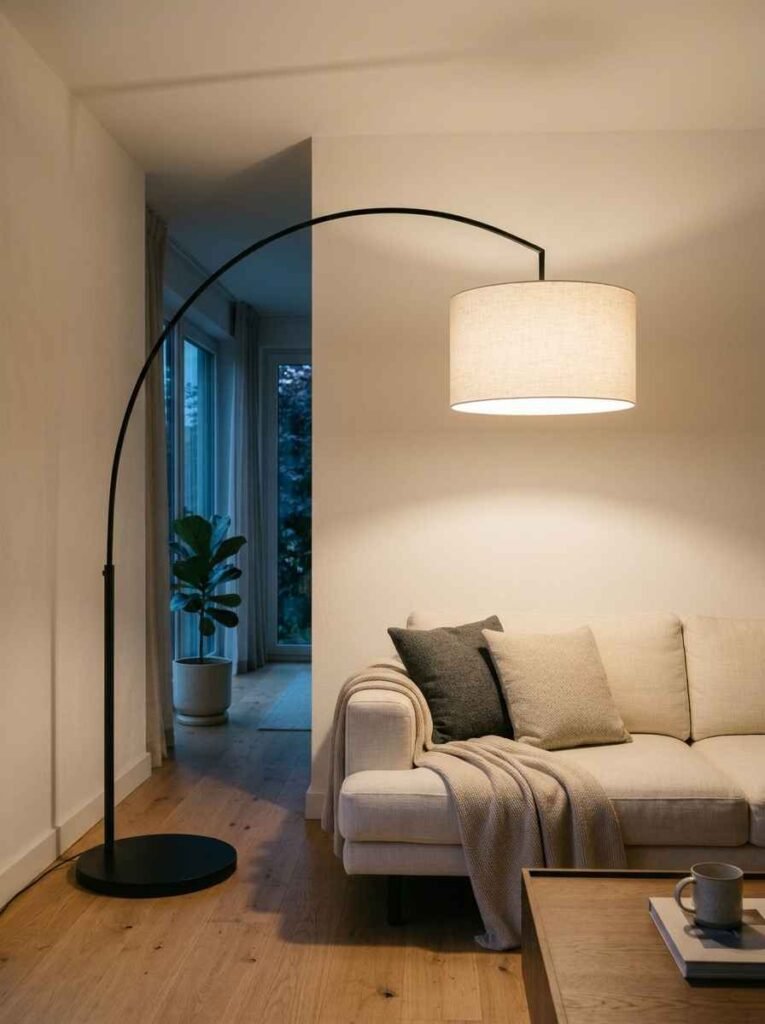
Around 2018, grey-everything was everywhere. Ash grey floors, grey couches, grey walls. It looked great in photos and exhausted in person.
Warm wood tones (oak, walnut, pine) age better in real life and photograph warmer on Pinterest.
Lighting makes or breaks it
Get your lamps off the ceiling
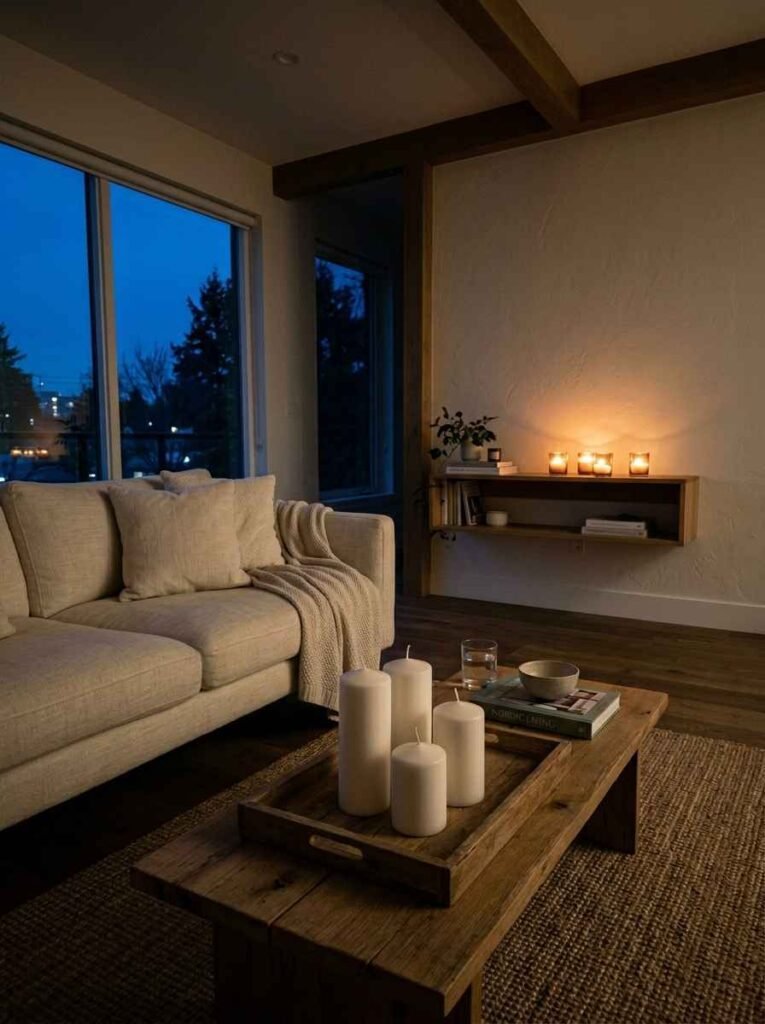
Overhead lighting is practical and unflattering. Layer in floor lamps and table lamps. The pools of light from lower fixtures make a room feel intimate in a way that overhead can’t.
Warm bulbs only
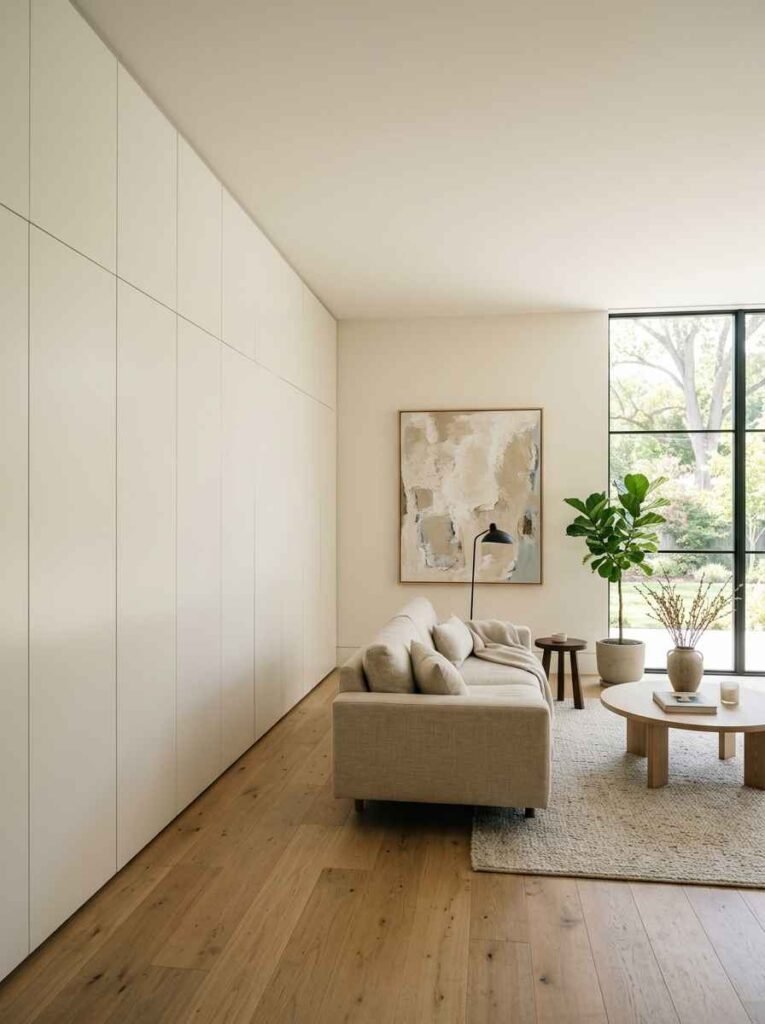
2700K to 3000K. That’s the range for warm, cozy light. Anything above 3500K starts reading clinical and blue-tinged.
This is the cheapest change you can make to a room’s atmosphere. A pack of warm LED bulbs is maybe $12.
One statement floor lamp
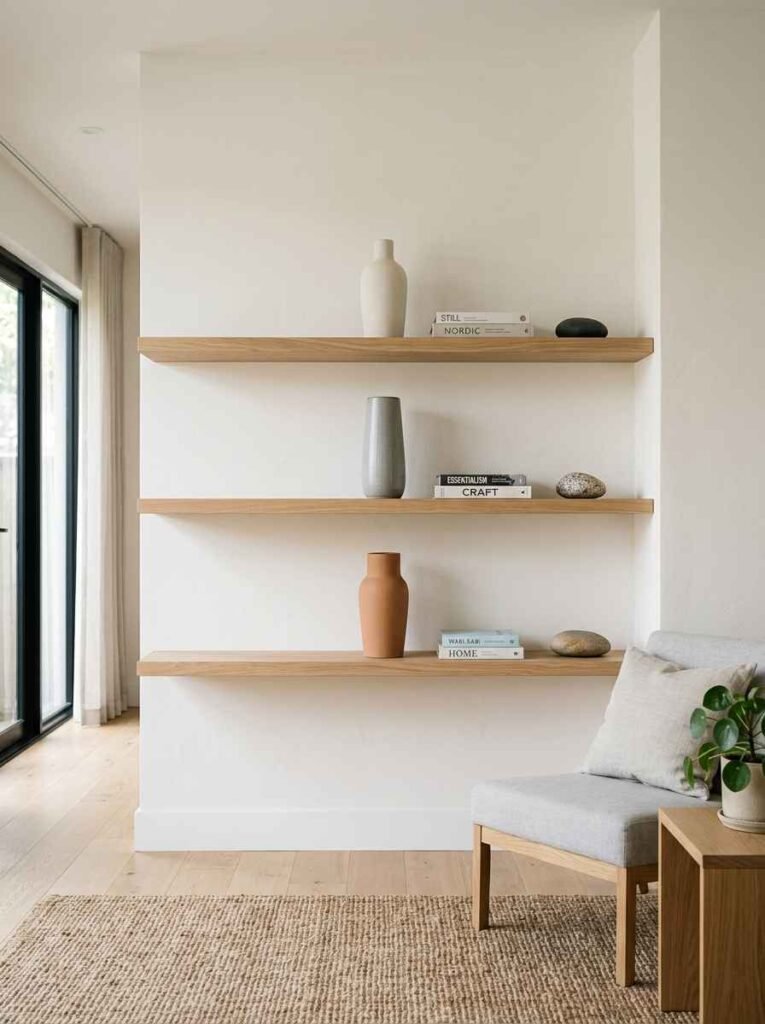
A sculptural floor lamp (arc style, or something with an interesting base) reads as both functional and decorative.
You don’t need both a floor lamp AND a reading lamp AND a table lamp. Pick one good one.
Candles still count
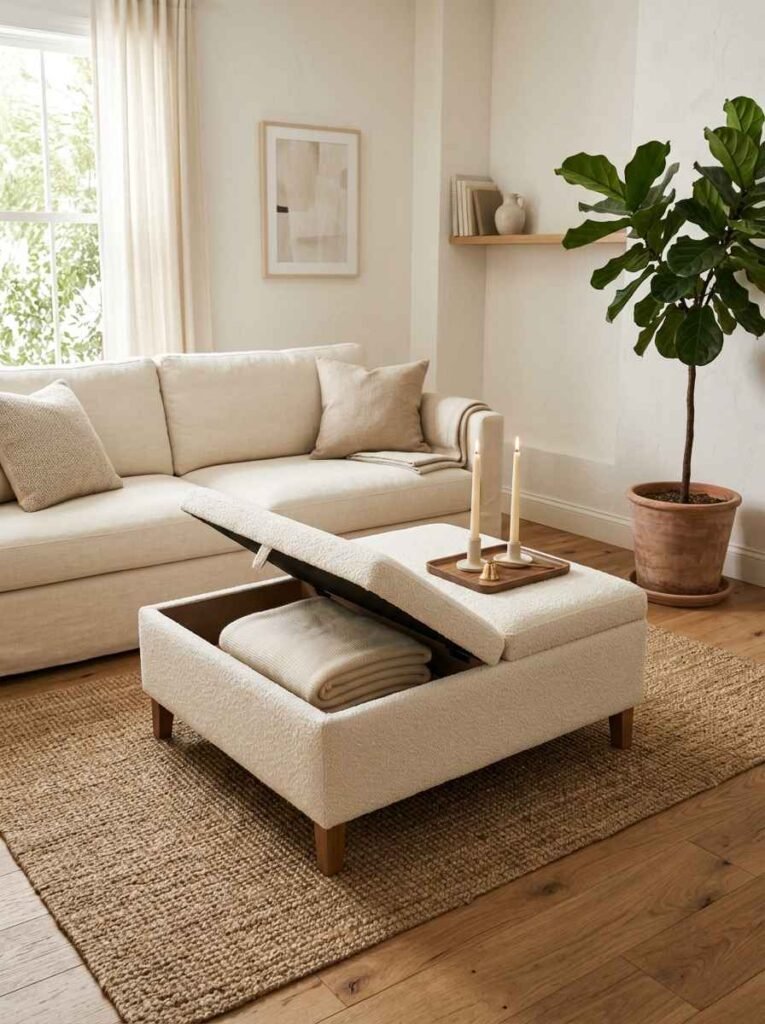
Unscented pillar candles on a wooden tray, a cluster of votives on a shelf. They add warmth in the evening in a way that no light bulb quite replicates.
I genuinely prefer candles to any smart lighting product I’ve tried, and I’ve tried quite a few.
Storage that stays invisible
Built-in shelves beat open shelving
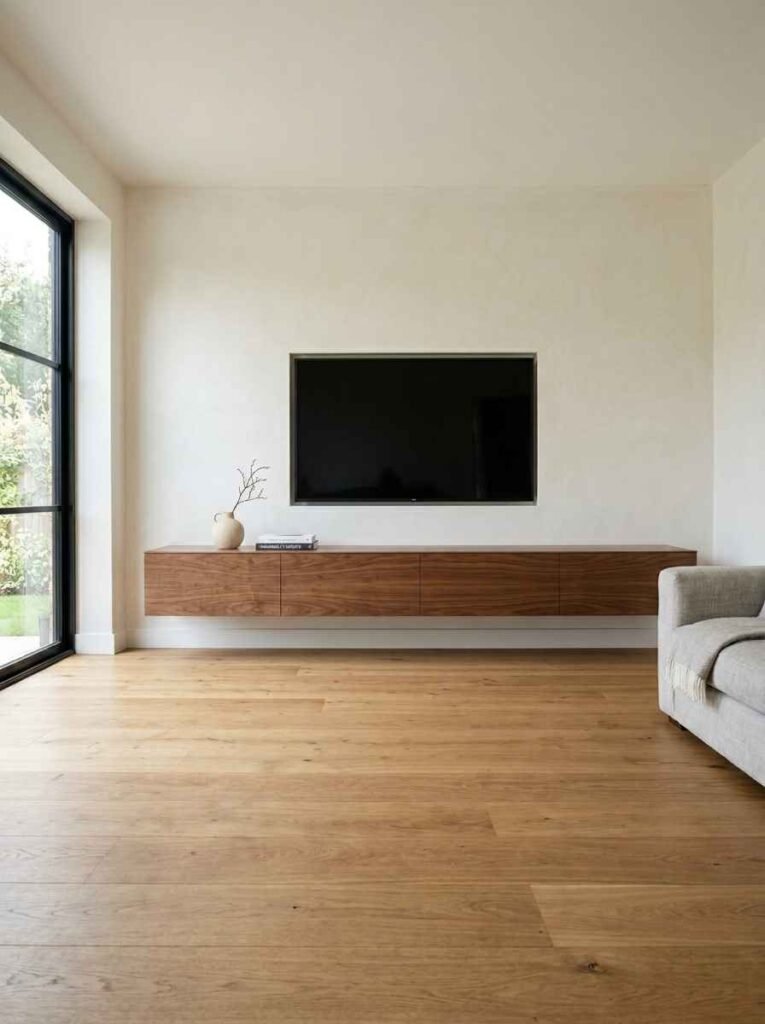
Open shelving looks beautiful when it’s styled and a disaster 3 weeks later when life happens. Built-in closed cabinets keep the room looking clean without requiring constant curation.
The “one third empty” shelf rule
If you do have open shelving, keep about 1/3 of the space empty. It sounds wasteful but it looks intentional.
Style the remaining 2/3 with a mix of heights: a tall vase, a stack of 2-3 books, one small object. Done.
Ottomans with storage inside
A tufted or boucle ottoman that opens up for storage is probably the most practical piece of furniture you can buy for a minimalist living room. Hides blankets, kids’ toys, remotes, chargers. Looks good closed. Functional open.
Floating media unit over a TV stand
A floating media unit mounted at the right height keeps the floor clear and makes the wall feel deliberate.
IKEA’s Besta system is the standard here for good reason: modular, affordable, looks clean.
Plants: the right ones, in the right spots
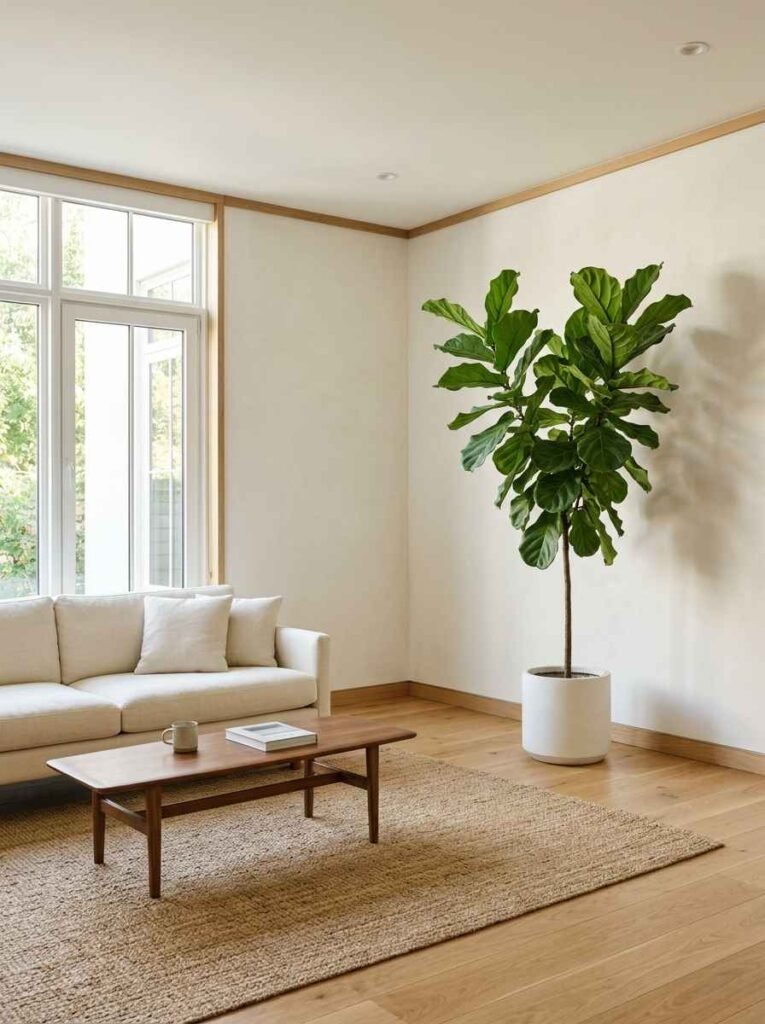
One large plant per corner
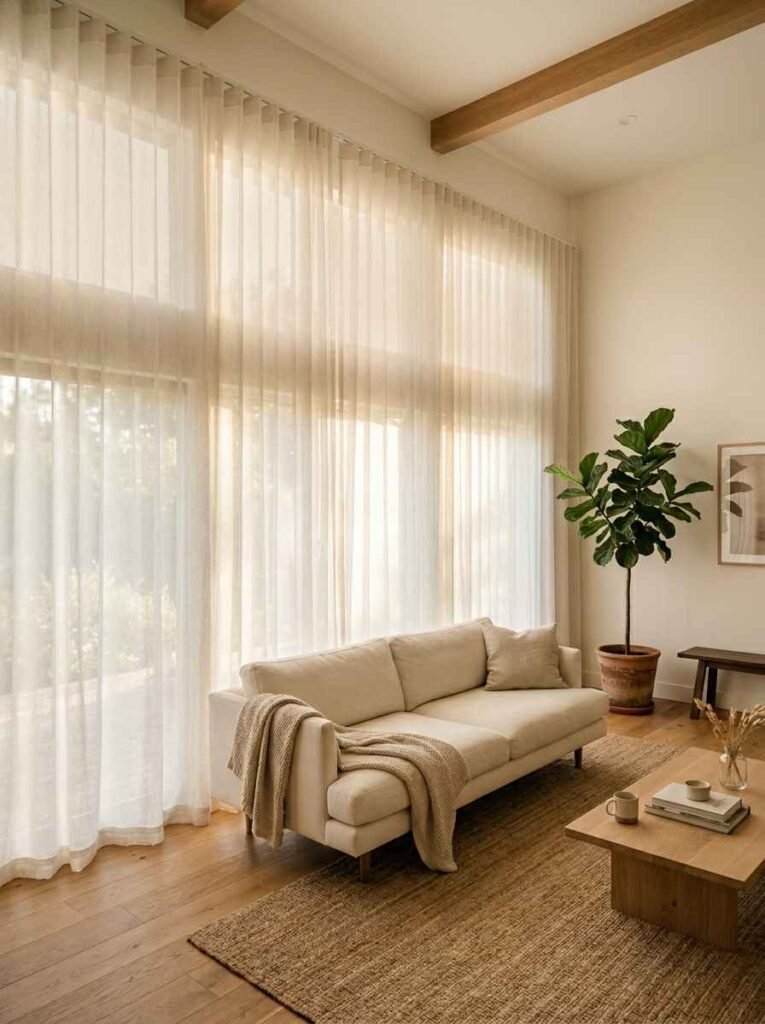
A big fiddle leaf fig or monstera in a corner does more for a room than 6 small plants scattered around. Scale matters. One large plant reads sculptural.
Matchy-matchy pots are fine, actually
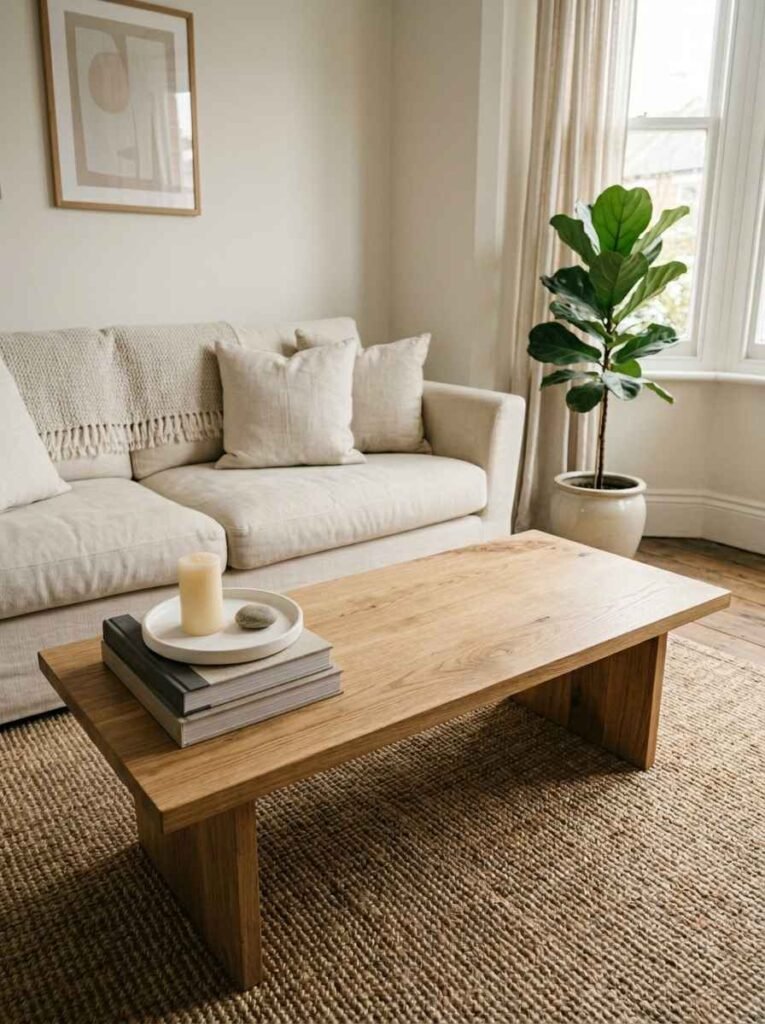
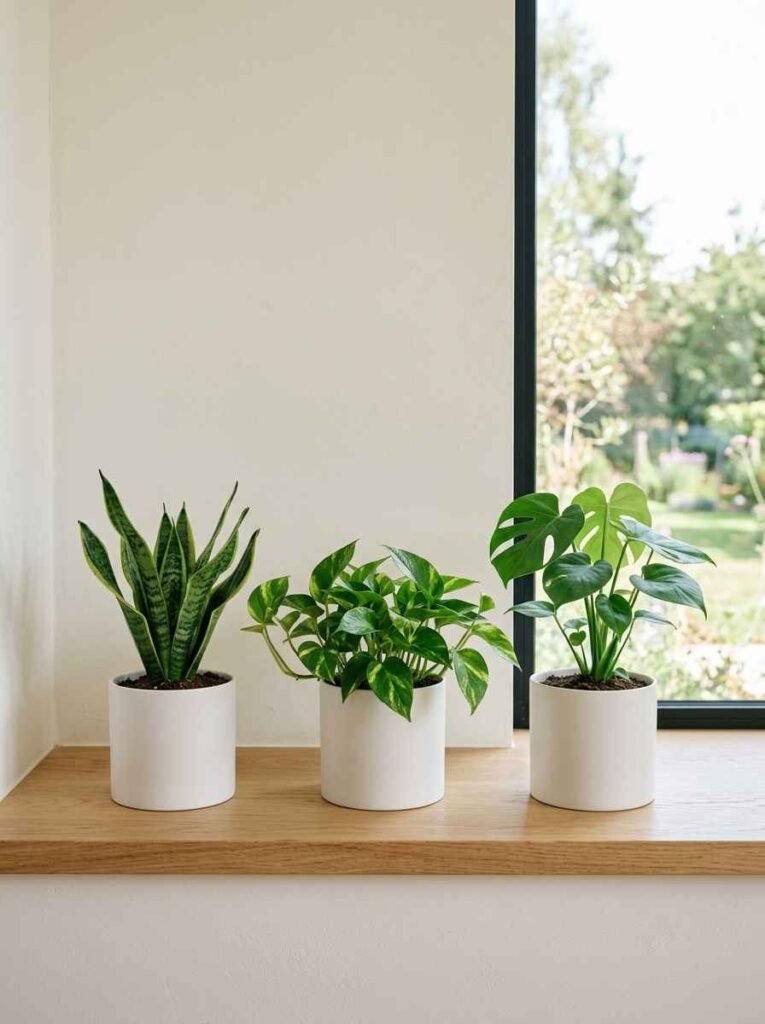
I know the trend is to mix terracotta, white, and black pots for variety. But 3 plants in identical white pots in a row looks considered and minimal. Don’t let anyone tell you matching is boring.
Low-maintenance picks for real people
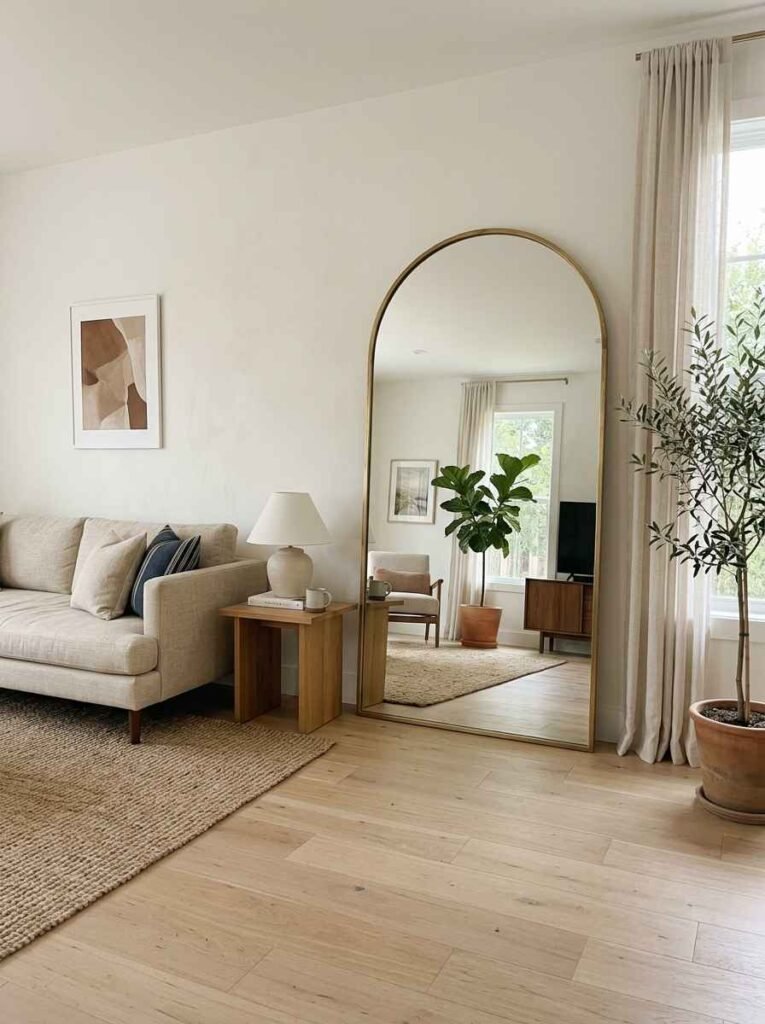
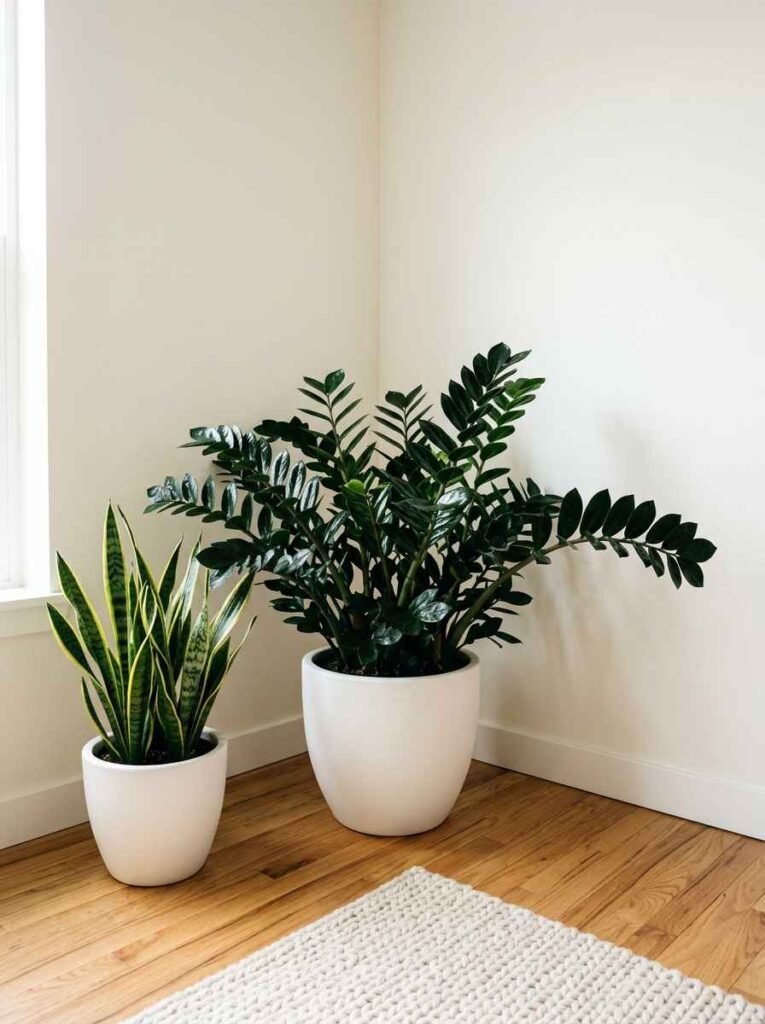
Not everyone wants to research watering schedules. The pothos, the ZZ plant, and the snake plant are genuinely hard to kill and look great in a minimal room. The ZZ plant in particular has a graphic, architectural quality that photographs really well.
The Pinterest-specific details
Here’s where I get slightly specific about what actually performs on Pinterest, since that seems to be the audience here.
Linen curtains floor to ceiling
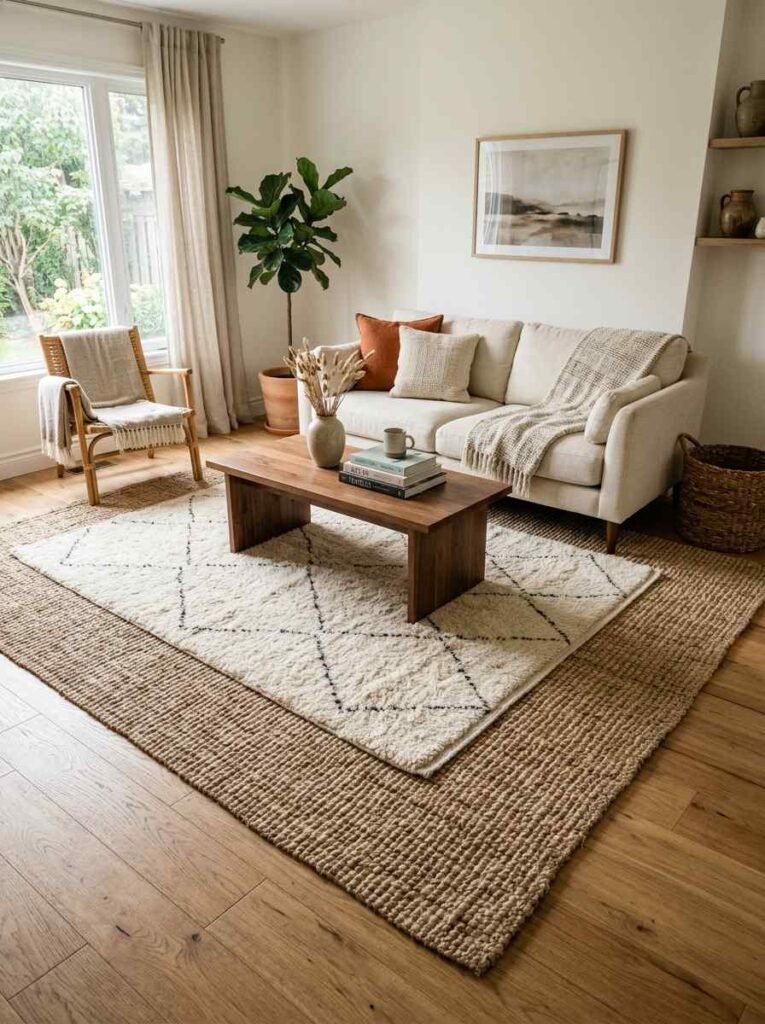
Hang your curtains at ceiling height, even if your windows are mid-wall. This makes the room look taller and is probably in the top 5 most-repinned living room details on Pinterest. Sheer linen in off-white or natural reads airy and works in almost any light condition.
The “styled coffee table” formula
This is genuinely a formula that works: 1 stack of 2-3 design books, 1 small tray with 1-2 objects (a candle, a small vase, a smooth stone), and leave the rest of the table empty.
That’s the whole thing. It photographs beautifully and doesn’t take more than 10 minutes to set up.
Architectural arches (even faked ones)
Arch-shaped mirrors, arch-shaped wall cutouts, arch doorways: these have been in every minimalist living room mood board for 3 years running. An arch mirror leaned against a wall is the fastest way to get that look without construction.
The layered rug trick
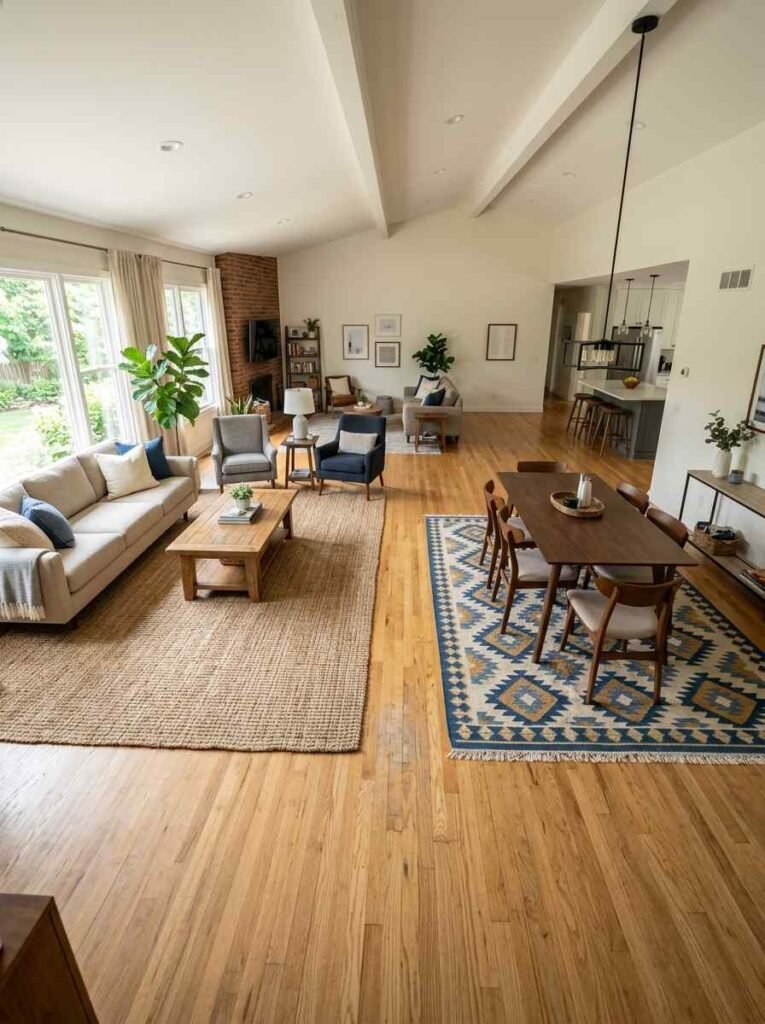
A smaller patterned rug (something with a subtle print or a different texture) placed on top of a larger jute base rug adds depth without committing to a bold floor pattern.
The Moroccan beni ourain style rugs work really well here.
Natural materials in your accents
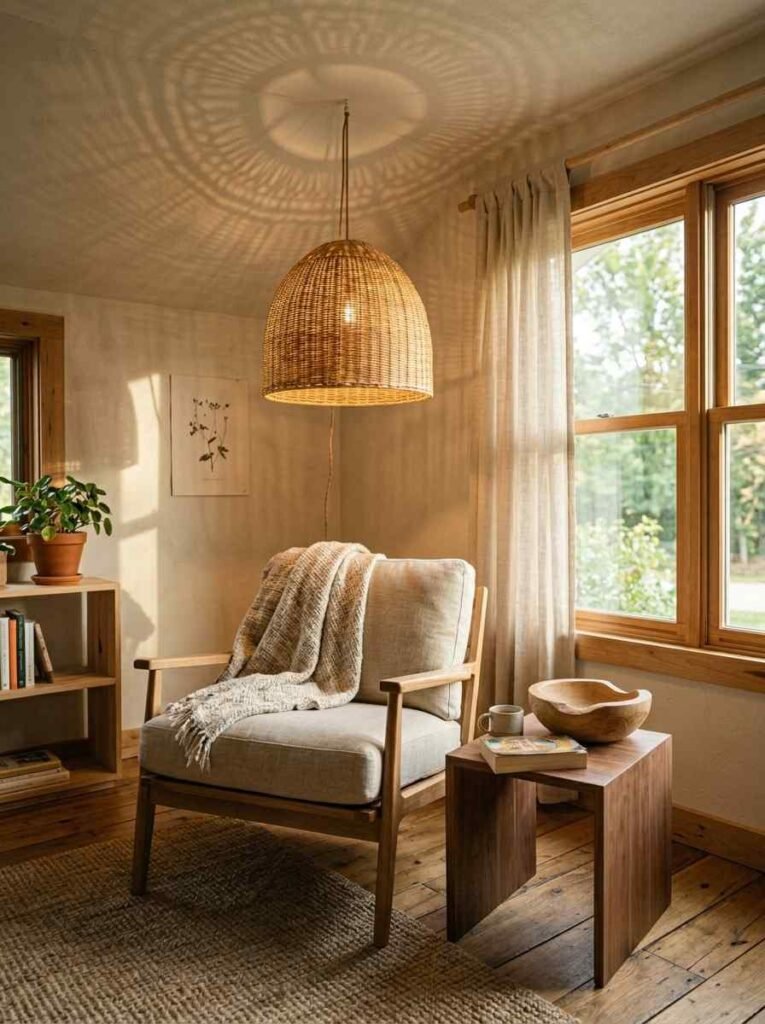
Rattan, cane, raw wood, linen, stone. The more natural materials in your accent pieces, the warmer a minimal room feels. A rattan pendant light over a reading chair, a raw wood bowl on your coffee table. These details photograph warmly and age well.
Room layout ideas worth trying
Push furniture away from the walls
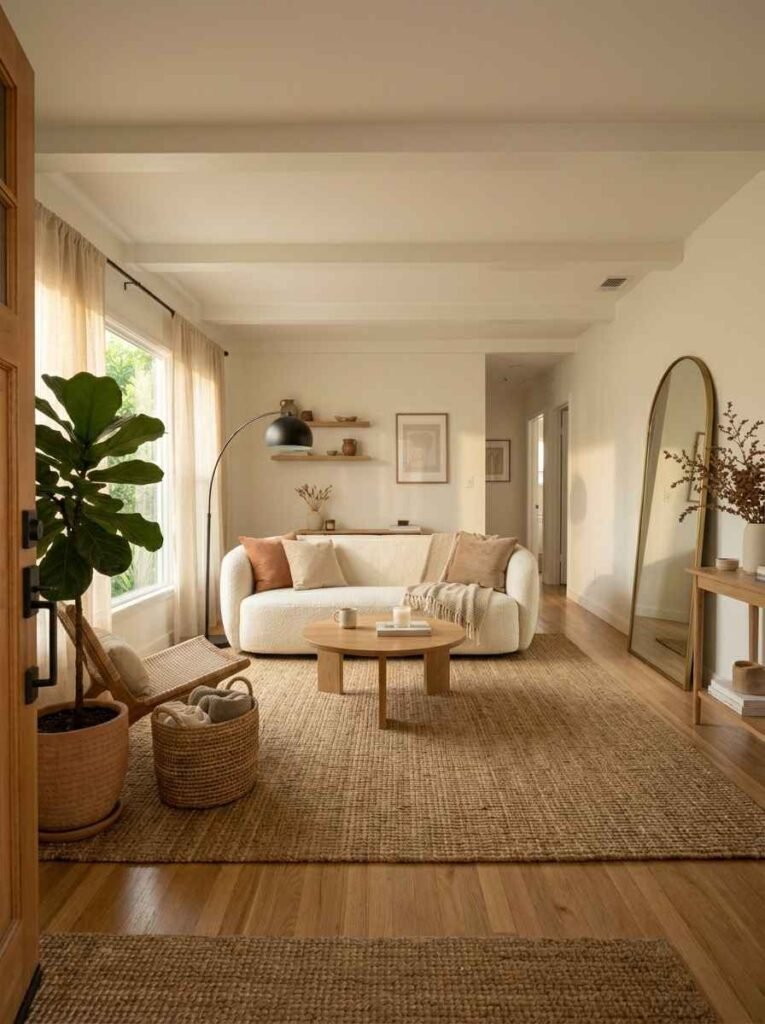
This sounds counterproductive in a small room, but floating furniture 6 to 12 inches from the walls actually makes a room feel larger, because it creates negative space around each piece. Interior designers almost universally recommend this and almost nobody does it.
Define zones with rugs
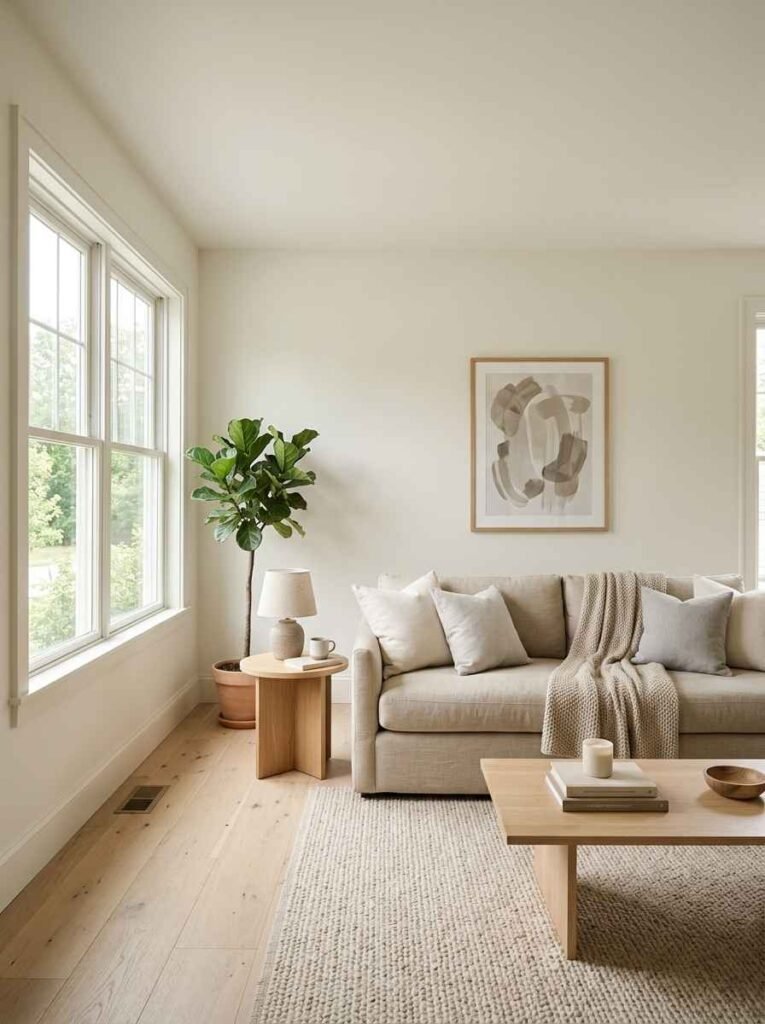
In an open-plan space, use rugs to define the sitting area, the reading nook, the dining space. Each rug anchors a zone and the overall space reads organized without walls or dividers.
The reading corner setup
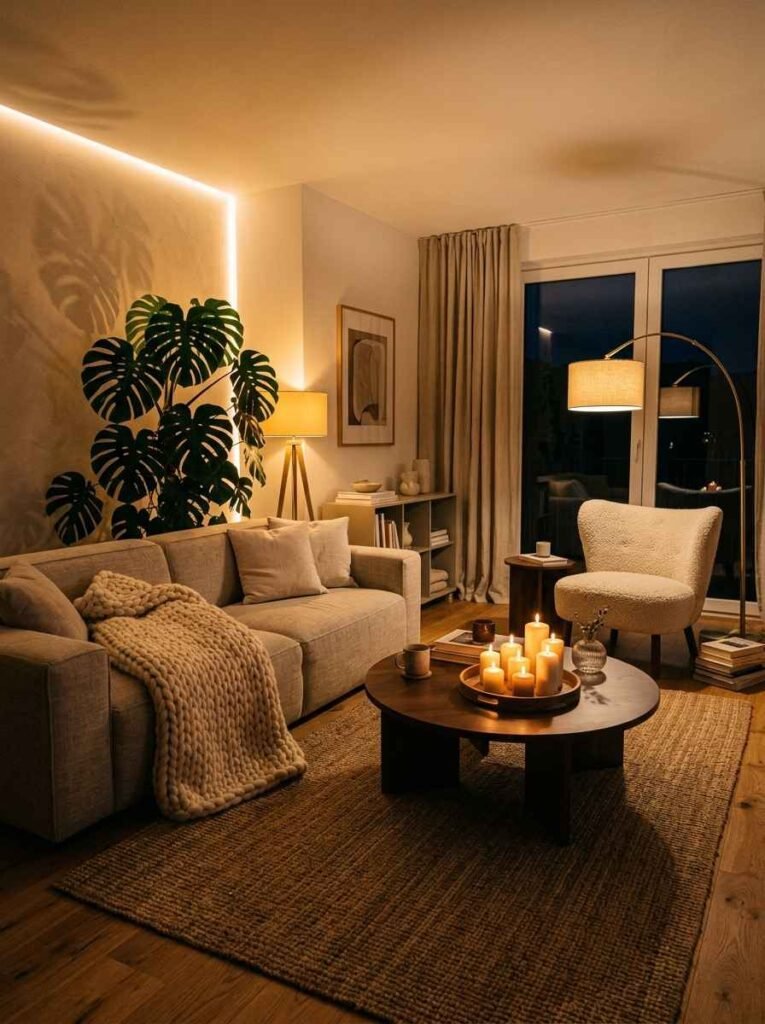
1 accent chair angled toward a window, 1 floor lamp positioned behind the chair, 1 small side table for a drink.
That’s a reading corner. It photographs like a lifestyle editorial and takes up maybe 4 square feet.
Things I’d skip if starting over
Decorative ladders. Everywhere for a while, they always tipped over and scratched walls. Oversized clocks above sofas.
Heavy and hard to level. Too many cushions. I had 11 cushions on one sofa at one point (don’t ask). You need 4, maybe 5 if your sofa is very long.
FAQ
How do I make a minimalist living room feel warm and not cold? Texture is the answer. Warm bulbs, a chunky throw, a jute rug, and at least one large plant all add warmth without adding clutter.
The colder a room looks, the more likely it has too many hard, shiny surfaces and not enough soft, matte ones.
What’s the best color scheme for a minimalist living room? Warm neutrals with a wood accent almost always work: cream walls, a natural linen sofa, an oak coffee table. It’s a low-risk palette that photographs well and doesn’t get dated quickly. See Design Milk’s living room archives for real-home examples across different scales and budgets.
Can a minimalist room work with kids or pets? Yes, with the right materials. Performance fabrics (look at brands like Crypton or Sunbrella for sofa upholstery) handle spills without looking clinical. Closed storage keeps toys out of sight. Darker rugs (or patterned ones with enough texture to hide debris) are more practical than a light jute in a high-traffic household.
If you’ve been collecting living room pins for months and haven’t actually made any changes yet, pick just one idea from this list and do it this week. Move the furniture away from the walls. Swap your bulbs to 2700K. Buy one large plant. The small, specific changes stack up faster than you’d expect.
Which of these are you actually going to try? Drop it in the comments, I’m genuinely curious what lands for people.
